

Google AI


Modern Australian

New report reveals glaring gaps between Australia’s future needs and science capabilities

  • Written by: Chennupati Jagadish, President of the Australian Academy of Science and Emeritus Professor of Physics and Electronic Materials Engineering, Australian National University
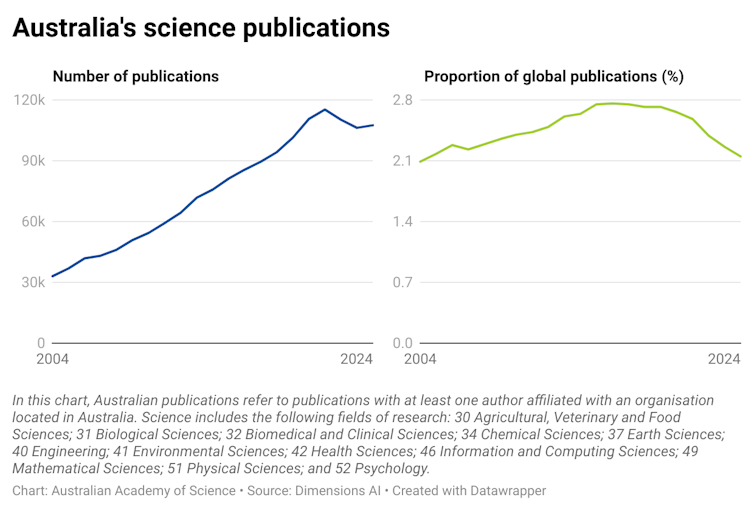
Chart showing Australian science publications compared to global output.

Since 1945, three-quarters of all global economic growth has been driven by technological advances. Since 1990, 90% of that advance has been rooted in fundamental science, according to Michael M. Crow, president of Arizona State University.

Corporate leaders in the United States understood this decades ago when they urged Congress to back “patient capital” for research – because this type of investment creates openings for breakthrough applications.

Think of the building blocks of our modern economy – wifi, smartphones, advanced cancer therapies, drought-tolerant crops and satellite navigation. These began as basic research, often with no obvious immediate application. Then they became the platforms for whole new industries.

But in Australia, we still treat research funding as a discretionary extra, subject to the ebb and flow of political expediency and annual budgets. Despite decades of speeches, reviews and strategic papers, our investment in knowledge creation and its application has nose-dived.

Today, the Australian Academy of Science released a landmark report that systematically measures our science capability against future needs for the first time.

The findings are blunt. We have gaps – in workforce, infrastructure and coordination – that will cripple our ability to secure a bright future for the next generation, unless we act now.

What did the report find?

The new report maps Australia’s scientific capability and shortfalls across three major areas.

Over the next decade, Australia is facing a demographic change with an ageing population, a decreasing fertility rate, and increasing growth in urban and regional cities.

The second national challenge is technological transformation. In most areas of life, we’re experiencing rapid technological changes. This includes advances in artificial intelligence (AI) that are already changing the shape of the workforce.

The third challenge is climate change, decarbonisation and environment. It’s imperative for Australia to transition to a net-zero economy and become resilient against the impacts of climate change.

What do we need to have in place for Australia to meet these challenges by 2035? Two key factors are science literacy and education, and national resilience. In a world of fractured geopolitics and technological competition, the countries that will thrive are those that can generate and apply knowledge for their own needs, in their own context.

The report has found eight key science areas that will be most in demand by 2035: agricultural science, AI, biotechnology, climate science, data science, epidemiology, geoscience and materials science.

For each of these, the report contains a full dashboard that shows gaps in capabilities – from education to workforce needs, research and development spending, publications and more.

Chart showing Australian science publications compared to global output.
Still not innovative enough Since 2008, Australia’s spending on research and development as a proportion of gross domestic product has fallen so far behind the OECD average, it would take an extra A$28 billion a year just to reach parity. In his election speech in 1990, then Prime Minister Bob Hawke issued a warning: being the lucky country was not enough, we had to become a clever country, too. Today, 35 years on, Hawke’s vision of the clever country remains just that – a vision. Former Prime Minister Malcolm Turnbull tried to rekindle the impetus in 2015 with “the innovation nation”. However, this year Treasurer Jim Chalmers conceded our economy is still “not dynamic or innovative enough”. The vast majority of global climate and earth system models have been developed in the northern hemisphere, and we need more work to understand Australian conditions as well as the Southern Ocean. Our AI capacity is hostage to developments offshore. We import more than we invent in biotechnology, advanced manufacturing and clean energy. These are not merely academic concerns – they are constraints on our sovereignty, resilience and competitiveness. We need a ‘reservoir of talent’ But scientific capability is not something you can simply conjure up on a whim. You need a “reservoir of talent”, infrastructure and knowledge that takes decades to build. Developing a climate scientist, a quantum physicist, or a vaccine researcher takes long-term investment in education, facilities and research programs. Abandoning or under-funding these pipelines for even a few years creates gaps. Knowledge can’t just flow when the tap is turned on if the reservoir is dry. Today’s report shows the current pipeline and study choices of students don’t match the needs of Australia’s future workforce. For example, in 2023 only 25.2% of students with a Year 12 qualification studied mathematics to at least intermediate level. Yet it’s a fundamental science discipline for AI. Chart that shows percentage of year 12 students studying higher and intermediate mathematics in Australia.
Similarly, our economy relies heavily on resources and critical minerals, yet Australia isn’t training enough geoscientists. It’s time for a whole-of-government science strategy, embedded in economic, education, defence and industry policy. The government should use the evidence in this report to address capability gaps and direct resources strategically to better position Australia for the next ten years and beyond. Thirty-five years after Hawke’s challenge, it’s never been clearer: if we don’t act now, our luck will run out. Authors: Chennupati Jagadish, President of the Australian Academy of Science and Emeritus Professor of Physics and Electronic Materials Engineering, Australian National University

Read more https://theconversation.com/new-report-reveals-glaring-gaps-between-australias-future-needs-and-science-capabilities-264355

Why the Spring School Holidays Are a Great Time to Visit Coffs Harbour

The spring school holidays are a good time to spend a few days on the Coffs Coast. The weather is starting to warm up, there is plenty to do outdoor...

What to Do When an Older Car Is No Longer Worth Keeping in Melbourne

Ever looked at another repair quote and wondered whether your old car is still worth the trouble? It is a common turning point for Melbourne motoris...

Your Baby's First Year: A Local Guide to Feeding, Sleep, and When to Get Extra Support

Ask ten parents in a Brisbane mothers' group how their baby is feeding or sleeping, and expect ten different answers.  Someone's baby sleeps throug...

Kitchen and Laundry Makeover Ideas That Don't Require a Full Renovation

Full kitchen renos are expensive — and most people don't actually need one.  They need the kitchen to stop looking like it's stuck in 2009, or they...

How Technology Is Reshaping the Modern Australian Commercial Kitchen

The commercial kitchen has always been shaped by technology. Refrigeration changed how ingredients could be stored, modern ventilation transformed k...

The Number on a Roller Blind Fabric That Nobody Explains

Somewhere in the fabric book, next to the colour name, there is a percentage. Three per cent. Five per cent. Ten per cent. Nobody explains it, most c...

What’s Trending in Men’s Jewellery This Father’s Day!

Finding a Father’s Day gift that feels personal, stylish and genuinely wearable is not always easy. While socks and novelty mugs have traditionally ...

Road Signs: Understanding Their Role in Clear and Effective Signage

Effective signage and display hardware can help businesses communicate information, promote products and organise customer or visitor movement. Road...

Bottle Label Printing: Key Factors to Consider Before Your Next Packaging Run

Effective packaging begins with understanding the product, bottle material, artwork and production requirements when planning bottle label printing. H...

Planning a Long-Distance Move With Interstate Movers Melbourne

Moving between states involves more planning than a typical local relocation. Along with packing and transporting household belongings, you need to...

Understanding the Role of an I/O Controller in Industrial Automation

Modern industrial systems depend on accurate communication between sensors, machines and control systems. An I/O controller can help manage this commu...

How the Right Mining Hose Supports Demanding Operations

Mining environments place considerable demands on equipment used for material transfer, water management and processing. Hoses operating in these co...

Simple Ideas for Making Social Gatherings More Memorable

We have all been to those parties where everyone just stands around the kitchen island, staring at their phones, waiting for someone else to make a mo...

Outdoor Wall Lights: Improving Exterior Lighting Around Your Home

Lighting can influence how a room looks, feels and functions, so the right fitting should be selected according to both appearance and practical req...

Commercial Office Cleaning: Combining Routine Office Cleaning With Melbourne Service

Keeping a workplace clean requires a service that can accommodate everyday tasks as well as the particular needs of the business. Professional comme...

Caravan Sales in Queensland: How to Find the Right Caravan for Sale QLD

Caravan ownership is about more than having somewhere to sleep while travelling. For many Queenslanders, it is one of the best ways to explore regio...

What Sir Walter Buffalo Turf Actually Costs in 2026 (And Why Quotes Vary So Much)

Two quotes landed on a Hills District homeowner's kitchen table last spring for the exact same 80-square-metre backyard. One said $12 a metre. The o...

Nearly 1,300 NSW Hospital Beds Are Occupied By People Who Are Ready To Go Home

1,276 people in NSW hospitals have been medically cleared for discharge but remain in hospital because they're still waiting for NDIS or aged care sup...
















