

Making younger trees age faster could create more homes for wildlife – and it can be done without chainsaws
- Written by: Stanislav Roudavski, Founder of Deep Design Lab and Senior Lecturer in Digital Architectural Design, The University of Melbourne
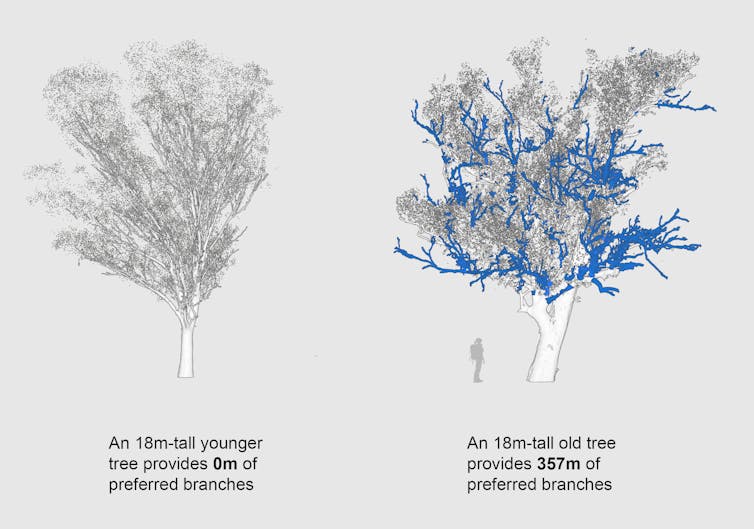
For wildlife, not all trees are equal. Large old trees have many horizontal and dead limbs for perching, and many fissures or hollows for sheltering. By contrast, younger trees have far fewer such features or lack them entirely. More than 300 species of Australian mammals, birds, reptiles and amphibians rely on on habitat structures in older trees.
Pygmy possums use small hollows that take around 100 years to form. Black cockatoos need larger hollows that might take 200 years, and bigger birds such as powerful owls need still older hollows. Many species also need dead branches, peeling bark and other features found only in older trees.
But these large old trees are getting rarer around the world. Australia has already lost many of its giants and they’re still falling due to farming, logging and urbanisation.
Birds and animals can’t wait centuries for new hollows to form. In response, land managers are experimenting with veteranisation, where younger trees are artificially given the features of older trees. If done carefully, veteranisation may have promise.
Making young trees older
Artificially ageing trees isn’t new. The ancient practice of pollarding trees to promote growth also encourages hollow formation.
But there’s new interest in exploring veteranisation to boost habitat, either by damaging trees or adding structures or supports.
Most commonly, veteranisation is done by damaging younger trees to encourage decay. Using chainsaws to cut off a limb can open up the dead heartwood inside a tree to wood-rotting fungi, which can deepen smaller hollows.
Veteranisation can also involve adding structures resembling natural hollows or cavities. Nesting boxes are well known, but animals can avoid artificial-looking structures, find them too hot or struggle to climb smooth walls. Our research has found innovative shapes and materials and other approaches can avoid this. Mimicking natural complexity can trick wildlife into using younger trees.

Removing limbs, causing damage
In Europe, managers have tried cutting off the crown of the tree, breaking or pruning branches, scorching surfaces with fire, ringbarking limbs, using “coronet” cuts to trap water, drilling holes to expose internal decay and bruising stems. Swedish researchers found these techniques increased decay and created more microhabitats but didn’t affect formation of large dead branches.
In Australia, researchers have trialled using chainsaws or modified drills to carve hollows into living wood. These hollows are rapidly put to use by mammals as well as invertebrates, reptiles and birds. Informal reports suggest hollows made by skilled arborists in Tasmania were rapidly used by critically endangered swift parrots.
Land managers in the UK are using veteranisation to create more nesting hollows for birds.Supporting branches, adding features
It’s not essential to damage younger trees. Another approach is to add missing features, such as by:
Our research suggests another possibility: constructing artificial perches able to stand on their own or attach to younger trees.
We should think of these human-made features as long-lasting habitat rather than a temporary tweak. They should be carefully designed, safely installed, maintained as needed and their use monitored. At the end of their life, they should be retired and an equivalent type of habitat installed or grown.
Another approach is to preserve existing veteran trees by propping and bracing branches likely to fall.
Techniques worth exploring?
To date, Australian trials have recorded feathertail gliders, sugar gliders, brown antechinuses, long‑eared bats, white‑throated treecreepers and other species using features created by both damaging and feature-adding techniques. Fungi, mosses and microorganisms can also benefit.
Many other species could benefit, including hollow‑nesting and perching birds, bats, arboreal marsupials and the saproxylic beetles which eat dead and decaying wood.
It will take more research to find out which techniques work best. Approaches such as topping aren’t very effective in speeding up hollow development, while other approaches can attract unwanted species or shorten the lives of damaged trees.
Similarly, some fissures close soon after their creation, while modifications such as inoculation with tree-rotting fungi don’t work well in producing these features.
Applying veteranisation in Australia will require adaptation. Bushfires can pose a threat to trees temporarily weakened by veteranisation or augmented by artificial structures. Eucalypts have distinct wood chemistry allowing them to repair wounds and resist rot.
Overall, we should think of veteranisation as a supplement rather than substitute for large old trees.
This is because artificial features aren’t the same as natural. The communities of fungi and invertebrates that live on tree surfaces, in cracks and within hollows can differ from their natural counterparts.
 Large old trees offer far more habitat in the form of hollows, cavities and horizontal branches than younger. Pictured: an ancient Antarctic beech in Queensland.
Oliver Strewe/Getty
Large old trees offer far more habitat in the form of hollows, cavities and horizontal branches than younger. Pictured: an ancient Antarctic beech in Queensland.
Oliver Strewe/Getty
Protect large old trees first
It can be alluring to come across new ideas such as veteranisation. But the thrill of the new can make it hard to see the situation clearly.
For land managers, the priorities are clear. Protect every remaining large old tree and ensure younger trees can grow old safely.
If this is done, it may be worth experimenting with veteranisation to mimic old trees in areas where there are shortages. Testing will be essential. Run trials, make adjustments to find improvements, share data openly about what works and what doesn’t, and make advanced methods available to everyone.
Tree-damaging methods are worth exploring, but they should not be our first choice. It doesn’t seem right to damage young trees to make up for the damage humans have done to their ancestors.
Acknowledgements: We thank Darren Le Roux for his research informing this article’s figures.
Authors: Stanislav Roudavski, Founder of Deep Design Lab and Senior Lecturer in Digital Architectural Design, The University of Melbourne


















