

The legend of Troy explained
- Written by: Marguerite Johnson, Honorary Professor of Classics and Ancient History, School of Historical and Philosophical Inquiry, The University of Queensland
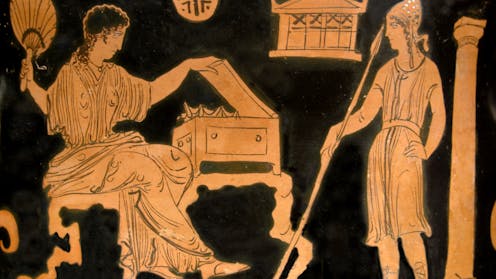
The Trojan War is a legend that sprang from a distant memory of a real Greek incursion into the Bronze Age city of Troy (in modern day Türkiye). This may have taken the form of annual piracy raids and/or encounters based on control of the Aegean Sea.
These real life encounters between Greeks and Trojans, led to the destruction of Troy circa 1150 BCE (likely though warfare and fire). Over hundreds of years, they were transformed into oral tales.
Collectively known as the Trojan War Cycle, these tales were later committed to writing. They were retold and readapted over centuries in Greek and Roman antiquity, with writers and artists changing and adding to the basic plotline to suit their own purposes. Adaptations of the hundreds of stories that make up this cycle continue today, particularly in theatre.
The immediate cause of the legendary war, as storytellers have told it, was the abduction of King Menelaus’s wife Helen, Queen of Sparta, by the Trojan prince, Paris. (In the shame-based culture of Bronze Age Greek society, this act was deeply humiliating for a man, especially a king).
In response to the kidnapping, Menelaus’s brother, Agamemnon, King of Mycenae (a city in the Peloponnese), led a military campaign against Troy. The city of around 10,000 people was surrounded and held under siege for ten years.
The war ended with the ingenious deception of the Trojan Horse. This huge wooden beast was offered to the Trojans as a so-called gift from the Greeks, but secretly contained Greek soldiers. Once inside the city, they crept out, threw open the gates to their fellow Greeks and so began the city’s final days.

Is any of it true?
Most of us may find it strangely romantic to believe in a heroic quest for a stolen queen rather than accept that the city of Troy ultimately fell as a result of strategic and economic assaults at the hands of the Mycenaean Greeks.
Indeed, the actual city of Troy has been located, complete with two archaeological sublayers. Experts have found evidence that attests to the city’s destruction by siege. Similarly, the site of Bronze Age Mycenae, a palatial structure, as old as the particular sublayers of Troy, has been identified at the place of origin for the Greek expeditions.
But such physical sites cannot prove the historical existence of Helen, Achilles and the other superstars of the storytellers.
Such heroes and heroines most likely came into being as the stories developed, although some characters may have been partially based on historic leaders, their wives and families.

The Iliad’s account
The Iliad (c. eighth century BCE) is the earliest example of how the shadowy, inglorious invasion of a prosperous city was transformed into a monumental national epic. Other stories tell aspects of the myth, for example Euripides’ tragedy, The Trojan Women (415 BCE).
Attributed to the poet Homer, the Iliad chronicles some weeks in the last year of the war. Composed in dactylic hexameter and divided into 24 “books” (chapters, if you will) that culminate in 15,693 lines of poetry, it is the definitive masterpiece of war literature.
Moving from the Greek encampment along the shores of northwest Asia Minor (modern-day Türkiye) to the fortified citadel of Troy (the modern-day city of Hisarlik) at the mouth of the Dardarnelles, the Iliad evokes the lives of both Greek and Trojan warriors as well as those of civilians.
As a war narrative, its battle scenes are visceral and drenched in blood, evoking both courage and cowardice, and certainly not for the squeamish. Yet it also captures the devastation war brings to children, wives, mothers, men too old to fight and hostages, along with soldiers.
The poem opens with an internal feud among the Greeks themselves, centring on the animosity between Agamemnon, and Achilles, leader of the Myrmidons (from modern-day Thessaly), who is also fighting for the Greeks.
At the heart of this bitter dispute are two hostages. Chryseis, daughter of the Trojan priest of Apollo, Chryses, has been taken by Agamemnon as a sex slave following a raid. Briseis was awarded to Achilles during a similar incursion.
The god Apollo sends a plague upon the Greeks as a result of Agamemnon’s refusal to return Chryseis to her father. Achilles – enraged and acting above his station – publicly confronts Agamemnon, demanding he return the young woman. Humiliated, Agamemnon eventually agrees but, in order to regain his preeminent status, takes Briseis from Achilles.
This scene evokes what modern people might recognise as combat fatigue. There is tension around decision-making, confused thinking, mistrust and anger. This personal feud depicts both men, not only as larger than life warriors, but also as complex human beings enduring almost unendurable conditions.
While such a situation may seem irrelevant in an epic that tells such a monumental tale, explicating the horrors of war on such a grand and devastating scale, the reality is quite the opposite.
Firstly, it is a reminder that war can be banal. Indeed, the “mini war” over two sex slaves seized during raiding parties reenacts the overarching “super war” at Troy, reinforcing the vanity of the human condition as well as the recklessness and even malignancy propelling some conflicts.
 Karl Friedrich Deckler, ‘The Farewell of Hector to Andromaque and Astyanax’
Wikimedia, CC BY
Karl Friedrich Deckler, ‘The Farewell of Hector to Andromaque and Astyanax’
Wikimedia, CC BY
Interestingly, the story of the Trojan Horse, the death of Achilles, and the many other instalments that constitute the Trojan War Cycle, do not interest the poet who compiled the Iliad. These are tales told elsewhere, in the fragments that remain of other epics, in the songs of lyric poets and in some of the extant tragedies of playwrights, right up to the literature and art of Late Antiquity.
Rather, Homer is interested in the stories of the humans trapped in the crossfire. For example, in Book Six of the Iliad, Hector, a Trojan prince and Troy’s greatest warrior, farewells his wife, Andromache, and his infant son, Astyanax, as he prepares to return to the battlefield. Andromache, who senses her husband is soon to die, says:
[…] for me it would be far betterto sink into the earth when I have lost you, for there is no otherconsolation for me after you have gone to your destiny – only grief […]
The Trojan Women
Andromache’s story and those of other women after the fall of Troy are of particular interest to Greek tragic playwrights of the fifth century BCE. The most powerful of the extant plays on this theme is Euripides’ The Trojan Women. The play consists of the voices of the four women who mourn the death of Hector at the hands of Achilles in the last book of the Iliad: Cassandra, the Trojan princess; Hecuba, the Queen of Troy; Andromache; and, finally, Helen herself.
To emphasise the suffering in war, the Chorus (the traditional collective narrators in Greek plays) is comprised of captive Trojan women, representing the nameless and forgotten human collateral.
This tragedy has been retold and re-imagined since its original production, including a heralded Australian adaptation by Barrie Kosky and Tom Wright in 2008.
Euripides details the fate of Cassandra, the princess also taken as a sex slave by Agamemnon; Hecuba, the wife of Priam, the last king of Troy, who is enslaved to Odysseus, King of Ithaca, and Andromache, indentured to Neoptolomus, son of Achilles. As for Helen, she is vilified as having caused the Trojan War, although in this play she, too, is a victim of war as she must beg her husband for her life.
The horror and inhumanity expressed in The Trojan Women culminates in the Greek execution of Astyanax, the baby son of Andromache and Hector. The tiny body is prepared for burial by his grandmother, Hecuba, while Andromache wails and Troy burns.
The endless interpretations of the siege of Troy in both literature and art can show courage and the triumph of the human spirit in the face of the worst of adversities. Yet others show that heroism is debatable and mutable, victory comes with loss of humanity, and women and children are always the victims.
Authors: Marguerite Johnson, Honorary Professor of Classics and Ancient History, School of Historical and Philosophical Inquiry, The University of Queensland
Read more https://theconversation.com/the-legend-of-troy-explained-263905



















