

It takes a village to raise a child, but not everybody gets the support
- Written by: Megan Blaxland, Senior Research Fellow, Social Policy Research Centre, UNSW Sydney
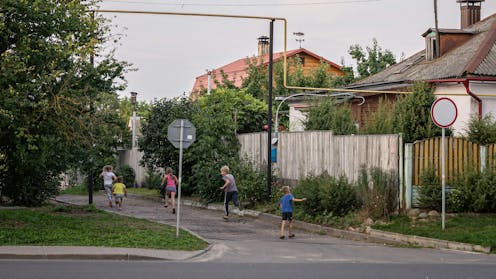
Many of us have heard the saying, “it takes a village to raise a child”. The idea that families need communities of support to raise their children has long resonated.
New research explores how this applies to modern Australian families and communities. We looked at the villages helping raise children and young people and importantly, who has one and who doesn’t.
We found while many benefit from these support networks, other families go without, particularly those who could most do with the help.
Our research
The report is a collaboration between Uniting NSW.ACT and the University of New South Wales’ Social Policy Research Centre.
It expands on previous work that showed Australian families are increasingly diverse, including multi-generational, sole-parent, blended families and foster families.
Read more: What does family look like in Australia? It's more diverse than you think
This work goes beyond the household to look at extended family, friends, neighbours and communities who are also involved in raising children.
Our analysis of 2022 and 2023 Household Income and Labour Dynamics in Australia (HILDA) data and qualitative interviews with 28 families reveals that Australian villages provide wide-ranging support networks. They are highly dependable and care for one another.
Grandparents, extended family and friends are at the heart of modern Australian villages. About 42% of grandparents actively help care for their grandchildren, such as with child-minding and transport.

Friends are relied on too, often for emotional support through the highs and lows of parenting, with close to three quarters of all families (74%) connecting regularly.
Sole-parent families are most likely to make regular time to see friends.
Families told us a good mix of support is most helpful. While practical help and emotional support matter, parents and carers also value having other trusted adults in their children’s lives who provide cultural connections.
Extended family and community groups play a key role here in sharing language, traditions and stories. As one mother said:
my mum is like […] the big tree that we all sit under. She gives us that shade […] so, when I mean shade, is that she gives us the wisdom […] she tells us a lot of stories from her childhood […] the struggles, just everything that she’s been through. So, my kids listen to that as well.
When it comes to advice on raising children, extended family and friends who have relevant experience offer valuable advice, along with trusted professionals, such as early educators.
Importantly, families with more community connection are less likely to report that they find parenting difficult or exhausting. Only 34% of those with weekly contact with family and friends say that taking care of their children is much more work than pleasure, compared to 43% of those with only monthly contact.
Not everyone has a village
Not everyone can easily build strong social connections outside the family unit. Insecure housing, employment status or additional care responsibilities can negatively affect this.
Families who rent often feel less connected to their local community, with almost two in three (64%) reporting low participation in local social and community events.
Only 40% of families living with someone with a limiting health condition see friends or extended family weekly, compared to almost 50% of families without any care responsibilities.

Of families facing financial stress (they cannot pay for food, heating, utilities or the like), 65% say they seldom take part in community activities, compared to 59% of families with little or no stress.
These families also spend less time with relatives and friends.
Whether someone has a job or not can affect how connected they feel to their community. Our analysis shows 66% of families with no employment were less involved in community activities, and many felt less satisfied with their sense of belonging.
There are differences between family types, too, with 44% of couple-parent families maintaining medium to high levels of community connections. This is more than the 38% of foster and other kin families, 37% of families living with multiple generations, 34% of sole parent families and 31% of step-blended families.
These less connected families are also more likely to have care responsibilities and to experience financial stress.
Giving back
Families value giving back just as much as receiving help from others. They describe their village as a reciprocal network: a dynamic, participatory ecosystem of care.
Often this means supporting ageing parents with doctors’ appointments, technology or just company.
They also help friends, taking turns transporting or minding children, and many reach out to help others in the community. Helping others matters, as one mother said:
I’m not the one that’s just a taker. I always give as well […] I find that I like helping more.
Families born overseas, particularly those from non-English speaking backgrounds, are more likely to volunteer or participate in local groups.
These families also have higher levels of community participation, with 44% reporting moderate participation and 37% regularly attending places of worship.
More support for all
Our research has implications for services supporting families that have few people they can rely on. Families using services want to give something back, too.
Services can respond by attending to the contributions people are able to make, as well as addressing their needs.
But to do this, services must be funded and supported to adopt models which build the connections between families.
Then, instead of support services focusing solely on filling a gap for families, they would enable peer relationships to grow, and provide opportunities for families to share their knowledge and expertise, building more villages for everyone.
Authors: Megan Blaxland, Senior Research Fellow, Social Policy Research Centre, UNSW Sydney


















