

As storms become more extreme, it’s time to rethink how we design roofs
- Written by: Shubham Tiwari, PhD Candidate in Civil Engineering, University of Waikato
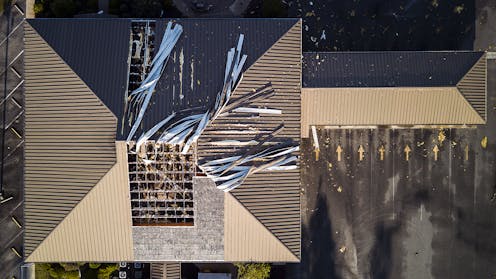
As extreme wind events are becoming more intense across New Zealand and the Pacific, roofs are often the first point of failure. But they remain one of the most overlooked elements in discussions about resilience and safety.
Storm systems such as Cyclone Gabrielle and tropical Cyclone Tam have caused widespread damage. But it’s not only cyclones we should worry about.
Increasingly, non-cyclonic wind storms are revealing deep-rooted vulnerabilities in our built environment, particularly in our roofs.
Despite repeated damage, public awareness of roofing vulnerability and how to address it remains low.
Small mistakes, big consequences
A typical roofing system consists of cladding fixed to a supporting structure (such as battens or purlins) using fasteners, often self-piercing screws. The supporting structure is connected to the rafters, which are then attached to the walls, forming a continuous load path that transfers wind forces to the ground.
Among these components, the connection between the roof cladding and the supporting structure is particularly vulnerable because it is directly exposed to wind pressures during extreme weather events.
In New Zealand, the Metal Roofing Manufacturers Association provides industry guidelines and supports research on the performance of metal roofing and cladding.
Roof failures during wind events rarely occur at random. More often, they begin with localised connection failures, which then spread across the roof system. Typically, this manifests as roof cladding “pulling through” the fastener, where the fastener stays attached to the supporting structure but the cladding detaches.
A “pull-out” failure may occur when the fastener detaches from the supporting structure while remaining fixed to the cladding. These weaknesses in the connections can rapidly escalate, leading to partial or total roof collapse.
Such failures don’t just lead to expensive repairs. They compromise people’s safety, expose homes to rainwater damage and create high-velocity debris that poses further risks during the storm and in the aftermath.
Even partial roof failures can overwhelm infrastructure, delay disaster recovery and inflate insurance claims. This raises systemic questions about how we design, test and regulate roofing systems in storm-prone regions.
A major issue lies in the misconception that roofs can be treated as peripheral or cosmetic elements. In truth, they are structural components, and they should be treated with the same rigour as any other critical load-bearing system.
Next generation of roofs
Our research group is addressing this challenge through a combination of full-scale wind-load testing and advanced modelling simulations.
We are developing a scientifically grounded understanding of how metal roof cladding behaves under extreme wind pressures, both cyclonic and non-cyclonic, and how fastener arrangements and cladding profiles influence the resilience of roofing systems.
This work is helping to quantify what has previously been anecdotal – how minor design or installation oversights can trigger catastrophic failures. Our data will feed into improved building codes, resilient design practices and potentially new product standards for roofing systems in New Zealand and beyond.
It is time to treat roofs not just as shelters but as engineered systems with quantifiable risks and performance criteria.
We strongly recommend using only code-compliant roofing products, particularly those tested for uplift resistance under both cyclonic and non-cyclonic wind loads.
While roofing companies are required to use code-compliant materials, not all products are rigorously tested or certified for the specific wind regions where they are installed. Emphasising uplift-tested compliance ensures materials meet the minimum code requirements while offering proven safety and performance under diverse wind conditions.
Roof installers should also be trained and certified to ensure workmanship is not the weak link in an otherwise well designed system. We also encourage regular inspections and maintenance, particularly after minor wind events, which can loosen components and create vulnerabilities for the next storm.
Extreme winds are no longer rare events; they are part of our climate future. But each storm also offers an opportunity to learn, adapt and build better.
We need a shift that sees roofs not as afterthoughts but as front-line defences. Through science and smarter design we can reduce risk, protect lives and build a more resilient New Zealand.
Authors: Shubham Tiwari, PhD Candidate in Civil Engineering, University of Waikato


















