

At Primavera 2025, young Australian artists consider making art in the age of commodities
- Written by: Sara Oscar, Senior Lecturer, Visual Communication, School of Design, University of Technology Sydney
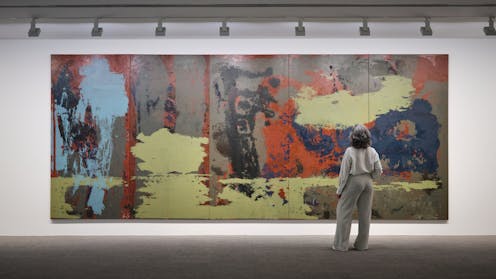
Primavera is the Museum of Contemporary Art’s annual spring exhibition featuring selected Australian artists under 35. This year, curator Tim Riley Walsh asks what it means for artists to create in a post-industrial age of reproduction.
Walsh foregrounds a material fascination running through the artists’ works.
Many artists integrate metallurgy into their installations, often using machine fabrication. Traps, cages, monuments, pipes, window frames, carpet and boomerangs appear in the show.
These are not inert objects but create spaces that privilege embodied experience. It is a gesture that resonates in an age when the screen is ubiquitous to daily life.
From fabricated monuments to traps
The tension between touch and industrial manufacture is most evident in Vinall Richardson’s corten steel and copper monoliths.
Each block, scaled up from cardboard maquettes, carries the trace of handmade imperfections. Set against the engineered precision of architectural steel, these marks of inaccuracy break with the exactitude of 1960s’ Minimalism and the emphasis on repetitive, mass-produced forms.

Francis Carmody’s two-part installation turns material toward commodification.
A white dog is dissected at the midsection, trapped in three intersecting silver rings. Nearby, amorphous silver forms crusted with salt and electroplated graphite suggest a production line that leads to shiny polished silver vessels.
Between objects and canines, the dogs act as metaphorical stand-ins for us: ensnared by the gleaming lure of commodities and capital.

Mining: labour or leisure
The emphasis on metallurgy and the material of mining’s infrastructure is brought into focus in Emmaline Zanelli’s installation and two-channel video.
Second-hand rat and hamster cages are linked by a labyrinth of plastic tunnels lit with coloured LEDs. Like a nightscape, the cages lead into a film centred on teenagers in Roxby Downs, South Australia, where families service the nearby Olympic Dam mine for copper, gold and uranium.
 Emmaline Zanelli, Magic Cave, 2024/2025, installation view, Primavera 2025: Young Australian Artists Museum of Contemporary Art Australia, Sydney, 2025, bird, mouse, rat, cat, dog, hermit crab and bird cages, plastic tunnels, toys, LED lights.
Image courtesy the artist and Museum of Contemporary Art Australia © the artist, photograph: Hamish McIntosh
Emmaline Zanelli, Magic Cave, 2024/2025, installation view, Primavera 2025: Young Australian Artists Museum of Contemporary Art Australia, Sydney, 2025, bird, mouse, rat, cat, dog, hermit crab and bird cages, plastic tunnels, toys, LED lights.
Image courtesy the artist and Museum of Contemporary Art Australia © the artist, photograph: Hamish McIntosh
In the video, teens appear with exotic pets in bedrooms. As a girl dances on one screen, the other cuts to a copper smelter and the camera’s swift, claustrophobic passage through plastic pipes, echoing a miner’s subterranean descent.
Placed at the centre of the exhibition and lined with gaming chairs, the work embeds the materials of mining into the social realms of labour and leisure.
Eerie corporate veneers and the business of art
The final two works move from extraction into the corporate interior.
Alexandra Peters’ installation is an expanded painting that blurs surface, sculpture and architecture. Enamel-coated industrial pipes designed to feed oil, gas or water are coiled with culturally coded shisha tubing that props a false wall over the gallery wall.
Window frames double the building’s own frames. A three-panel, screen-printed work on imitation leather hangs above dead stock grey carpet. The installation feels like the foyer of a shell company.
The effect is deadpan, summoning what cultural theorist Mark Fisher called the eerie – a sense of space emptied of its expected presence.
In Peters’ hands, this eeriness is decentering: materials and veneers leave the human adrift in the architecture of surfaces designed for occupation but hollowed of life.
 Alexandra Peters, The Infinite Image (detail), Special Purpose Entity I and Special Purpose Entity II, enamel on ductile iron and steel, arguileh hoses, Fenestration (Autoantibodies), enamel on timber, vinyl decal, and Leg Over Leg V, commercial carpet, 2025, installation view, Primavera 2025: Young Australian Artists, Museum of Contemporary Art Australia, Sydney, 2025.
Image courtesy the artist and Museum of Contemporary Art Australia © the artist, photograph: Hamish McIntosh
Alexandra Peters, The Infinite Image (detail), Special Purpose Entity I and Special Purpose Entity II, enamel on ductile iron and steel, arguileh hoses, Fenestration (Autoantibodies), enamel on timber, vinyl decal, and Leg Over Leg V, commercial carpet, 2025, installation view, Primavera 2025: Young Australian Artists, Museum of Contemporary Art Australia, Sydney, 2025.
Image courtesy the artist and Museum of Contemporary Art Australia © the artist, photograph: Hamish McIntosh
The staging of corporate life inflects Keemon Williams’ adjacent installation. The work positions the artist’s Aboriginal identity as embedded within the commodities of industry.
Metal boomerangs fabricated offshore are stacked into towers that read as a cityscape or corporate graph.
On the wall, a large vinyl chart divides boom from doom; along with Williams’ portraits between those states – in one he lifts a boomerang like a phone, in another he slumps on a modernist sofa.
At the media preview, Williams quipped he doesn’t know what he’ll do with the boomerangs after the show: stripped of their use-value, they are not designed to be thrown.
 Keemon Williams, Business is Booming (detail), aluminium, resin, and Business is Dooming (detail), digital video, colour, sound, photographs on matte rag and lustre paper, vinyl, wool, 7:17 minutes, looped, 2025, installation view, Primavera 2025: Young Australian Artists, Museum of Contemporary Art Australia, Sydney, 2025.
Image courtesy the artist and Museum of Contemporary Art Australia © the artist, photograph: Hamish McIntosh
Keemon Williams, Business is Booming (detail), aluminium, resin, and Business is Dooming (detail), digital video, colour, sound, photographs on matte rag and lustre paper, vinyl, wool, 7:17 minutes, looped, 2025, installation view, Primavera 2025: Young Australian Artists, Museum of Contemporary Art Australia, Sydney, 2025.
Image courtesy the artist and Museum of Contemporary Art Australia © the artist, photograph: Hamish McIntosh
Together, Peters and Williams bring the exhibition’s focus on material residues into the present tense. Industrial processes and social relations are reassembled as corporate veneers, graphs and flightless boomerangs.
From here, the show’s broader stakes become clear.
Australia in the post-industrial age
All of the artists in Primavera 2025 were born in the 1990s. While the following decades marked the global rise of internet and screen culture, more locally, this era saw the effects of Australia’s trade liberalisation.
These artists grew up during the collapse of manufacturing, leaving mining extraction and services dominant. This shift echoes in the fabricated forms and thematic concerns of the exhibition.
As Karl Marx observed in Capital, raw materials are not neutral but products of past labour, their extraction and history. That inheritance runs through the materials and objects of the exhibition: the corten steel monoliths, the silver canine traps, the mining tunnels, the oil and water pipes, the corporate foyer, the stacked boomerangs.
Each work gestures to the way materials of industry are embedded within the social and environmental aspects of Australian life.
In the show, artists play with materials as alluring yet toxic, solid yet emptied of use, all bearing the social and political conditions of their making. That reckoning finds its sharpest expression in a line from Zanelli’s video, penned by poet Autumn Royal: “I could croak with copper on my nails”.
To make art in a post-industrial age is not to escape commodities, but to reckon with their afterlife.
Primavera 2025: Young Australian Artists is at the Museum of Contemporary Art Australia, Sydney, until March 8 2026.
Authors: Sara Oscar, Senior Lecturer, Visual Communication, School of Design, University of Technology Sydney


















