

Tesla’s self-driving mode is coming to Australia amid controversy – but it won’t create true driverless cars
- Written by: Hussein Dia, Professor of Transport Technology and Sustainability, Swinburne University of Technology
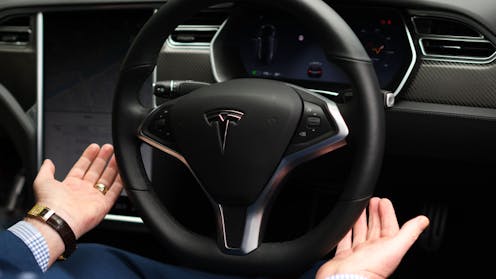
Tesla is expected to soon turn on its “Full Self-Driving (Supervised)” (FSD) mode in Australia and New Zealand.
Is a future of driverless cars upon us? Not exactly – it’s essentially more advanced driver assistance. Legally, Tesla drivers using this mode must be ready to take control and pay attention at all times. Calling it “full self-driving” is questionable.
The move comes amid scrutiny. This week, a video showed a Tesla navigating roads in Melbourne’s CBD without the driver’s hands on the wheel. Authorities warned these trials had not been approved.
It’s a reminder of how contested “self-driving” remains. While the technology is advancing rapidly, there are still real concerns over regulations, technological readiness, safety and public trust.
Is it legal?
Tesla’s FSD mode is not truly driverless. Technically, it’s classified as an advanced driver assistance system. On the recognised five-level list of increasingly automated cars, where 5 is fully automated, FSD is a Level 2.
At this level, the driver has to remain attentive and ready to take proper control. Legally, this means Tesla’s FSD would be treated the same way as other vehicles with advanced driver-assist systems. Tesla cars with FSD running would be compliant with Australian regulations and legal to use with human oversight.
At higher levels of automation (Levels 3-5), the car takes on the whole driving task without constant supervision, which would be considered “automated driving”. Level 3 cars exist in limited markets overseas. Level 4 cars are being used in fleet-based robotaxi trials but not sold to consumers. Level 5 cars offering true autonomy, anywhere, anytime don’t yet exist.
At present, cars with Level 3 automation and above are not compliant with Australian regulations and can’t operate without special permits for trials and testing. They have strict conditions on safety, insurance, data sharing and geographic restrictions.
This is why the Tesla video in Melbourne video triggered pushback – it gave the impression of a higher level of automation than legally permitted without a trial permit.
What can FSD actually do?
Tesla is taking a phased approach to enable FSD for eligible vehicles in Australia.
In this mode, the car can change lanes, navigate interchanges, recognise stop signs and automatically bring the car to a stop. It can even handle Melbourne’s famous hook turns.
But the system has hard limits. The driver must be ready to step in at any moment. The system can make errors in complex or unpredictable settings.
Overseas, Tesla is promoting a new supervised feature – autosteer on city streets – which would go beyond automated highway driving into more complex residential and city roads with roundabouts, traffic lights and pedestrians. But this feature remains “upcoming” in Australia.
Tesla’s approach to self-driving remains controversial. To sense their surroundings, the vehicles rely mainly on cameras and artificial intelligence. Critics argue this leaves the system more vulnerable to errors. Other self-driving car developers such as Waymo have added LiDAR and radar sensors to boost safety in case other sensors fail.
Tesla’s branding of FSD as a step towards full autonomy is misleading. In reality, it’s closer to a diligent learner driver than a professional chauffeur. It can read the road, but still needs close supervision.
The long road to autonomy
Tesla’s push into autonomy is partly about capturing market share in the fast-emerging robotaxi industry.
Tesla CEO Elon Musk has promised Tesla cars will one day be able to be monetised in a shared robotaxi fleet.
In June, the first Tesla Robotaxi went live in limited areas of Austin, Texas. But these vehicles are not truly driverless – a human safety monitor must be on board.
Globally, Tesla is one of many companies vying for a share of the robotaxi market. Trials are expanding quickly. Waymo is leading the race with paid driverless rides in several cities in the United States. Its Jaguar cars are Level 4 autonomous, able to drive unsupervised but only in a set area.
Meanwhile, Baidu, WeRide and Pony.ai are scaling up in China, their domestic market, as well as the Gulf region, including Dubai, Abu Dhabi and Riyadh.

True self-driving cars are a way off
What if a self-driving consumer car causes a crash? For a Level 2 car, supervising human drivers remain responsible.
But if a true self-driving car caused a crash, liability could fall on the manufacturer or even the software developer. Regulators are working to resolve this legal grey area.
Even as Tesla pushes towards self-driving, the company faces a class action from thousands of Australian drivers over alleged “phantom braking” where the cars suddenly brake for no apparent reason, risking rear-end crashes.
Tesla says its system can be affected by obstructed cameras and drivers are always responsible for maintaining control.
This echoes a wider debate: how safe must autonomous systems be before they can replace human drivers? Human error is a major cause of road crashes. But glitches such as phantom braking undermine confidence and public trust, especially when lives are at stake.
In the US, federal authorities are investigating crashes linked to Tesla’s driver-assist systems. California’s regulator has accused Tesla of misleading advertising, and senators have pressed for tougher oversight of Tesla’s marketing.
Despite progress, fundamental breakthroughs are still required to handle rare but high-risk scenarios, such as pedestrians behaving unexpectedly.

The road ahead
Cars with advanced driver-assist can recognise objects and follow rules. But unexpected things can happen.
True autonomy demands the ability to interpret complex and ambiguous human behaviour.
Until then, the driver must remain firmly in charge.
Authors: Hussein Dia, Professor of Transport Technology and Sustainability, Swinburne University of Technology


















