

1 in 3 Australians in their late 60s are still working, new HILDA survey shows
- Written by: Kyle Peyton, Senior research fellow, The University of Melbourne
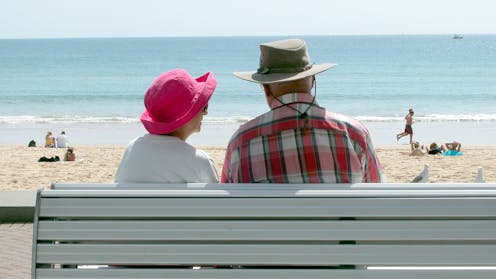
Australia has seen a dramatic transformation of retirement over the past 20 years, with more Australians delaying retirement than ever before, reshaping expectations for later life.
This shift matters because it marks a fundamental change in how people transition out of the workforce — with important implications for financial security in later life.
The decision to retire is no longer driven purely by personal preference or age alone. It’s increasingly shaped by policy, housing wealth, super balances and whether someone can afford to stop working.
In 2003, about 70% of women and almost half of men aged 60–64 had fully retired from the workforce. Twenty years later, those numbers have fallen to 41% and 27% respectively. For people aged 65–69, retirement rates have also dropped – from 86% to 66% among women, and from 73% to 61% among men.
These figures come from the latest annual report from the Household, Income and Labour Dynamics in Australia (HILDA) Survey, released today.
The HILDA Survey has been following the same households every year since 2001, which makes it possible to examine how the lives of Australians have changed across several aspects. Funded by the Australian government and managed by the Melbourne Institute, the survey is one of Australia’s most valuable social research tools.
I am part of the team that collects and analyses the data – here’s what we found.
How policy changes have influenced retirement age
The survey has included a special module on retirement every four years since 2003. The latest data, from 2023, show a clear and continuing trend: people are retiring later in life.
Policy changes are a major factor behind this shift. Since 2003, the age pension eligibility age has risen from 65 to 67 through two major reforms.
First, the eligibility age was equalised for men and women at 65 by July 2013. This was followed by a gradual increase to 67 for everyone between 2017 and 2023. Other factors likely include better health, increased workforce participation among women, and broader changes in social and economic expectations around retirement.
Still, retirement at younger ages hasn’t disappeared entirely – and for some people, it’s not a choice. Health problems remain the most common reason Australians give for retiring.
In 2023, 29% of recent retirees in our survey said they left work because of their own or a loved one’s health. That number has come down from 39% in 2003, reflecting longer life expectancy and better health outcomes, but health issues remain the most cited reason for retirement.
Job-related factors – such as redundancy or pressure from an employer – are another major factor cited by recent retirees. And financial reasons, such as becoming eligible for the pension, have also become more common. The share of recent retirees citing financial reasons as their main motivation has risen from 13% in 2003 to 21% in 2023.
The super gap is narrowing, but still there
The new HILDA data also shows superannuation balances are rising, but not evenly.
In 2023, the median super balance at retirement was just under A$191,000 for women and $310,000 for men. That’s a marked improvement for women – up more than 110% in real dollars (adjusted for inflation) since 2015 – but large gender gaps remain. In 2023, the median super balance at retirement was more than 1.5 times higher for men than women.
Yet these gaps are dwarfed by another source of inequality in retirement: housing wealth. Among recent retirees, 67% owned their home outright in 2023, down from 75% in 2003. These homeowners had average total wealth – including superannuation and home equity – of around $1.66 million. By contrast, those still paying off a mortgage had lower wealth, averaging about $1.48 million.
The wealth divide in later life
But the real divide is between homeowners and renters.
In 2023, 12% of recent retirees were renting privately – double the share from 2003. These retirees had no housing wealth and far less in super. In 2023, 59% of them retired with less than $100,000 in superannuation, compared to just 26% for homeowners. The overall financial position of renters is much more precarious in retirement, with two out of three living in poverty.
This shift has profound implications for future generations.
Housing plays a central role in shaping economic wellbeing in later life. People who retire without owning a home face much higher ongoing costs and have fewer options if health or income shocks occur. Unlike homeowners, they don’t benefit from rising property values or reduced housing expenses. And they’re more exposed to rent increases and housing insecurity.
Unfortunately, the number of retirees in this position is likely to grow. Homeownership is falling among younger Australians, especially those without access to family wealth. And while super balances are improving, renters will burn through their retirement savings much faster than homeowners, just to keep a roof over their head.
Australia’s retirement system is built on the assumption of homeownership. For most homeowners, it allows for a comfortable life after work.
But for renters, the picture is increasingly uncertain. If current trends simply persist – and housing affordability doesn’t get worse – then nearly one in four retirees could be renters by 2043.
Authors: Kyle Peyton, Senior research fellow, The University of Melbourne


















