

Dangerous climate change threatens Northern Australia’s big ‘food bowl’ dreams
- Written by: Steve Turton, Adjunct Professor of Environmental Geography, CQUniversity Australia
Australia’s worrying future under climate change was laid bare last week when the first National Climate Risk Assessment was released. It revealed extreme heat, fires, floods, droughts and coastal inundation already threatens lives and livelihoods – and will wreak further havoc in coming decades.
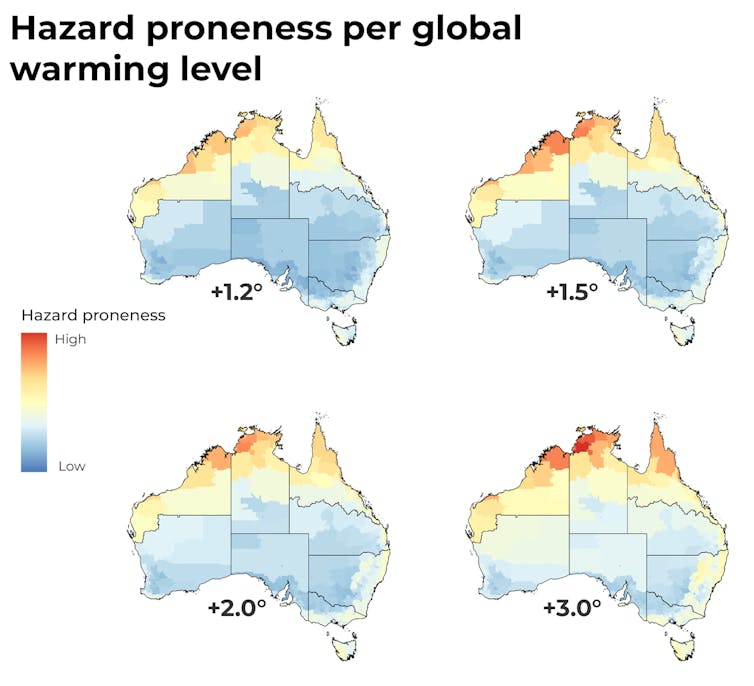
Much media attention focused on the effects in the continent’s south, where most Australians live. But the assessment found Northern Australia will be hardest hit on many fronts, including extreme heat.
This has major implications. Big plans are afoot to turn Northern Australia into Asia’s “food bowl”, as part of broader development for the region. It would involve building large-scale irrigation, dam and water infrastructure to increase agricultural production, create jobs and boost local economies.
But any discussion about transforming Northern Australia must confront the climate hazards threatening the region’s prosperity.
What’s the food bowl idea?
Northern Australia comprises roughly 53% of Australia’s land mass.
Turning the region into a food bowl would involve irrigating savannas and other ecosystems across northern parts of Western Australia, the Northern Territory and Queensland. The concept dates back decades, but gained momentum in 2015 when the Abbott government released a national white paper on developing Northern Australia.
Efforts to bring the plan to fruition are continuing. In 2018 for example, CSIRO released analysis of Northern Australia’s water resources and agricultural potential. And last year, a business case was developed for a major irrigation area in Far North Queensland.
The vision has been criticised due to concerns about river ecosystems, economic feasibility and Indigenous rights.
A decade ago, I challenged the Northern Australia development agenda from a climate change perspective. While proponents pointed to a bright future for the north – with new roads, rail, dams and food production – I argued climate change may eventually make large parts of the region unlivable.
Since then, changes in climate across the north have confirmed many concerns I described.
More frequent and intense extreme weather poses the biggest climate risk for the region. Northern Australia is largely tropical and subtropical, so global heating effects will be more pronounced. This will force natural, social and economic systems into uncharted climate territory.
Research already shows people, food production and nature will be vulnerable to higher-intensity cyclones, more intense heatwaves, floods, droughts, bushfires and other climate harms.
The new climate risk report paints an even more dire future for the region.
Danger in store for the north
As the risk assessment made clear, the world is on track to heat by at least 2.7°C by the 2090s if we don’t change course. In light of this, the report says:
Northern Australia is likely to experience escalating challenges as its proneness to hazards increases as global temperature rise. This will put pressure on health, critical infrastructure, natural species and ecosystems, and primary industries. It will also pose additional challenges to emergency responders.
Extreme weather events, including heatwaves, bushfires, flooding and tropical cyclones, will intensify safety and security risks, potentially resulting in loss of life, destabilisation of community structures, and increased migration away from high-risk areas.
The number of heatwave days is projected to increase across Australia – but particularly in the north.
Global heating is already affecting the production of some tropical tree crops, including mangoes and avocados. These crops need periods of cooler winter weather to flower and bear good fruit.
Livestock grazing is the economic lifeblood for many communities in the north’s tropical savannas. The risk assessment notes changes in temperature and water can worsen pasture for livestock. Increasing thermal stress in northern cattle herds is also a significant threat.
The risk assessment also raises concerns about other primary industries, many of which exist in the north. Changes in practices may buy more time. Much will depend on future carbon emissions.
Supply chains – such as storage, transport and distribution – are crucial for getting agricultural produce to consumers. Extreme weather, such as Cyclone Jasper in 2023, is already disrupting supply chains in the north. This will only worsen.
And an agriculture industry needs people. But the risk assessment says without action, some areas of the north may become unliveable and uninsurable. Floods, tropical cyclones and bushfires can leave communities isolated, and these and other hazards pose serious health risks.

What must happen now
Northern Australia has much to lose if carbon emissions keep rising and global heating continues. Adaptation and innovation may allow human communities and industries to survive for a while. But at some stage, crucial tipping points will be breached.
This will degrade the natural assets underpinning the north’s food, fibre and tourism industries.
Australia, like the rest of the world, must continue the journey to net zero carbon emissions by 2050. This includes meeting Australia’s new pledge to reduce emissions by 62–70% below 2005 levels by 2035.
Unless global warming is dramatically curbed, Northern Australia is unlikely to prosper in the second half of this century – and grandiose plans to turn the region into a food bowl will turn to dust.
Authors: Steve Turton, Adjunct Professor of Environmental Geography, CQUniversity Australia


















