

Many animals can reshape and shed their teeth – and now scientists have traced this ability back 380 million years
- Written by Kate Trinajstic, John Curtin Distinguished Professor, Molecular and Life Sciences, Curtin University
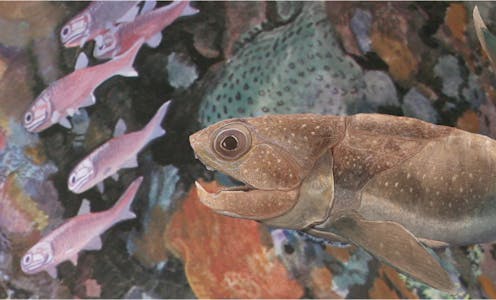
Losing your baby teeth is a strange experience. The teeth gradually loosen until they’re replaced by thicker, more durable and permanent ones. But humans aren’t the only animals capable of shedding teeth. In fact, most mammals have two sets of teeth throughout their life. And reptiles, amphibians, fish and sharks replace their teeth continuously throughout their lives.
But before a tooth can be replaced, it must first undergo a process known as “resorption”. This involves specialised cells called osteoclasts breaking down the bone at the tooth root, allowing it to become loose and fall out.
Until now, it’s been unclear when the ability to resorb the bone at the root of the tooth first evolved. A new discovery by our team, published in the Swiss Journal of Palaeontology, shows the start of this process dates back more than 380 million years.
The first fish to have teeth
The first evidence of teeth in any vertebrate (back-boned animal) is in primitive armoured fishes called placoderms that thrived in the Silurian and Devonian periods (438–359 million years ago).
Placoderms had a head and thorax covered with bony plates, and although many were predators, scientists long thought they lacked true teeth – teeth with the same tissues and growth processes found in other vertebrates.
Most placoderms had two pairs of bony upper tooth plates (called “supragnathals”) attached to the skull, and a paired lower jawbone (called “infragnathal”) that were thought to wear down to a sharp biting edge. The advent of synchrotron imaging, a powerful X-ray that can show details of tissue at very high resolution, confirmed the presence of teeth with a bony base and pulp cavity, yet lacking an outer layer of enamel.
However, scientists still thought that as the placoderm grew, the teeth wore away, so that the jaw bones of many adult placoderms looked like they had no teeth.
An ancient tropical reef
The Gogo Formation in Western Australia on Gooniyandi Country represents an ancient Devonian tropical reef with a rich diversity of fishes, dominated by many species of placoderms. In order for many species to share the same area on a reef and thrive, they need to somehow divide up the available resources. Placoderms did this by simply feeding differently: one species ate different foods to others, or foraged in different places, or fed at different times of the day or night.
Placoderms that lived on the reef show a great diversity of dentitions – the arrangements and shape of teeth in the mouth.
Eastmanosteus was the largest of the placoderms on the reef, reaching up to around two metres in length. As the top predator, it bore sharp cutting blades with two distinct “fangs”. Compagopiscis, less than half the size of Eastmanosteus, had small, pointed teeth used for feeding on prawn-like invertebrates called arthropods.
The fish we studied for our new study was Bullerichthys. It had low flat teeth used to crush hard-shelled prey. These teeth showed a highly unusual arrangement: they wrapped around a bony plate. In addition, the teeth of Bullerichthys had a shiny surface which looked much like enamel.

How our placoderm resorbed its teeth
In the early 2000s we found two additional specimens but they were of different sizes to the original, and their tooth plates had different numbers of tooth rows. These new specimens meant that we had found a growth series, showing how teeth changed through life from juveniles to adults.
This gave us an inkling there was something different going on in the way these teeth were forming compared to those of all other placoderms. Instead of the teeth on the upper tooth plates being worn away, the number of tooth rows and teeth increased as Bullerichthys grew.
Was this an early example of what’s known as a tooth whorl – a kind of coil of teeth – like that found in Qianodus, an early shark? Or something altogether different?

To investigate, we took the tooth plates to the Australian Synchrotron ANSTO Research Facility in Melbourne where we could get high-definition imaging of the tissues without damaging the fossils. The results showed that, like in other placoderms, younger teeth had a wide-open pulp cavity that became infilled with bony tissue known as dentine.
However, as the tooth aged, it didn’t wear down nor fall out and it was not replaced. Instead, the tooth was resorbed from within: we observed numerous small canals for blood vessels in the older teeth, with spongey bone invading the base of the tooth and eventually replacing the central dentine.
Underneath the tooth plate, corresponding to each of the oblique tooth rows, was a single newly formed tooth sitting in a shallow pit. We interpreted this as the site for the soft tooth-forming tissue known as the dental lamina, similar to what occurs in bony fishes such as trout today.
 A simple evolutionary tree showing the sequence of character development for how tooth resorption originated. Starting with ancient placoderms (left) through to bony fishes (ray-fins and lungfishes, centre) and sharks (on the right).
Kate Trinajstic, John Long & Vincent Dupret, CC BY
A simple evolutionary tree showing the sequence of character development for how tooth resorption originated. Starting with ancient placoderms (left) through to bony fishes (ray-fins and lungfishes, centre) and sharks (on the right).
Kate Trinajstic, John Long & Vincent Dupret, CC BY
Another piece of the evolutionary puzzle
However, that’s not all we found.
Many of the tooth plates of Bullerichthys show pits with characteristic scalloped edges, indicating the presence of osteoclasts, the cells that break down bone.
These are not restricted to a single tooth like in living bony, ray-finned fishes, such as trout. Instead they are widespread across the tooth plate on its outside surface. The amount of resorption present differed between adults and juveniles, with dramatically decreasing resorption in older individuals.
Placoderms, while not widely known in the community, ruled the planet for more than 80 million years as the most abundant and diverse vertebrates on Earth. Our new study shows they are much closer to the living bony fishes than we thought – and provides another piece of the evolutionary puzzle about our deep time ancestors.
Authors: Kate Trinajstic, John Curtin Distinguished Professor, Molecular and Life Sciences, Curtin University

















