

Netflix’s 1670 satirises the absurd ruling class of 17th century Poland-Lithuania – with lessons for today
- Written by Darius von Guttner Sporzynski, Historian, Australian Catholic University
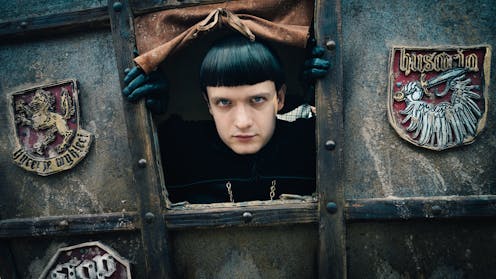
Netflix’s 1670 is one of the sharpest period comedies of recent years.
Shot in a mockumentary style, it follows Jan Paweł Adamczewski (Bartlomiej Topa), a vain provincial nobleman, and his family, in the Polish-Lithuanian Commonwealth of the late 17th century.
Season two, released this month, builds on the absurd humour of the first – mixing slapstick with political parody and playful anachronisms.
But while the series is not meant as a history lesson, it works best when viewed against the real story of Poland-Lithuania, a vast but fragile state that once dominated East-Central Europe. Understanding this background explains why the jokes land, and why the series resonates beyond Poland.
A big, bold and unstable commonwealth
The Polish-Lithuanian Commonwealth was created in 1569, when the Kingdom of Poland and the Grand Duchy of Lithuania joined in a union. At its height, it stretched from the Baltic Sea almost to the Black Sea, covering much of present-day Poland, Lithuania, Latvia, Belarus and Ukraine. Home to some 11 million people in the 17th century, it was one of Europe’s largest states.
This commonwealth was unique. It was neither a monarchy like France at the time, nor an autocratic empire like Russia. Instead, it called itself a “Republic of Nobles”. The king was elected, not hereditary. The parliament (the Sejm) had representatives from across the realm, but only nobles (about 10% of the population) had political rights. Most people were peasants, bound to estates and excluded from decision-making.
One of the state’s defining quirks was the liberum veto: the right of any single deputy to dissolve parliament by shouting “I object”. This was meant to protect noble freedom, but in practice it paralysed government. The commonwealth became famous for dysfunction: assemblies collapsed, reforms failed and decisions were delayed.
Nonetheless, the state produced a striking culture. Convinced they descended from ancient warriors, Polish nobles cultivated a proud, mustachioed style known as Sarmatism. It was colourful, theatrical, self-important – and ripe for parody.
The commonwealth endured until the late 18th century, when its neighbours (Russia, Prussia and Austria) dismembered it in three “partitions” (1772, 1793 and 1795).
How 1670 plays with history
1670 mines this history for comedy. Jan Paweł dreams of being the most famous John Paul in Polish history, oblivious to his own mediocrity.
His wife Zofia (Katarzyna Herman) is a religious fanatic, his daughter Aniela (Martyna Byczkowska) a rebellious proto-feminist, and his brother-in-law Bogdan, a hussar given to mushroom-induced visions. They argue, scheme, and confess to camera with the self-importance of characters from The Office.

Season two sees the family blunder into diplomacy with the Ottomans, organise a ruinous harvest festival, and navigate witch trials, funerals and romantic scandals. The humour is often absurd – at one point we see a talking donkey – but always circles back to the vanity of power.
The series is not historically accurate in its detail. Peasants in the 17th century did not discuss climate change, nor did nobles gamble in casinos. But these anachronisms serve a purpose: they underline how fragile institutions can be, how elites cling to prestige while ignoring reality, and how societies can collapse under the weight of their own absurdities.
Where 1670 succeeds is in capturing the feel of the commonwealth: the endless quarrels, the obsession with status, and the paralysing procedures. The liberum veto becomes a running gag, as does the nobles’ habit of preferring spectacle over substance.
For many, this series offers a rare introduction to a region and period often absent from pop culture.
Lessons from comedy and history
So what can viewers take away from a show that treats history with such irreverence?
First, the lesson that power often breeds absurdity. The Polish-Lithuanian Commonwealth was undone not only by foreign rivals, but by its own elite who prized their privileges over effective rule. Watching Jan Paweł self-sabotage is funny, but it also reflects a deeper truth about how states collapse.
Second, that diversity is both a strength and a challenge. Poland-Lithuania was multi-ethnic and multi-religious, populated with Poles, Lithuanians, Jews, Armenians, Tatars and Ukrainians. The show nods to this through its side character – Jewish innkeepers, Jesuit schemers and Cossacks — reminding us the commonwealth was not a monolith, but a complex patchwork.
Finally, 1670 teaches us how satire can be a powerful form of history-telling. You will not leave it knowing dates or dynasties. But you will understand something about how politics, identity and human folly intertwine. Laughter becomes a way of grasping what textbooks call dysfunction.
At a time when democracies the world over are struggling with gridlock, populism and polarisation, the lessons of the series feel oddly current.
Institutions can collapse when individual freedoms are prioritised above collective responsibility. Grand rhetoric about heritage can be used to conceal weakness. And elites obsessed with their own status can doom a state as surely as foreign invasion.
Authors: Darius von Guttner Sporzynski, Historian, Australian Catholic University

















