

Modern Australian
The Times

12,000-year-old rock art marked ancient water sources in Arabia’s desert

  • Written by Maria Guagnin, Director, Ha’il Archaeology Identification Project, University of Sydney; Max Planck Institute of Geoanthropology
12,000-year-old rock art marked ancient water sources in Arabia’s desert

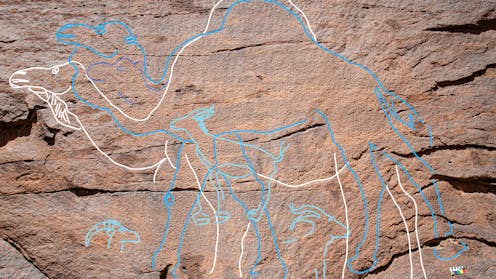
About 12,000 years ago, high up on a cliff in the desert of northern Arabia, an artist – or perhaps artists – was hard at work.

Standing on a narrow ledge and with primitive tools, they engraved into the rock an image of a life-sized camel. This wasn’t the first artwork of its kind: in fact, there was already an entire row of fresh camel engravings on the 39-metre-high cliff face, below which a shallow lake sparkled in the sunshine.

Over thousands of years, these engravings weathered the elements. They gradually eroded until they were almost invisible and had been forgotten.

That is, until our international team discovered them and more than 170 others while on a field trip to the region, which sits near the southern edge of the Nefud Desert in Saudi Arabia, roughly two years ago.

As we explain in a new study, published today in Nature Communications, the engravings would have marked important desert water sources – and demonstrate the resilience and innovation of people who lived in such a harsh, arid environment.

A barren, rocky desert under a clear blue sky.
The engravings are near the southern edge of the Nefud Desert in Saudi Arabia. Sahout Rock Art and Archaeology Project

Searching for clues

Our earlier research had shown that between 10,000 and 6,000 years ago Arabia was much wetter than it is today.

Grasslands had spread into areas that are now desert, and cattle herders used these pastures for their herds.

The rock art they left behind is well known from two UNESCO World Heritage sites.

We could see there was also older rock art at these UNESCO sites. It was much larger and more detailed, showing life-sized and naturalistic camels and wild donkeys. But it was not clear how old it was. So in May 2023 we set out to find more of this ancient rock art in the hope of finding clues about its age.
A sand-coloured rock face, featuring an engraving of a large camel.
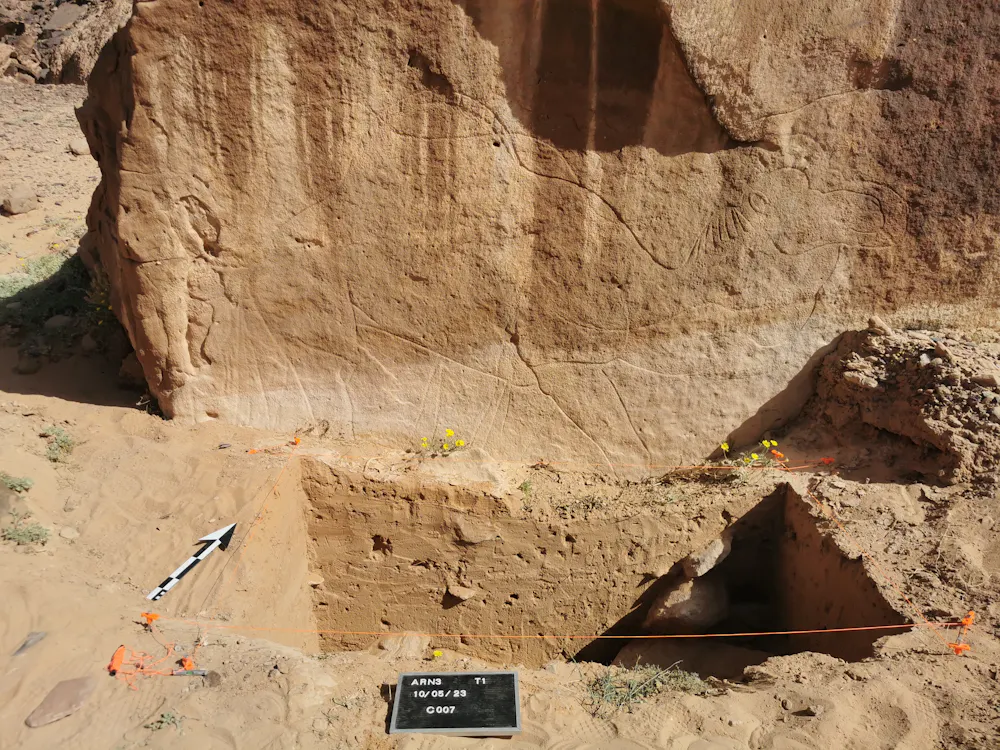
The newly discovered engravings include 130 images of large, life-sized animals – camels, ibex, wild donkeys, gazelles and aurochs. Sahout Rock Art and Archaeology Project

Life-sized engravings

In total, we identified more than 60 rock art panels containing 176 engravings in three previously unexplored areas – Jebel Arnaan, Jebel Mleiha and Jebel Misma. The engravings include 130 images of large, life-sized animals – camels, ibex, wild donkeys, gazelles and aurochs. Some are almost three metres long and more than two metres high.

We reached the first panel via a long off-road track which cut through a beautiful mountain landscape. A cool breeze made the heat of the emerging Saudi summer bearable.

The rock art panel showed two large camels, one on top of the other. The older camel looked as though it was in motion and about to stand up, the other like it was striding across the rock surface.

We were excited to find undisturbed archaeological layers directly beneath the engraved camels. In one sealed layer we even found an engraving tool that was once used to make rock art.

Luminescence dating – a dating method that measures when sediment was last exposed to sunlight – revealed the layer in which the tool was found is about 12,000 years old.

The same layer also contained artefacts that are typical for this time, including small arrowheads, stone beads and even a bead made from a seashell.

A hand holding a small arrowhead. An arrowhead uncovered during excavations. Michael Petraglia

A far-reaching network

These artefacts tell us the people who made the rock art were part of a far-reaching network. They used the same stone tools and jewellery as communities in the Levant, 400 kilometres further north.

Significantly, our team also discovered the rock art was placed near ancient seasonal lakes.

At the end of the last ice age, during the Last Glacial Maximum, the climate was extremely dry.

These lakes, dated at roughly 15,000 years, are the first evidence of surface water returning to Arabia following the extremely arid period. And they move the timeline of the returning humid conditions back thousands of years, enlarging the opportunity window for humans to settle in these dry inland conditions.

Our results show 12,000 years ago, humans were able to use these seasonal lakes to survive in the desert. They marked these water sources, and the paths leading to them, with monumental rock art.

We don’t know why they did this. But even for us today, the camel is a striking symbol for survival in the desert.

Authors: Maria Guagnin, Director, Ha’il Archaeology Identification Project, University of Sydney; Max Planck Institute of Geoanthropology


Read more https://theconversation.com/12-000-year-old-rock-art-marked-ancient-water-sources-in-arabias-desert-266144

Your Baby's First Year: A Local Guide to Feeding, Sleep, and When to Get Extra Support

Ask ten parents in a Brisbane mothers' group how their baby is feeding or sleeping, and expect ten different answers.  Someone's baby sleeps throu...

Kitchen and Laundry Makeover Ideas That Don't Require a Full Renovation

Full kitchen renos are expensive — and most people don't actually need one.  They need the kitchen to stop looking like it's stuck in 2009, or t...

How Technology Is Reshaping the Modern Australian Commercial Kitchen

The commercial kitchen has always been shaped by technology. Refrigeration changed how ingredients could be stored, modern ventilation transformed k...

The Number on a Roller Blind Fabric That Nobody Explains

Somewhere in the fabric book, next to the colour name, there is a percentage. Three per cent. Five per cent. Ten per cent. Nobody explains it, most c...

What’s Trending in Men’s Jewellery This Father’s Day!

Finding a Father’s Day gift that feels personal, stylish and genuinely wearable is not always easy. While socks and novelty mugs have traditionall...

Road Signs: Understanding Their Role in Clear and Effective Signage

Effective signage and display hardware can help businesses communicate information, promote products and organise customer or visitor movement. Road...

Bottle Label Printing: Key Factors to Consider Before Your Next Packaging Run

Effective packaging begins with understanding the product, bottle material, artwork and production requirements when planning bottle label printing. H...

Planning a Long-Distance Move With Interstate Movers Melbourne

Moving between states involves more planning than a typical local relocation. Along with packing and transporting household belongings, you need to...

Understanding the Role of an I/O Controller in Industrial Automation

Modern industrial systems depend on accurate communication between sensors, machines and control systems. An I/O controller can help manage this commu...

How the Right Mining Hose Supports Demanding Operations

Mining environments place considerable demands on equipment used for material transfer, water management and processing. Hoses operating in these co...

Simple Ideas for Making Social Gatherings More Memorable

We have all been to those parties where everyone just stands around the kitchen island, staring at their phones, waiting for someone else to make a mo...

Outdoor Wall Lights: Improving Exterior Lighting Around Your Home

Lighting can influence how a room looks, feels and functions, so the right fitting should be selected according to both appearance and practical req...

Commercial Office Cleaning: Combining Routine Office Cleaning With Melbourne Service

Keeping a workplace clean requires a service that can accommodate everyday tasks as well as the particular needs of the business. Professional comme...

Caravan Sales in Queensland: How to Find the Right Caravan for Sale QLD

Caravan ownership is about more than having somewhere to sleep while travelling. For many Queenslanders, it is one of the best ways to explore regio...

What Sir Walter Buffalo Turf Actually Costs in 2026 (And Why Quotes Vary So Much)

Two quotes landed on a Hills District homeowner's kitchen table last spring for the exact same 80-square-metre backyard. One said $12 a metre. The o...

Nearly 1,300 NSW Hospital Beds Are Occupied By People Who Are Ready To Go Home

1,276 people in NSW hospitals have been medically cleared for discharge but remain in hospital because they're still waiting for NDIS or aged care sup...

National Survey Launched to Measure Operational Impacts of Federal NDIS Policy Reforms

The effects of recent NDIS reforms are beginning to move beyond policy papers and into day to day service delivery. A new national survey is asking ...

Beyond the Nappy Cake: Baby Shower Gifts That Get Used

What new Australian parents unwrap, keep, and quietly thank you for months later. Six weeks after my daughter was born, I did an audit of the baby sh...














