

The controversial GST deal with the states is under review. There are better alternatives
- Written by Stephen Bartos, Professor of Economics, University of Canberra
Treasurer Jim Chalmers last week announced the Productivity Commission will review the 2018 deal that gave states a guaranteed minimum share of the goods and services tax (GST).
Within minutes, the Western Australian Treasurer Rita Saffioti responded with a promise to fight to keep WA’s “fair share” of the GST. She announced a “fairness fighter” team would be set up in the WA Treasury.
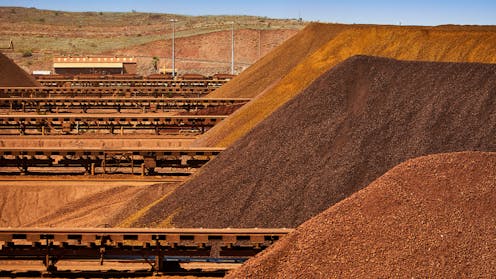
The reason WA is worried is that the 2018 deal gives it a higher share of funding than it would have received under the previous formula, which took into account states’ own capacity to raise revenue. The WA government has been raking in revenue thanks to mining royalties, which have mushroomed since the mining boom, collecting more than A$10 billion a year for the past three years.
Thanks to high iron ore and gas prices – on top of the special GST deal – WA now has a large budget surplus, when other states and territories are struggling.
A booming surplus
A budget update last week revealed WA had a higher than expected $3.7 billion surplus for 2024-25. The West Australian newspaper said “the strong result is sure to put pressure on the 2018 GST deal”.
The Commonwealth Grants Commission was established in 1933 to advise the Federal government on grants to financially weak states. Since July 2000 that has included advice on how to distribute the billions in revenue collected nationally through the GST.
For much of its history it applied a principle of “horizontal fiscal equalisation”. This meant giving each state and territory roughly equal budget capacity to provide public services such as schools, hospitals and roads. It took account of disadvantages like remoteness and a host of other factors, along with states’ ability to fund services from their own revenue.
The 2018 deal flies in the face of equalisation. It gives all states in theory a guaranteed minimum share of the GST pool, regardless of their revenue. In practice, this gives WA much greater fiscal capacity because of its royalties. Without the deal, WA would receive a lower share of the GST – which, taking account of its own resources, would still put it on the same footing as other states.
Whether WA residents deserve better services because their state sits on mineral resources is a matter of opinion. Obviously WA politicians think this only fair. Other states might disagree.
The problems with the 2018 deal
Most economists and commentators outside WA are critical of the 2018 deal that carved up GST revenues. Economist Saul Eslake calls it “the worst public policy decision of the 21st century thus far”. He notes the cost – over the next four years, WA will receive $26.3 billion more from the carve-up of GST revenues than it would otherwise have done.
Another economist, Robert Breunig at the Australian National University, has called for an end to the deal. He points out that WA benefited from Commonwealth grants continuously from 1933 through 1968, and from 1981 to 2000. WA never complained the system was unfair in that period – nor did other states, even though WA was benefiting.
The deal was introduced by the Morrison government for political purposes, to win WA seats in parliament. Labor supported the deal because it too wanted WA votes. It is enormously popular in WA. So a recommendation to simply abolish the deal may not gain traction; the government will not want a running battle with WA ahead of the next federal election.
A new system is needed
The Productivity Commission will therefore need to think laterally. Fortunately its terms of reference are broad enough to allow it to consider alternatives.
While simply scrapping the 2018 deal might not be feasible, moving to an altogether new system could be a way forward.
An option worth considering is to split the grants system into two parts.
One part would distribute some of the GST – say, half – on a simple per capita (per person) basis. States like New South Wales and Victoria support moving to a per capita formula because at present they get less than a per capita share. This would provide all states and territories with some budget certainty, but smaller ones, and WA, would gain less than at present. They would need a top-up.
That top-up could be delivered by a separate fund, using the remaining half of the GST revenue to provide grants to overcome state and territory disadvantages and to meet special needs. It would remain open to WA to argue, as it does now, that it needs Commonwealth grants to support infrastructure for mining.
Other states could make their own arguments for special needs.
A feature of such a system could be making such grants conditional on the state or territory using the funds to reduce their disadvantages.
One of the frustrations in the system at present is that the Northern Territory is highly subsidised by other states (that is, it receives a higher share of GST funds, meaning others get less) due to remote disadvantage and a high First Nations population. Although it receives higher funding due to these factors, it still puts most of its budget into Darwin and surrounds.
Services for remote communities and meeting the needs of Aboriginal and Torres Strait island people are comparatively low priorities. A new system of more accountable funding would help to address this anomaly.
No doubt, there are other ways to devise a new and fairer system. There is plenty of time for the Productivity Commission to consider them. It is something that should interest all Australians – because ultimately we pay the price for the WA special deal.
Authors: Stephen Bartos, Professor of Economics, University of Canberra

















