

Evacuating with a baby? Here's what to put in your emergency kit
- Written by Karleen Gribble, Adjunct Associate Professor, School of Nursing and Midwifery, Western Sydney University
Every summer in Australia, bushfires, cyclones and floods threaten lives and properties. Preparing for these emergencies includes creating an emergency kit that contains everything you and your baby will need if essential services are disrupted or you need to evacuate.
Infants are particularly vulnerable in emergencies. Without access to appropriate food and fluid they can become seriously ill within hours, particularly in hot weather.
Read more: Hospitals feel the heat too from extreme weather and its health impacts
Families can be isolated without power or water in their homes for long periods. They can be stranded in their cars while evacuating for hours or even days. And because government planning for infants is lacking, even when you reach an evacuation centre, you may have to wait to access infant feeding supplies.
But parents can find it difficult to pack the necessary supplies for their babies. We are so used to having reliable power and water that it’s hard to imagine what it’s like not to have them.
During the 2011 Queensland flooding and cyclone Yasi disasters, for example, one-quarter of families evacuated were unable to pack adequate infant feeding supplies.
This difficulty is compounded by the fact that, apart from Queensland, state and territory governments do not provide detailed guidance for parents on what to pack for babies in emergency kits. Some emergency organisations offer more advice on what to pack for pets than for babies.
Gathering supplies at the last minute can be dangerous as it can delay leaving.
So, what do parents and caregivers need in their kit?
Emergency kits should have everything you need to look after your baby for at least three days without having any access to electricity or water.
Breastfed babies
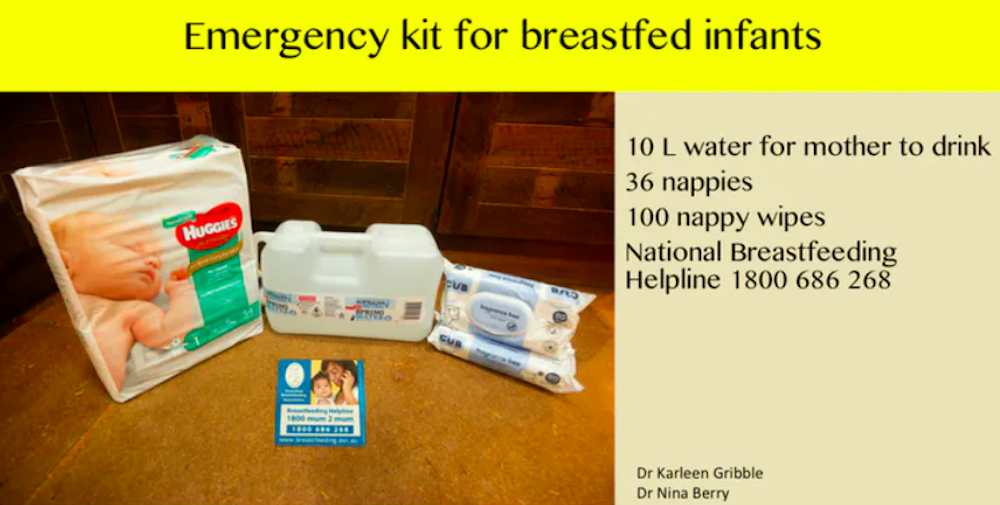
If your baby is less than six months old and fully breastfed, you will need nappies, wipes, and some extra water to keep hydrated.
 Author provided
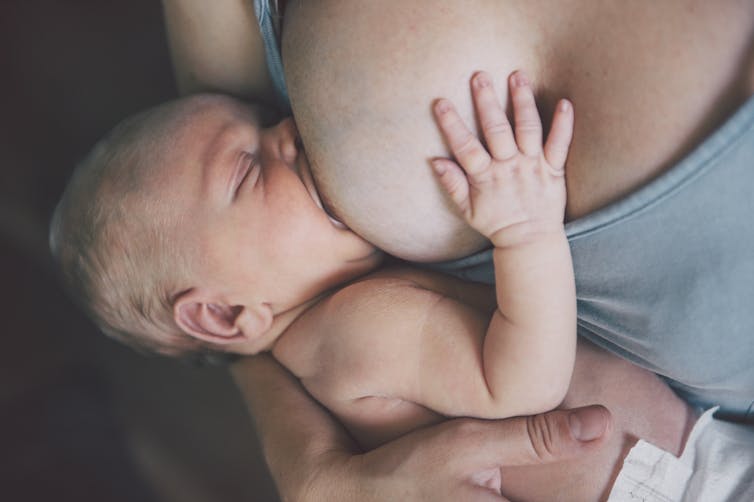
Some mothers worry they won’t be able to breastfeed during an emergency. Babies are often unsettled in emergencies but stress doesn’t impact milk production.
However, it can slow the release of milk. If this happens, keep offering the breast, look at your baby, think about how much you love them; this will release hormones that make the milk flow and help you and your baby to feel more relaxed. Frequent breastfeeding increases the amount of milk a baby takes from the breast.
Author provided
Some mothers worry they won’t be able to breastfeed during an emergency. Babies are often unsettled in emergencies but stress doesn’t impact milk production.
However, it can slow the release of milk. If this happens, keep offering the breast, look at your baby, think about how much you love them; this will release hormones that make the milk flow and help you and your baby to feel more relaxed. Frequent breastfeeding increases the amount of milk a baby takes from the breast.
 You might need to feed more often.
Romanova Anna/Shutterstock
Expressed breastmilk-fed babies
If you feed your baby expressed breastmilk, you need to learn how to hand express, as it may not be possible to wash pump parts.
You will also need drinking water for yourself, detergent, around 400ml of water per feed for washing hands, disposable plastic cups or single-use bottles and teats for feeding the baby, as well as nappies and nappy wipes.
You might need to feed more often.
Romanova Anna/Shutterstock
Expressed breastmilk-fed babies
If you feed your baby expressed breastmilk, you need to learn how to hand express, as it may not be possible to wash pump parts.
You will also need drinking water for yourself, detergent, around 400ml of water per feed for washing hands, disposable plastic cups or single-use bottles and teats for feeding the baby, as well as nappies and nappy wipes.
 Author provided
Formula-fed babies
If you are are formula feeding, we suggest the following as a minimum:
an unopened tin of infant formula
enough bottles and teats to have one for every feed (thoroughly washed, sterilised and completely dry before sealing in a ziplock bag)
small bottles of still drinking water (not mineral or carbonated water) for reconstitution
large containers or bottles for washing hands and the preparation area (about 500ml per time)
detergent for washing hands and the preparation area
paper towels for drying hands and the preparation area
nappies and nappy wipes.
Author provided
Formula-fed babies
If you are are formula feeding, we suggest the following as a minimum:
an unopened tin of infant formula
enough bottles and teats to have one for every feed (thoroughly washed, sterilised and completely dry before sealing in a ziplock bag)
small bottles of still drinking water (not mineral or carbonated water) for reconstitution
large containers or bottles for washing hands and the preparation area (about 500ml per time)
detergent for washing hands and the preparation area
paper towels for drying hands and the preparation area
nappies and nappy wipes.
 Author provided
All of these supplies can be stored in a large plastic tub with a flat lid that you can turn upside down and use as a clean preparation surface.
When using the kit, it’s important to only make up the infant formula when it is going to be fed to the baby and to throw out any leftover formula within an hour of starting the feed.
Babies aged over six months
If your baby has started solids, include enough canned baby foods and disposable spoons in your kit to feed your baby for three days.
Author provided
All of these supplies can be stored in a large plastic tub with a flat lid that you can turn upside down and use as a clean preparation surface.
When using the kit, it’s important to only make up the infant formula when it is going to be fed to the baby and to throw out any leftover formula within an hour of starting the feed.
Babies aged over six months
If your baby has started solids, include enough canned baby foods and disposable spoons in your kit to feed your baby for three days.
 Babies aged over six months will need solids as well.
Syda Productions/Shutterstock
Other things to consider
If you are formula feeding and it’s possible you’re going to be isolated at home without power for more than a few days, you may need to store resources such as a gas stove and a large quantity of water to enable washing.
Emergencies often occur during heat waves and general advice includes drinking plenty of water to prevent dehydration. This advice doesn’t apply to babies under six months of age. Young babies can be made very ill if given water alone. Instead, offer your baby more frequent breast or formula feeds.
If you’re wondering whether to stop breastfeeding, consider delaying this decision until after the summer emergency season has passed, as it’s much easier to breastfeed than to formula feed in emergency conditions.
Babies aged over six months will need solids as well.
Syda Productions/Shutterstock
Other things to consider
If you are formula feeding and it’s possible you’re going to be isolated at home without power for more than a few days, you may need to store resources such as a gas stove and a large quantity of water to enable washing.
Emergencies often occur during heat waves and general advice includes drinking plenty of water to prevent dehydration. This advice doesn’t apply to babies under six months of age. Young babies can be made very ill if given water alone. Instead, offer your baby more frequent breast or formula feeds.
If you’re wondering whether to stop breastfeeding, consider delaying this decision until after the summer emergency season has passed, as it’s much easier to breastfeed than to formula feed in emergency conditions.
Authors: Karleen Gribble, Adjunct Associate Professor, School of Nursing and Midwifery, Western Sydney University
Read more http://theconversation.com/evacuating-with-a-baby-heres-what-to-put-in-your-emergency-kit-127026

















