

are your kids cheating on their virtual partners?
- Written by Janine M. Cooper, Founder, Everyday Neuro & Honorary Fellow Manager, Clinical Sciences, Murdoch Children's Research Institute
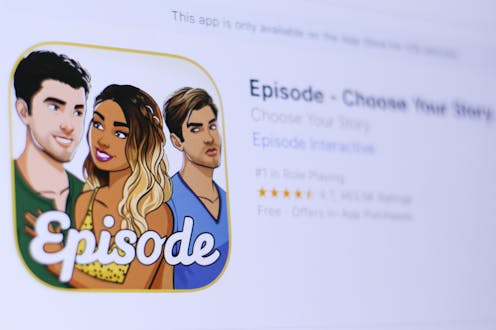
As smartphone ownership surges, we’re seeing a drastic rise in the use of mobile apps, many of which are marketed towards impressionable young audiences.
One such app is Episode – Choose Your Story, a free game with more than 50 million downloads and five million weekly users.
Episode is coming under scrutiny by parents and users, many as young as 10, for its inappropriate themes. Such apps are far-reaching, and parenting their use can be tricky.
According to a US report published this year, which surveyed 1,677 kids, 41% of tweens (aged 8-12) and 84% of teens (aged 13-18) owned a smartphone.
There’s an increasing number of games targeted at these age groups, of which many follow a “choose your story” format.
The stories are divided into episodes and the user, or “reader”, can interact with storylines and even create their own. Readers can choose from a list of responses to influence things such as a character’s appearance, dialogue and reaction to events.
While most storylines focus on romance and high school relationships, many have raised alarm bells in parents. A number of parents have voiced concerns on Common Sense Media, a leading source of entertainment recommendations for families.
What your child engages with online
Episode features numerous storylines about sexual discrimination, underage sex and pregnancy. Many of these glorify adultery and are potentially promoting reckless decision making, pettiness and unkind acts.
On inspection, there are several issues with the app.
First, storylines can be written by anyone, even those aged 13-17. And while there are more than 12 million creators, there is little content regulation, even when the Episode community expresses concern.
One story regarding sexual consent raised uproar with users, who were concerned at the poor moral message of a young female character being “blind drunk” and not consenting to a sexual liaison with an older male character.
Yet, the story was not removed, and the author did little to address the backlash.
Another concerning aspect of the game is that in many situations, users have to pay money to make morally correct decisions, yet reckless choices are free. This reinforces inappropriate reactions to events. This is also where players can unwittingly spend huge amounts of money.
Read more: The app trap: how children spend thousands online
What about parental guidance ratings?
On the Common Sense Media website, parents have given Episode a parental advisory rating of 14+, whereas kids have rated it suitable for ages 13+.
On the Apple App Store, the game is rated 12+ and on Google Play it’s rated “Mature”.
That said, players of Episode are often impressionable older children and teens. A 12+ rating offers little guidance to parents, and ratings overall don’t seem to deter children from playing.
This is hardly surprising. At this stage of development, peer relationships are highly rewarding. Many players are introduced to apps such as Episode by siblings or friends, and are enticed by the excitement they offer.
Research shows several areas of the brain make adolescents more sensitive to the rewards of peer relationships than adults. This motivates teens to focus on their peers in decision-making situations that involve risky behaviour.
This is apparent in one comment from a 13-year-old made on a Common Sense Media forum about Episode:
WOW!!! The best app!!!!! I love it!!!!! P.S. – kids, make sure your parents don’t know you’re using Episode! ;)
No universal standard
Although different countries offer their own classifications for online sites and gaming, there’s no universal standard apps have to meet in order to establish suitability for children and teens.
Read more: Is that porn your child is watching online? How do you know?
Due to the discrepancy in app store ratings, the best prevention of a child or teen using inappropriate apps is to refer to guidance sites such as Common Sense Media.
But an even better defence is for parents to test questionable apps themselves. From those adults who offer valuable feedback online for childrens’ apps, many are parents who have personally tried the apps.
Until there’s an improved consensus on app classification, parental monitoring remains best practice.
Other things parents can do
To prevent the use of unsuitable apps by children and teens, parents can try establishing a verbal and written contract with their child before they are allowed to own a smartphone, or other smart device.
It should contain guidelines for when, how long and what can be viewed on the device. There should also be transparency around what’s being downloaded, with parents checking the device(s) on a regular basis.
Furthermore, due to the tendency of apps such as Episode to encourage consumerism, children and teens should not buy gems, tokens, cards or any app-related digital currency, without first discussing this with an adult.
As it is, the estimated daily revenue of Episode is US$105,000.
Passive versus interactive
A major criticism of screen time and app use is that it’s passive and requires little or no involvement from users.
Research suggests typing on a keyboard to calculate times tables, rather than writing by hand or using a smartphone, can hinder long-term learning and memory.
Instead of encouraging device usage, children benefit from more reading, storytelling and imaginative play. As they mature, such activities enable greater fluency, theory of mind (which is understanding that others may have different beliefs and desires to you), and moral reasoning abilities.
Read more: Five reasons why you should read aloud to your kids – and pick their favourite book
The good news is, app developers have also started to heed such advice, with many promoting the interactive components of their product.
And this isn’t just to appease parents.
Apps that encourage storytelling, many led by research and developed by educators, are popular with children and teens too.
Authors: Janine M. Cooper, Founder, Everyday Neuro & Honorary Fellow Manager, Clinical Sciences, Murdoch Children's Research Institute

















