

The water crisis has plunged the Nats into a world of pain. But they reap what they sow
- Written by Daniel Connell, Research Fellow, Crawford School of Public Policy, Australian National University
When farmers descended on Parliament House in Canberra this month to demand the Murray Darling Basin Plan be dumped, they reserved sharp words for Nationals leader Michael McCormack.
“The National Party is not going to exist after the next election unless you grow some spine,” one angry irrigator warned him.
“Get up there and say ‘this is not f—ing good enough’. Get angry!”
Read more: Fish kills and undrinkable water: here's what to expect for the Murray Darling this summer
By the end of the week, federal Minister for Water Resources David Littleproud, a Nationals MP, had announced a review of water sharing arrangements under the basin plan, claiming it would “take the politics out” of the issue.
But that hope will be in vain. If irrigators in New South Wales get more water, that means less for the environment and other water users downstream including irrigators in South Australia.
The Nationals are wedged between NSW irrigation communities and its coalition with the Liberals. But this crisis is largely of the party’s own making, and it will not go away any time soon.
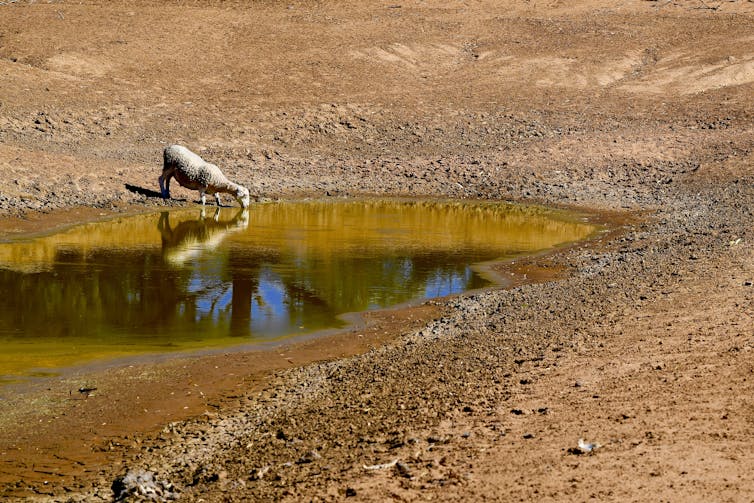 Farmers say water shortages are threatening their livelihoods and communities.
AAP
Farmers say water shortages are threatening their livelihoods and communities.
AAP
A political bind
The Murray Darling Basin Plan became law in 2012. It’s meant to determine how much water can be drawn from the river system by users, mostly irrigators who use about 95% of extracted water. The plan aims to return some water to rivers, wetlands and flood plains by buying it from willing sellers on the water market, and improving infrastructure to prevent water loss.
The National Party has long blamed the basin plan for a raft of problems facing rural communities. This attitude might have served the Nationals’ short-term political interests. But it created a monster: stoking dissatisfaction from rural voters it is now unable to manage.
Read more: The Murray-Darling Basin scandal: economists have seen it coming for decades
The beneficiaries are right-wing minor parties such as One Nation, to which rural voters in NSW and southern Queensland are now turning.
The Nationals’ base might be rural, but it is in coalition with the Liberals who must appease both capital city voters concerned about the environment, and constituents in downstream South Australia where voters of all persuasions think their state does not receive a fair share of water.
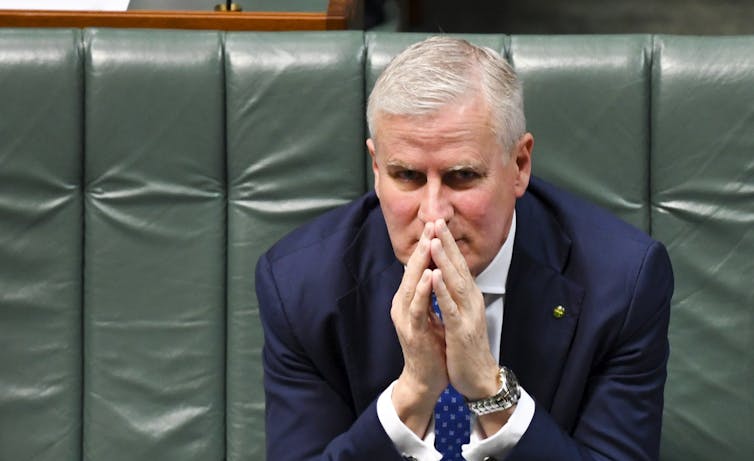 The Nationals are wedged between their rural base and Liberal voters.
Mick Tsikas/AAP
The Nationals are wedged between their rural base and Liberal voters.
Mick Tsikas/AAP
A history of white-anting
It is ironic farmers now accuse the Nationals of not doing enough to oppose the basin plan, given the party’s record on water policy at a state and federal level.
As far back as the 1980s, it became clear water salinity and over-extraction by irrigators was degrading river environments in the Murray Darling Basin.
Over ensuing decades the Nationals could have helped affected communities accept the need to take a basin-wide approach to water extraction. Instead they fuelled resentment by demanding more water for irrigators, implicitly dismissing the legitimate needs of the environment and downstream water users.
Read more: Paddling blind: why we urgently need a water audit
In the early 1990s, for example, when a cap on further extractions was being planned, the NSW government (whose water policy was controlled by the Nationals) insisted water licenses not yet activated should be accepted within the cap. This substantially increased the volume of water extracted.
But even after securing the the changes, the Nationals campaigned against the policy.
Later as part of the Howard government, the Nationals reluctantly helped prepare the Water Act 2007 which underpins the basin plan. When it finally went before Parliament in 2012, McCormack, then a backbencher, opposed it. Such opposition has been a hallmark of Nationals policy ever since.
 Receding waters in the NSW Menindee Lakes which is under pressure from low water flows.
Dean Lewins/AAP
Receding waters in the NSW Menindee Lakes which is under pressure from low water flows.
Dean Lewins/AAP
In NSW, Nationals water ministers have undermined the plan in many ways, including by failing to ensure the timely delivery of “water resource plans”. These plans are supposed to outline how water will be shared between irrigators and the environment at a regional level, and are essential to the success of the broader basin policy.
Read more: It's time to restore public trust in the governing of the Murray Darling Basin
Meanwhile federally, Nationals MPs have insisted water for the environment be acquired by improving water infrastructure rather than taking water from irrigators. The building of this infrastructure has led to additional costs for taxpayers for little environmental benefit.
 Farmers at a rally outside Parliament House. They want the basin plan scrapped.
Lukas Coch/AAP
Farmers at a rally outside Parliament House. They want the basin plan scrapped.
Lukas Coch/AAP
So what next?
The basin plan now appears on the brink of collapse. The NSW government is threatening to pull out if changes are not made and Littleproud’s decision to review water-sharing arrangements is hardly a ringing endorsement of the plan.
Meanwhile the Greens and other critics say the plan was never adequate anyway, given the low volumes of water redirected to the environment and its failure to properly recognise climate change.
If irrigators succeed in having the plan scrapped, their victory is likely to be short-lived. Public anger at ongoing environmental degradation will only grow. And depending on the party in government when a new Murray Darling policy is drafted, irrigators may be treated with far less sympathy.
Authors: Daniel Connell, Research Fellow, Crawford School of Public Policy, Australian National University

















