

scientists create first ever living, programmable organism
- Written by Simon Coghlan, Senior Research Fellow in Digital Ethics, School of Computing and Information Systems, University of Melbourne
A remarkable combination of artificial intelligence (AI) and biology has produced the world’s first “living robots”.
This week, a research team of roboticists and scientists published their recipe for making a new lifeform called xenobots from stem cells. The term “xeno” comes from the frog cells (Xenopus laevis) used to make them.
One of the researchers described the creation as “neither a traditional robot nor a known species of animal”, but a “new class of artifact: a living, programmable organism”.
Xenobots are less than 1mm long and made of 500-1000 living cells. They have various simple shapes, including some with squat “legs”. They can propel themselves in linear or circular directions, join together to act collectively, and move small objects. Using their own cellular energy, they can live up to 10 days.
This time-lapse video shows cells being manipulated and assembled to create xenobots. (Original video: Douglas Blackiston, Tufts University)While these “reconfigurable biomachines” could vastly improve human, animal, and environmental health, they raise legal and ethical concerns.
Strange new ‘creature’
To make xenobots, the research team used a supercomputer to test thousands of random designs of simple living things that could perform certain tasks.
The computer was programmed with an AI “evolutionary algorithm” to predict which organisms would likely display useful tasks, such as moving towards a target.
After the selection of the most promising designs, the scientists attempted to replicate the virtual models with frog skin or heart cells, which were manually joined using microsurgery tools. The heart cells in these bespoke assemblies contract and relax, giving the organisms motion.
The creation of xenobots is groundbreaking.
Despite being described as “programmable living robots”, they are actually completely organic and made of living tissue. The term “robot” has been used because xenobots can be configured into different forms and shapes, and “programmed” to target certain objects – which they then unwittingly seek.
They can also repair themselves after being damaged.
Possible applications
Xenobots may have great value.
Some speculate they could be used to clean our polluted oceans by collecting microplastics.
Similarly, they may be used to enter confined or dangerous areas to scavenge toxins or radioactive materials.
Xenobots designed with carefully shaped “pouches” might be able to carry drugs into human bodies.
Read more: Why we should welcome 'killer robots', not ban them
Future versions may be built from a patient’s own cells to repair tissue or target cancers. Being biodegradable, xenobots would have an edge on technologies made of plastic or metal.
Further development of biological “robots” could accelerate our understanding of living and robotic systems. Life is incredibly complex, so manipulating living things could reveal some of life’s mysteries — and improve our use of AI.
Legal and ethical questions
Conversely, xenobots raise legal and ethical concerns. In the same way they could help target cancers, they could also be used to hijack life functions for malevolent purposes.
Some argue artificially making living things is unnatural, hubristic, or involves “playing God”.
A more compelling concern is that of unintended or malicious use, as we have seen with technologies in fields including nuclear physics, chemistry, biology and AI.
For instance, xenobots might be used for hostile biological purposes prohibited under international law.
More advanced future xenobots, especially ones that live longer and reproduce, could potentially “malfunction” and go rogue, and out-compete other species.
For complex tasks, xenobots may need sensory and nervous systems, possibly resulting in their sentience. A sentient programmed organism would raise additional ethical questions. Last year, the revival of a disembodied pig brain elicited concerns about different species’ suffering.
Managing risks
The xenobot’s creators have rightly acknowledged the need for discussion around the ethics of their creation.
The 2018 scandal over using CRISPR (which allows the introduction of genes into an organism) may provide an instructive lesson here. While the experiment’s goal was to reduce the susceptibility of twin baby girls to HIV-AIDS, associated risks caused ethical dismay. The scientist in question is in prison.
When CRISPR became widely available, some experts called for a moratorium on heritable genome editing. Others argued the benefits outweighed the risks.
Read more: China's failed gene-edited baby experiment proves we're not ready for human embryo modification
While each new technology should be considered impartially and based on its merits, giving life to xenobots raises certain significant questions:
- Should xenobots have biological kill-switches in case they go rogue?
- Who should decide who can access and control them?
- What if “homemade” xenobots become possible? Should there be a moratorium until regulatory frameworks are established? How much regulation is required?
Lessons learned in the past from advances in other areas of science could help manage future risks, while reaping the possible benefits.
Long road here, long road ahead
The creation of xenobots had various biological and robotic precedents. Genetic engineering has created genetically modified mice that become fluorescent in UV light.
Designer microbes can produce drugs and food ingredients that may eventually replace animal agriculture.
In 2012, scientists created an artificial jellyfish called a “medusoid” from rat cells.
Robotics is also flourishing.
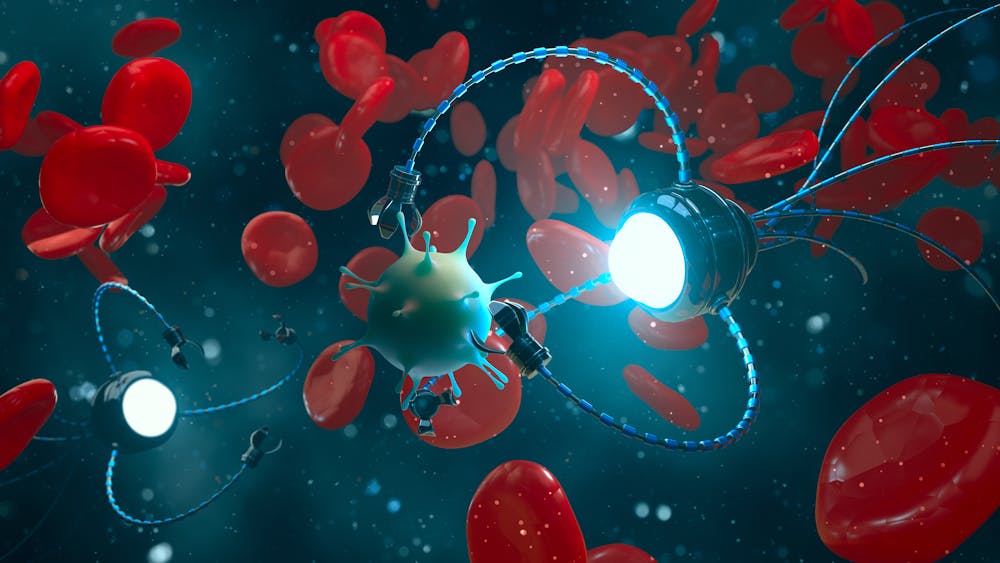 Nanobots are tiny robots that carry out specific tasks. In medicine, they can be used for targeted drug delivery.
shutterstock
Nanobots are tiny robots that carry out specific tasks. In medicine, they can be used for targeted drug delivery.
shutterstock
Nanobots can monitor people’s blood sugar levels and may eventually be able to clear clogged arteries.
Robots can incorporate living matter, which we witnessed when engineers and biologists created a sting-ray robot powered by light-activated cells.
In the coming years, we are sure to see more creations like xenobots that evoke both wonder and due concern. And when we do, it is important we remain both open-minded and critical.
Authors: Simon Coghlan, Senior Research Fellow in Digital Ethics, School of Computing and Information Systems, University of Melbourne

















