

a brief history of angels in Christianity
- Written by Philip C. Almond, Emeritus Professor in the History of Religious Thought, The University of Queensland
Christianity began with the appearance of an angel. In the gospel of Luke, Mary is told by the angel Gabriel she will conceive and bear a son and call him Jesus.
Angelic messengers such as Gabriel bookmarked Jesus’s life. After his baptism by John the Baptist, Jesus was taken by the Spirit into the wilderness for 40 days (according to the gospel of Matthew) where he was tempted by the Devil. When the Devil finally left him, “suddenly angels came and waited on him”.
Before Jesus’s crucifixion, in the garden of Gethsemane, as he was praying that God relieve him of the need to sacrifice himself,
an angel from heaven appeared to him and gave him strength. In his anguish he prayed more earnestly, and his sweat became like great drops of blood falling upon the ground.
In all four gospels in the New Testament, angels appear to speak to the various women who visit the tomb of Jesus.

Gabriel is one the two most important angels within the Christian tradition, along with Michael, who would have a key role at the time of the end of the world. These are the only two angels named in both the Old and New Testaments of the Bible.
According to Revelation, the last book in the New Testament, Michael was the leader of the warrior angels who would throw a dragon (called the Devil and Satan) and his evil angels out of heaven to earth.
From the first century onwards Gabriel and Michael were known as “archangels”, the rank higher than angels.
Where did they come from?
In the theory of angels (angelology) within the Christian traditions, angels were created by God on the first of the six days of creation. From then on, they were immortal.
All angels were created as good. But they also had free will to choose good or evil. Some chose the good and remained in heaven. Others, who chose evil, fell downwards, where they lived, along with their leader Satan, in the cloudy atmosphere between heaven and earth.
In the Old Testament, the angels were members of God’s heavenly council advising God on his plans. Their other internal role was to praise God. But they also assisted in God’s governance of the world, acting as heavenly intelligence gatherers, enforcers, and warriors in the heavenly army.
Their key role, however, was as messengers and mediators between God and the world. Thus, the most common term for the heavenly beings in the Hebrew Bible is ma’lak (messenger). In the Septuagint, the Greek version of the Old Testament (3rd-1st century BCE), ma’lak is translated as aggelos, the Greek word for “messenger”.
The first Latin translation of the Bible, the Vulgate (4th century CE) reserved the term angelos for heavenly rather than earthly messengers; and thence to “angel” in English translations of the Bible.
Generally, angels were mysterious spiritual creatures, awe-inspiring and terrifying. They were not gods, but they were like them. When the Old Testament prophet Daniel was confronted by an angel, although in the form of a man, he “became frightened and fell prostrate”.
When the soldiers guarding the tomb of Jesus saw “the angel of the Lord descending from heaven”, they “shook and became like dead men”.
Angels were not creatures to get on the wrong side of. As one Old Testament text informs us,
That very night, the angel of the Lord set out and struck down 185,000 in the camp of the Assyrians; when morning dawned, they were all dead bodies.
Narrowing the definition
Early Christians looked to biblical texts in their Greek and Latin versions to determine the varieties of heavenly creatures. Simply put, these included seraphim and cherubim (fearsome creatures with six and four wings respectively), thrones (depicted as fiery, many-eyed wheels), archangels and angels and around four other varieties. The nature and roles of most were unclear, along with the hierarchy of celestial creatures.
Only in the sixth century was a consensus reached when a work entitled ‘The Celestial Hierarchy’ burst upon the scene, written by a theologian who called himself Dionysius.
Dionysius ordered the celestial creatures in a hierarchy from those closest to God to those closest to us. He decided all were to be called angels and decreed that, despite their representations in human and other forms in the biblical texts, they were essentially beings without bodies. They were “heavenly and god-like intelligences” – pure minds, as it were.
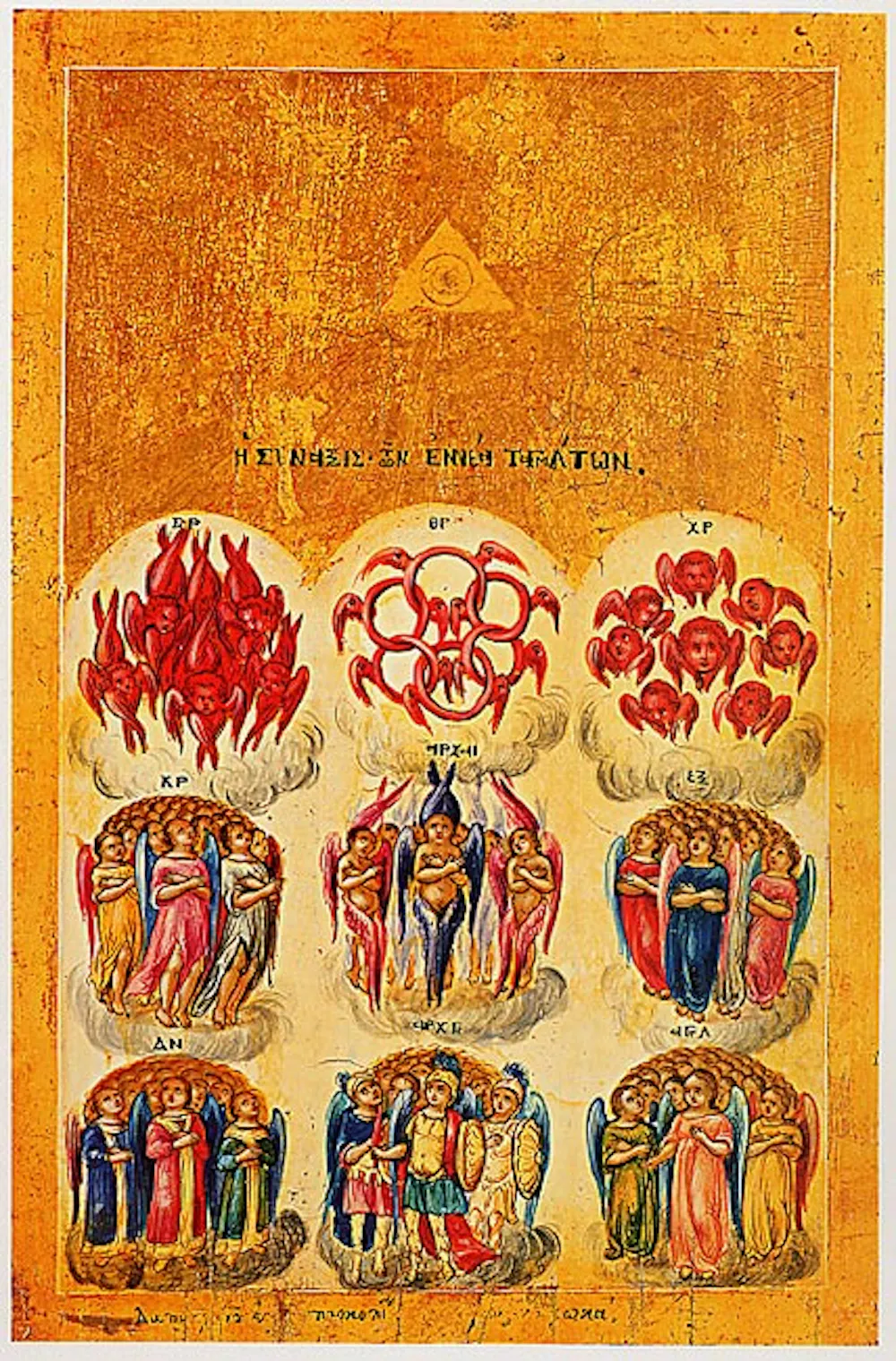
In the late 15th century, Dionysius was exposed as an obscure Greek theologian rather than a disciple of Paul, as he had claimed to be. However his idea that angels did not have bodies has remained the standard view within Christian angelology.
If angels were without bodies, how then did they appear to us? According to the medieval angelologists, angels, although incorporeal, were nonetheless able to assume virtual bodies temporarily (assumed usually to be of air) in which they appeared, were able to act in the world, and spoke to people.
In their virtual bodies, they were distinguished by their wings. The Christian theologian Tertullian (c.155-c.220 CE) was the first to attribute wings to angels and demons as the reason for their speed of movement.
In the artistic imagination, in the medieval period, possessing two wings became the decisive identifier of angels, separating them clearly from the saints, martyrs and from Christ himself.
Until the end of the 11th century, angels had generally been depicted as youthful males. But, during the 12th and 13th centuries, they became progressively less gendered, becoming amiably androgynous.
During the 19th century, Pre-Raphaelite artists depicted angels as increasingly female (with the exception of the two most powerful ones Michael and Gabriel).
 La Ghirlandata, Dante Gabriel Rossetti, 1873, with feminine angel heads at the top of the painting.
Wikimedia Commons
La Ghirlandata, Dante Gabriel Rossetti, 1873, with feminine angel heads at the top of the painting.
Wikimedia Commons
Angels also became infantilised. Children were viewed, rather like cherubs, as angels on earth, at least metaphorically, sent to us as models of purity and innocence.
The meaning of angels
Angels have long been seen as having a role as guardians to look after us and care for us. Each of us was said to have a guardian angel, appointed at the time of our birth who would look after us until our death and assist us in our journey to heaven.
Despite the Christian belief that God oversaw everything and everyone, there was much comfort to be gained (and perhaps still is) from the belief that one special angel was taking a particular interest in the well-being of each of us.
Angels could be caring and nurturing. And yet, they could be terrifying and severe when necessary (as shown earlier). Still, we might say, the more feminised they became in the 19th century, the less terrifying and the more nurturing they became.
In 20th century pop culture, freed from the constraints of traditional Christian angelology, angels were overwhelmingly seen as benevolent creatures in art, literature, film, television, and social media.
Indeed, a 2023 survey found about 70% of adults in the United States believe in angels. This is 10% less than those who believe in God, but significantly more than those who believe in Satan (56%), astrology (34%), and reincarnation (34%). A 2021 Australian survey found just over 50% of people believed in or were open to the existence of angels.
Angels offer a glimpse of a realm of the spirit beyond the material and, in so doing, provide a bulwark against a materialist understanding of the world. They continue to be signs of the human desire for transcendence, offering a promise of life in the future – an immortality like theirs, even in a godless universe.
In the West, they are a perfect fit for modern spiritualities, no longer focused on adherence to institutional religions, but to psychological wellbeing in the here and now.
Authors: Philip C. Almond, Emeritus Professor in the History of Religious Thought, The University of Queensland

















