

how worried should I be about the shortage of face masks? Or can I just use a scarf?
- Written by C Raina MacIntyre, Professor of Global Biosecurity, NHMRC Principal Research Fellow, Head, Biosecurity Program, Kirby Institute, UNSW
The World Health Organisation (WHO) has just declared the coronavirus outbreak a public health emergency of international concern.
There have been nearly 10,000 cases of the so-called 2019-nCoV in China, 23 countries affected and more than 213 deaths globally.
China, Germany, the US and several other countries confirmed the virus can spread person to person, even from people without any symptoms.
Now there are reports of face mask shortages around the world, including Australia, the US and in many cities of China.
How concerned should we be about these shortages? Or can we just wrap a scarf or piece of cloth around our face to protect against infection?
Read more: How contagious is the Wuhan coronavirus and can you spread it before symptoms start?
How important are face masks?
For a disease with no drug or vaccine yet, non-pharmaceutical measures are the mainstay of control. This includes personal protective equipment, such as face masks.
But the type of face masks we typically see (surgical masks) do not provide a seal around the face or filtration of airborne particles, like those that may carry coronavirus.
They do however provide a limited physical barrier against you transferring the virus from your hand to the face, or from large droplets and splashes of fluid.
You also need to put on and remove your mask properly, as this advice from the World Health Organisation shows.
Make sure your face mask is the right way round, says the World Health Organisation.Disposable respirators reduce the risk of respiratory infections. They are designed to fit around the face and to filter 95% of airborne particles. However, these should be reserved for health workers, who need them most.
Do we really need these masks anyway?
In the disease epicentre, Wuhan, or on an evacuation flight out of Wuhan, face masks are a sensible precaution. They are also needed in other Chinese cities that are affected by the outbreak and where transmission is ongoing.
However, in countries where transmission is not widespread and there are only a handful of cases being treated in hospital isolation rooms, masks serve no purpose in the community.
For example, there is no need for the general public to use face masks in Australia, US and other counties where a few imported cases are reported, and the risk of catching the virus is low.
Read more: The Wuhan coronavirus is now in Australia – here's what you need to know
Panic buying will result in a lack of supplies when we need them most, for instance, if the number of cases escalates dramatically. During the H1N1 influenza pandemic in 2009, the WHO did not recommend the general public use face masks.
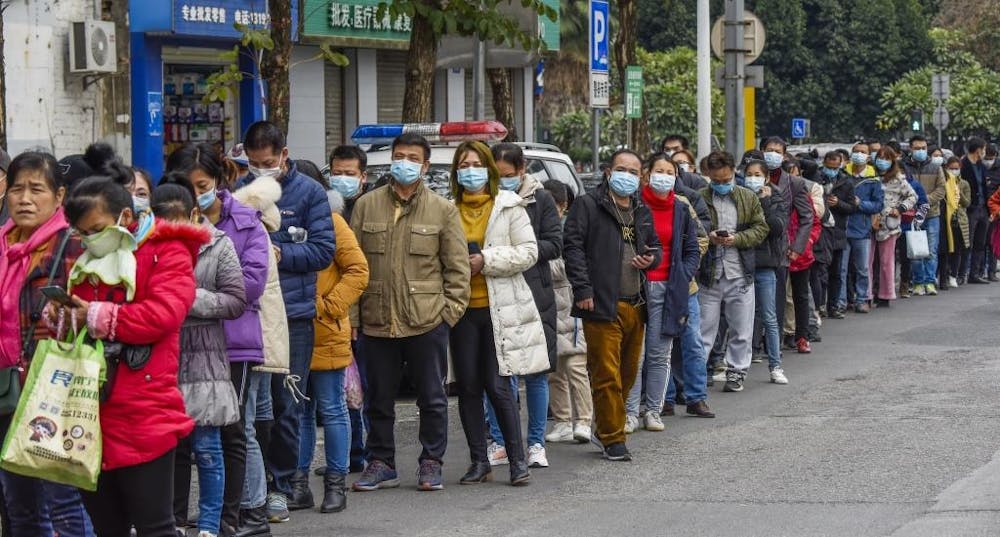 Residents of Nanning, China, lining up to buy face masks this week.
Peng Huan/EPA/AAP
Residents of Nanning, China, lining up to buy face masks this week.
Peng Huan/EPA/AAP
The case is different for health workers, who face greater risks. It is essential we provide health workers with the best protection, because if they get sick or die, we lose our ability to fight the epidemic. During the SARS epidemic, 21% of all cases globally were health workers.
Read more: SARS, MERS ...? Preparing for the next coronavirus pandemic
How concerned should we be about the shortage of face masks?
This is a concern, especially if people hoard or stockpile face masks when there is no need. We saw a shortage of masks early during the 2009 influenza pandemic. The surge in demand during such events also results in higher prices.
Countries have started releasing stockpiles of masks and other personal protective equipment to the health system. For example, the Australian government this week released one million masks for general practices and pharmacists from the national medical stockpile.
There is also an existing shortage of masks in some areas of Australia due to the bushfire response and face masks from the national stockpile have mainly been released in those areas.
What happens if the situation gets worse?
The number of cases is expected to increase and a large quantity of face masks may be needed.
If the current situation becomes a pandemic (an epidemic that goes global), we could be facing a much greater demand for personal protective equipment in the health sector alone.
In a modelled serious epidemic in Sydney of smallpox, if health workers use two disposable respirators a day for 6 months, over 30 million respirators will be needed for 100,000 clinical health workers.
Read more: What is a super spreader? An infectious disease expert explains
China is the largest producer of face masks globally and it has already stepped up production to meet the high demand.
If large outbreaks happen in other countries, China may not be able to meet the demand of face masks, respirators and other medical supplies.
Not all face masks are up to the job
Another problem is the sale of low-quality face masks due to a shortage of products on the market, as has been reported in China and Hong Kong.
Face masks are not regulated, may not filter the air, and also typically allow large amounts of air in through the sides. With a shortage of masks, low-quality masks could be exported to other countries.
Read more: I've always wondered: why many people in Asian countries wear masks, and whether they work
If I can’t get hold of a mask, can I wrap a scarf around my face?
Wrapping cloth around your face probably will not protect you. That’s because a scarf or a hanky does not provide a tight fit around the face, isn’t designed to filter out air and may be contaminated.
However, during the Ebola epidemic, a woman nursed her entire family through the illness using home-made protective equipment and did not get infected.
In Asia, cloth masks are popular because they are cheap and re-usable. But they don’t protect you. Cloth masks may even increase your risk of infection, especially if you don’t wash them regularly. They may absorb moisture and provide a breeding ground for bugs.
So, ideally, people shouldn’t be using them. However, people may resort to cloth if there is no other choice.
In a nutshell
While news of mask shortages might sound scary, if you are in a country with few isolated cases, you don’t need one anyway as the risk of infection is very low for the general public.
Panic buying or stockpiling also means there won’t be enough to go round should the situation worsen.
Even if you do use a face mask, they may protect against large droplets (ones you can feel on your skin when someone sneezes) and self-contamination from your hands, but not against smaller airborne particles.
Don’t forget, hand-washing is also very effective in preventing infection.
Authors: C Raina MacIntyre, Professor of Global Biosecurity, NHMRC Principal Research Fellow, Head, Biosecurity Program, Kirby Institute, UNSW

















