

Modern Australian
Times Advertising

Giant dragonflies once roamed Earth’s skies. New research upends the textbook theory of why they went extinct

  • Written by Roger S. Seymour, Professor Emeritus of Physiology, Adelaide University

Insects first took to the skies about 350 million years ago, some 200 million years before birds first flapped their wings.

By the end of the Carboniferous period, 300 million years ago, some flying insects had become gigantic. Huge dragonfly-like insects called griffinflies had wingspans of 70cm – five times the size of the largest modern dragonflies.

These giant insects lived in a time when Earth’s atmosphere contained more oxygen than it does today: around 30%, compared with the modern 21%.

Because large flying insects lived in a time of high oxygen levels, scientists have proposed that they required these high external oxygen levels to power the rapid burn of energy during flight.

In new research published today in Nature, we studied the muscles of dozens of modern flying insects and made a surprising discovery: there is no reason the griffinfly could not survive in today’s atmosphere.

The structure of the insect flight respiratory system

Flying takes more energy than running or swimming, because a flapping flier must constantly work against gravity to remain in the air.

Consequently, the flight muscles use a lot of oxygen, and the rate of oxygen consumption increases roughly in proportion to the weight of the flier. The highest rate of oxygen consumption per gram by any known tissue occurs in a flying bee.

Microscope images showing vivid green veins on a dark red background.
Tracheal system (green) supplying oxygen into the flight muscles (red) of a vinegar fly. Jayan Nair and Maria Leptin / European Molecular Biology Laboratory, CC BY

Oxygen is supplied to insect flight muscles through the “tracheal system”, a tree-like branching system of air-filled tubes that lead to the smallest branches, called “tracheoles”, where oxygen moves into the muscle tissue.

Each tracheole is a dead end, which means oxygen delivered to the muscle travels primarily by diffusion. First it diffuses through the air inside each tracheole, and then through the muscle tissue itself.

The old hypothesis

In modern insects, oxygen levels near the oxygen-consuming mitochondria that power the flight muscle are very close to zero. This implies that the structure of the tracheal system was just adequate to supply sufficient oxygen.

A larger insect would need a greater supply of oxygen, which would mean a greater driving force for diffusion, which in turn means more oxygen in Earth’s atmosphere.
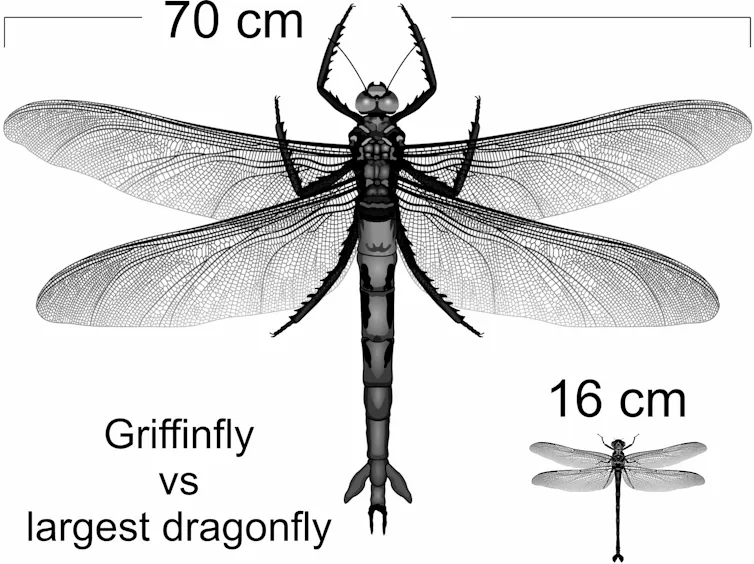
Illustration of a griffinfly with 70cm wingspan and a modern dragonfly with 16cm wingspan.
The extinct griffinfly (left) next to one of the largest living dragonflies, the giant petaltail (right). Estelle Mayhew / Aldrich Hezekiah

The idea that the structure and function of the insect tracheal system limits body size has prevailed for the past 30 years and appears in educational textbooks.

Our interest in the theory arose 15 years ago, when we looked at thin slices of the flight muscle of locusts. The tracheoles appearing between and within the muscle fibres were few and took up only about 1% of the area, compared with the mitochondria that were occupying about 20%.

New evidence

We initially thought all an insect had to do to increase its oxygen delivery would be to increase the number of tracheoles. After all, this is where oxygen is supplied to the mitochondria.

To be sure the locust was not exceptional and to properly understand the effect of body size, we measured 44 species of flying insects of different body masses and metabolic rates. The project required five years and 1,320 transmission electron micrographs.

But the results were essentially the same: the tracheoles occupied only about 1% of the cross-sectional area of the flight muscles regardless of body size. In contrast, the blood-filled capillaries in the flight and cardiac tissue of some birds and mammals occupy about 10% of the area.

Microscope images
Under the electron microscope, thin slices of insect muscle (left) and mammal muscle (right) show the tracheoles and capillaries in white. Antoinette Lensink and Edward Snelling

This shows there is plenty of scope to increase the number and volume of tracheoles without weakening the muscle. So the structure of the tracheal system is not an important constraint on body size.

Evidence from developing insects shows insects can grow more tracheoles in flight muscle in lower oxygen levels, and they pass this trait to their offspring. The conclusion is that the body size of flying insects has never been limited by the structure or function of their tracheal systems.

There is no physiological reason why insects the size of griffinflies could not fly in today’s atmosphere. And yet they don’t exist today.

The simpler reasons may be that larger animal species are more prone to extinction than smaller ones – and 300 million years ago, the griffinfly had no bird or mammal predators to watch out for.

Authors: Roger S. Seymour, Professor Emeritus of Physiology, Adelaide University

Read more https://theconversation.com/giant-dragonflies-once-roamed-earths-skies-new-research-upends-the-textbook-theory-of-why-they-went-extinct-278997

Winter Sanitation Gaps in Parramatta Kitchens: A Hidden Pest Risk

Winter brings a host of changes to our homes, from the chill in the air to the cozy warmth indoors. However, this season also introduces sanitation ch...

When to Seek Advice from Employment Lawyers in Melbourne

Australian employment law is detailed and, at times, complex, with rights and obligations that aren't always obvious to employees or employers witho...

7 Benefits of Professional Gutter Cleaning for Australian Homeowners

Gutters aren't exactly glamorous. They sit up there on the edge of your roof, doing their job quietly - until they stop working. Clogged, overflowing ...

Pipe Floats Strengthening Pipeline Performance In Demanding Environments

Pipelines often travel through environments that are anything but predictable, water currents shift, terrain changes, and materials keep moving unde...

Why Ceiling Fans Are Essential For Comfort, Efficiency, And Modern Living

Creating a comfortable indoor environment is not just about temperature; it is about how air moves, how a room feels, and how efficiently energy is ...

Why Duct Cleaning In Melbourne Is A Smart Investment For Healthier Living Spaces

Behind your walls, ceilings, and vents lies a network quietly working every day to keep your home comfortable. Yet over time, this system can become...

Disability Service Providers Supporting Inclusive And Independent Living

Finding the right support system can feel like assembling a puzzle where every piece must fit just right. For individuals and families navigating di...

A Beginner's Guide to Owning a Caravan in Australia

Owning a caravan opens up a style of travel that's hard to match for freedom and flexibility. However, for those just starting out, the process of c...

Preparing Your Air Conditioner for Summer: What Most Homeowners Overlook

As temperatures rise, many homeowners switch on their air conditioning for the first time in months — only to find it’s not performing the way i...

What Actually Adds Value to Properties in Newcastle

Newcastle has seen steady growth over the past few years, with more buyers looking beyond Sydney for lifestyle, space, and long-term value. As dema...

What is Design and Build in Construction?

Imagine you’re about to start a new construction project, maybe it’s a custom home or a commercial building. You’ve got the idea, the land, an...

Commercial roof leak detection: why early action protects your building

Water ingress is one of the most disruptive and costly issues facing commercial properties. For property managers and facilities teams, even a minor...

Custom Photo Frames: Turning Everyday Moments into Lasting Displays

Photos capture moments, but how you display them determines how they’re experienced every day. A meaningful photograph deserves more than a generi...

Managed IT Services: A Smarter, More Predictable Way to Run Your Business Technology

If you’ve ever had your systems go down in the middle of a busy day, you’ll know how quickly things can unravel. Phones stop ringing, emails sto...

Landscaping Geelong — Coastal Elegance Meets Practical Design

A Landscape Shaped by Location Geelong occupies a unique position within Victoria’s broader landscape. It carries the energy of a growing city, y...

Electric Adjustable Beds: A Simpler Way To Sleep Better

Sleep should feel natural. It should come easily, without discomfort, without constant repositioning, and without waking up feeling sore. But for ma...

Healthy Snacking Sorted: Premium Beef Jerky

In today's fast-paced world, finding a snack that's both satisfying and genuinely good for you can feel like a mission. Many readily available optio...

What to Know Before Getting Dental Implants: A Guide for First-Time Patients

Dental implants Perth patients often look for a long-term solution for missing teeth without the hassle of dentures or bridges. If you are thinking ...

















