

Social distancing may be worth it, but we need to talk about economic costs
- Written by Ross Guest, Professor of Economics and National Senior Teaching Fellow, Griffith University
Social distancing has been embraced as a key government strategy to manage the COVID-19 crisis.
The policy involves limiting contact between people to reduce viral transmission. It extends from advice to avoid shaking hands and maintain at least 1.5 metres’ distance from others to bans on “non-essential” gatherings of more than 500 people outdoors and 100 people indoors.
These measures will have significant economic impact. But how big will that impact be. Is it worth it compared to the health benefits?
Right now we don’t know the answer. Political and business leaders are deferring exclusively to public health advice about how to contain the COVID-19 virus. We have had no serious public discussion of the economic costs.
Read more: Social distancing: What it is and why it's the best tool we have to fight the coronavirus
Framing the response to the coronavirus emergency as a cost-benefit analysis may seem hard-hearted. Yet prioritising medical resources is routine in hospitals. The Australia New Zealand Intensive Care Society’s COVID-19 Guidelines specify “the likelihood of response to treatment” as a principle in accessing intensive care treatment.
We do put a value on lives lost or, conversely, lives saved. Under Australian government best practice guidelines the value of a life is A$4.2 million, with one year of life worth A$182,000 (in 2014 dollars).
The costs of social distancing may well be worth the benefits, but we have not yet had this discussion. We need to have a frank public conversation about the full economic costs versus benefits of major social-distancing policies.
Flattening the curve
The aim of social distancing is to “flatten the curve”. This means slowing the rate at which the virus is spread, so we get fewer critical cases in the short term.
Slowing the spread allows our medical services to cope with the caseload at any given time. It maximises the prospect of patients getting the care they need when they need it, therefore reducing deaths.
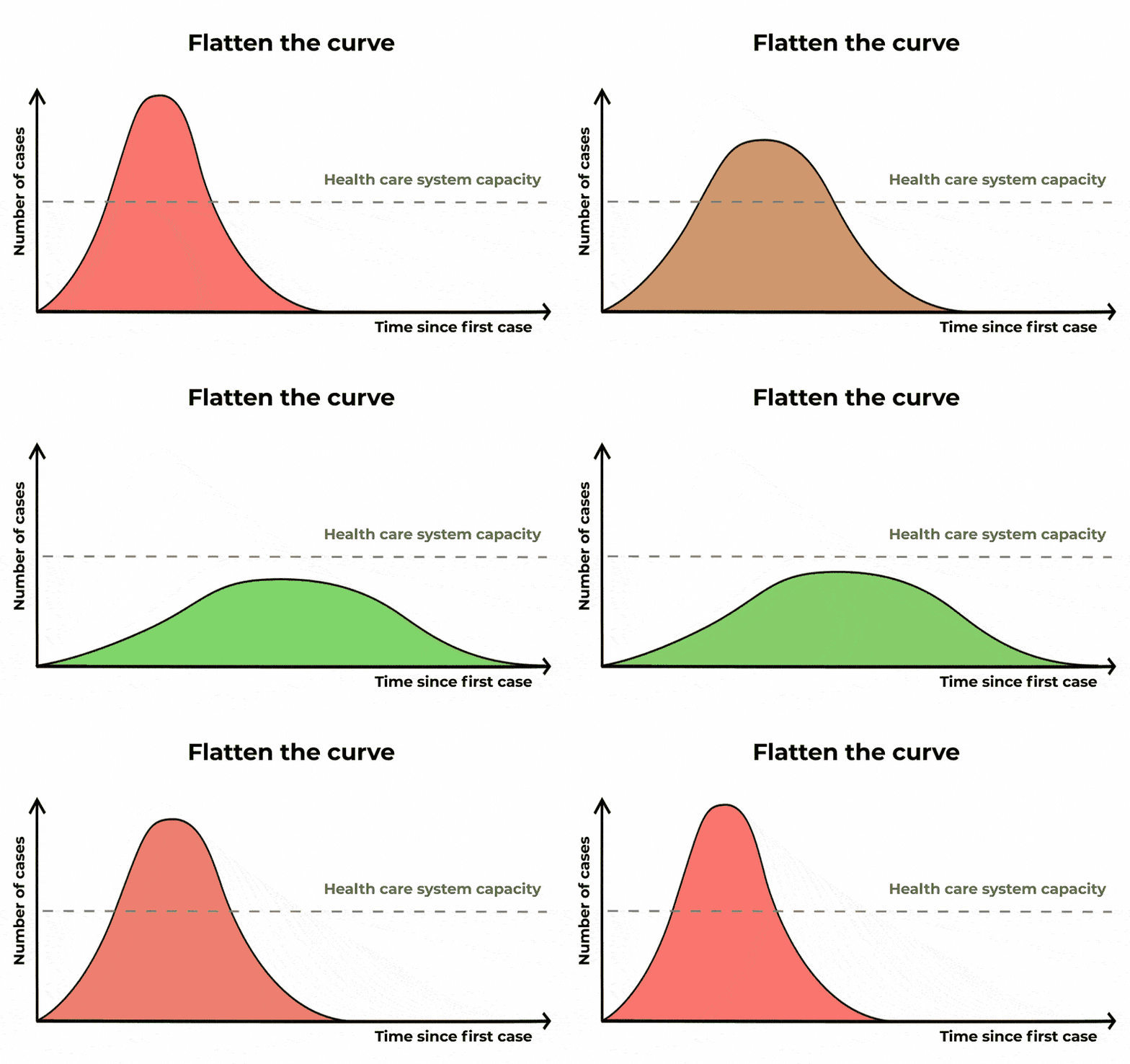 Flattening the curve is another way of saying slowing the spread. The Conversation/CC BY ND
But the question is whether the benefits of social distancing are worth the costs. Is it better to slug businesses, workers and households over a long time under draconian social-distancing policies? Or would it be better to go for a shorter and less severe economic hit, but with more stress on the health system during that time?
Read more: How to flatten the curve of coronavirus, a mathematician explains
Limited evidence
The cost-benefit evidence on social distancing is scarce. We have little hard data because there have been few actual epidemics/pandemics where social distancing has been widely adopted as public policy.
But modelling by health economists indicates some things.
One is that targeted social distancing – applied, for example, to old people – is more effective than a blunt policy applied to everyone. The reason is a blunt policy applies to recovered individuals as well as susceptible individuals. We don’t want recovered individuals to isolate or distance themselves – in fact we want them in public spaces acting as buffers between the infectious and uninfected.
Yet so far health experts have recommended blunt social distancing through cancelling large gatherings such as sport and cultural events, working from home and avoiding public places, and some school and work closures.
Read more: Australian schools are closing because of coronavirus, but should they be?
School closures are extremely costly. A 2010 study in Britain estimated a 13-week closure would reduce GDP initially by 8.1%.
On the other hand, modelling also shows the effectiveness of social distancing depends on the infectiousness of the disease and it being done very early on in the epidemic. Do it well, the authors advise, “or not at all”.
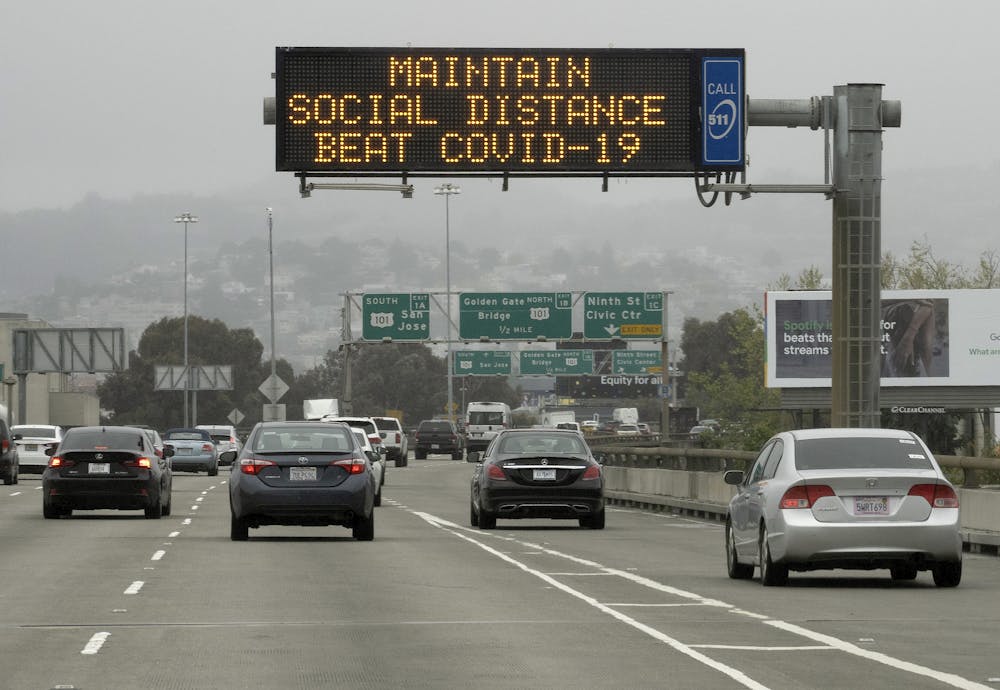 Social messaging about social distancing in San Francisco, March 18 2020.
John G. Mabanglo/EPA
Social messaging about social distancing in San Francisco, March 18 2020.
John G. Mabanglo/EPA
This makes decisions to close schools, as Britain has done, or keep them open, as Australia is doing, highly contestable, either as too blunt a response or as not doing social distancing well. More information to weigh costs and benefits might help.
Irreversible consequences
Warwick McKibbin, director of the Centre for Applied Macroeconomic Analysis in the ANU Crawford School of Public Policy, estimated a few weeks ago the coronavirus crisis will knock 2% off global GDP.
This estimate included the effects of sick workers and some effects on investment and supply networks. It did not include the effects of major social-distancing policies (such as widespread closures of schools and businesses and self-isolation), which would effectively destroy businesses and cause massive job losses.
Once we add these costs it is conceivable the total costs would be closer to those of the Great Depression, when GDP fell by 10% in 1931 and unemployment was more than 15%.
Lower-cost containment measures may more prudent right now than simply escalating social distancing in a knee-jerk way.
Economics tells us there can be a non-trivial “option value” in delaying decisions in the face of uncertainty where the decisions have irreversible consequences. It can be better to wait for new information. If we kill off businesses and jobs now, and the virus turns out to be not so bad, those lost jobs and businesses cannot be easily re-established just by scaling back on social distancing.
Government stimulus spending will be no silver bullet here, no matter how big. Even though it’s the appropriate time for governments to borrow and spend, future generations will have to pay the debt through higher taxes or lower government spending on things like health and education. There is no “free lunch” in economic stimulus.
Government spending does not bring back international tourists or international students. It cannot save every job and business, nor compensate for the costs of restarting a failed restaurant or shop.
The benefits of social distancing may or may not be worth it. But we don’t know, and as a society aren’t even asking the question.
Authors: Ross Guest, Professor of Economics and National Senior Teaching Fellow, Griffith University

















