

New plastic film covered in thousands of tiny pillars can tear apart viruses on contact
- Written by: Elena Ivanova, Distinguished Professor, Physics, RMIT University
Think of how many surfaces you touch every day, from your kitchen bench to the hand rail on the bus or train, your work desk and your phone screen.
A range of nasty viruses and other germs can easily spread via these surfaces. The typical route of infection involves touching a contaminated surface – and then touching your eyes, nose or mouth.
Of course, it’s possible to clean surfaces with chemical products. But these can wear off, harm the environment or contribute to antimicrobial resistance, where germs no longer respond to medicines because of repeated exposure.
In our new study, published in Advanced Science, colleagues and I created a thin plastic surface with tiny nanoscale features, billionths of a metre in size, that mimic the nanotextured surface of insect wings and can physically rupture viruses – specifically human parainfluenza virus type 3 (hPIV-3).
This new material offers a cheap, scalable way to make surfaces such as phones and hospital equipment far less likely to spread disease.
The downsides of disinfectants
Current methods for combating the spread of viruses via surfaces usually involves cleaning to remove dirt and disinfection to remove hidden contaminants.
Disinfectant must remain wet for some time to kill germs. This can be challenging in some real-world settings.
Surfaces can also be recontaminated quickly when other people touch them. And disinfection often involves the use of harsh chemicals which can damage equipment and the environment.
Scientists have previously developed antiviral surface modifications. These strategies often involve incorporating materials such as graphene or tannic acid and other natural agents into personal protective equipment such as masks, gloves, goggles, hard hats, and respirators.
These coatings are efficient. But they can pose a risk to human health. They can also be environmental hazards due to chemical leaching and have declining effectiveness over time as the potency of the active ingredients weakens.
A decade-long journey
Our journey toward a virus-bursting surface started more than a decade ago.
We initially aimed to engineer a surface so smooth that germs would simply slide off. Surprisingly, we discovered the opposite. Bacteria adhere quite readily to nanoscopically smooth surfaces.
Nature offers examples of bacteria-free surfaces. Take the water-repelling wings of cicadas and dragonflies. While these wings are self-cleaning, they act less by repelling bacteria and more as natural bactericides. That is, they kill bacteria. Natural bactericides are nature-derived “agents” that can kill germs, rather than inhibit their growth.
Experiments my colleagues and I did with gold-coated wings confirmed this bacteria-killing effect is not driven by surface chemistry, but rather by topography.
The physical nanostructures on the surface essentially force bacterial cell membranes to stretch and rupture.
Our earlier work showed that nanospike-covered silicon effectively destroys viruses on contact. But its rigid nature restricts its use on complex objects.
A lightweight, flexible and virus-bursting material
In this new study, we addressed this problem by creating a virus-bursting material that was lightweight, cost-effective and flexible.
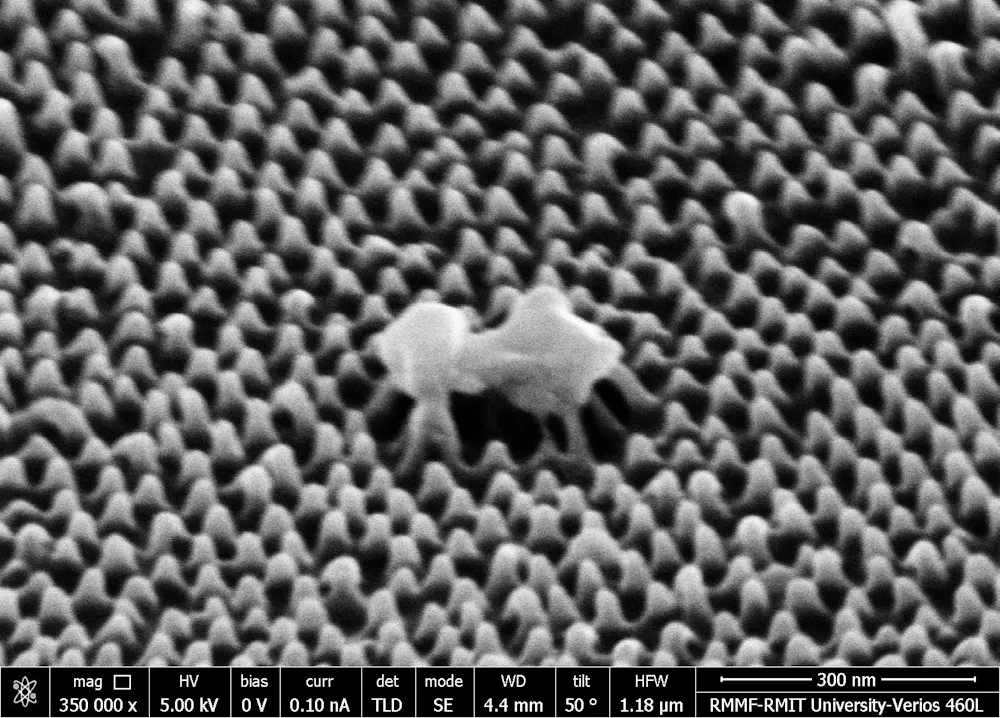
This material is a thin acrylic film covered in thousands and thousands of ultra fine pillars. The nanotextured materials are smooth to touch. However, these nanopillars grab and stretch a virus’s outer shell until it ruptures. This kills viruses through mechanical force.
Lab tests with hPIV 3, which causes bronchiolitis and pneumonia, found up to 94% of virus particles were ripped apart or fatally damaged within an hour of contact with this material.
We discovered the distance between nanopillars matters far more than their height, with tightly packed pillars about 60 nanometres apart working best.
The mould we used to create this material can be easily scaled to provide wide-ranging industrial opportunities, from food packaging to public transport systems to hospital equipment and office desks.
Nanostructured surfaces are built for durability. But they are susceptible to the same physical, chemical, and environmental stressors as any other material, and will degrade over time.
Much remains to be discovered in the search for germ-free surfaces. But these nanotextured surfaces have enormous potential in the fight against viruses and provide an alternative to traditional, chemical-based methods.
Authors: Elena Ivanova, Distinguished Professor, Physics, RMIT University


















