

Kids with autism less likely to be fully vaccinated
- Written by: Alexandra Hansen, Section Editor: Health + Medicine, The Conversation
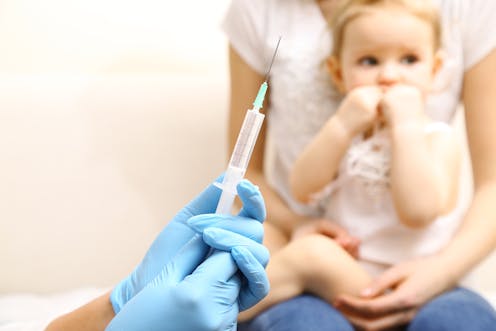
Children with autism and their younger siblings are less likely to be fully vaccinated than neurotypical children and their siblings, new research from the US has found.
Of children aged seven years and older, 94% of neurotypical children had received all the recommended vaccinations for children aged 4-6 years. For those with autism, the rate was 82%.
It has been two decades since Andrew Wakefield’s now retracted and widely discredited study in The Lancet falsely linked the measles, mumps and rubella (MMR) vaccine to autism.
This new study, published today in the journal JAMA Pediatrics, suggests many parents still have concerns around vaccines and autism.
The study included 3,729 children with autism and 592,907 neurotypical children who were born between 1995 and 2010, and their younger siblings born between 1997 and 2014.
Children with autism were observed after diagnosis; matched with neurotypical children based on age, sex and location. Researchers reviewed what proportion of each group had received the vaccines recommended by the Centers for Disease Control and Prevention at 4-6 years and 11-12 years.
“We found that after children received an autism diagnosis, the rates of vaccination were significantly lower when compared with children of the same age who did not have an autism diagnosis,” said lead author Ousseny Zerbo, a researcher at Kaiser Permanente.
Younger siblings
The vaccine adherence of the younger siblings was studied at 1-11 months, 1-2 years, 4-6 years, and 11-12 years.
The highest rates of under-vaccination in this study were among siblings of children with autism in the 1-11 months and 1-2 years age groups.
In the youngest age group, 73% of younger siblings of children with autism were fully vaccinated, compared with 85% of younger siblings of neurotypical children. In 1-2-year-olds, this was 60% compared with 71%.
At 4-6 years, 83% of younger siblings of children with autism were fully vaccinated, compared with 95% of younger siblings of neurotypical children.
This suggests some parents consider the potential risks of autism associated with vaccination to be highest at these younger ages at which more vaccines are recommended. However, as their children grow older, these parents may be more willing to vaccinate.
Autism and vaccine hesitancy
Despite the fluctuation between age groups, the disparities in vaccination rates between children with autism and neurotypical children, and their younger siblings, are reasonably consistent (with the exception of the 11-12-year-old age group).
While this research was quantitative in nature and therefore not able to give insight into why these disparities exist, the authors said parental vaccine refusal would likely play a role.
Sydney University’s Dr Nicholas Wood, who was not involved in the study, said this could be the case on two fronts. For children with autism, parents might resist administering further vaccinations for fear of worsening the condition; a notion which is not grounded in evidence.
For the younger siblings, parents might feel the early childhood vaccinations caused autism in their older child, and are therefore unwilling to have their subsequent children vaccinated.
“Traditionally there has been a thinking that ASD (autism spectrum disorder) is linked with the MMR vaccine,” Wood said.
Looking specifically at the MMR vaccine, 96% of neurotypical children were vaccinated at 4-6 years, compared with 84% of those with autism.
Of the younger siblings of neurotypical children, 94% received their MMR vaccination for 1-2 years, while for siblings of children with autism in the same age group, the rate was 77%. These figures suggest Wakefield’s 1998 study continues to generate fear.
“Parents of ASD kids may be worried; they may still feel that the MMR vaccine led to autism. And that a second dose may cause a regression,” Wood said.
While the MMR vaccine had the lowest uptake of all the vaccines studied among children with an ASD and their younger siblings, Wood noted parents’ concerns surrounding MMR appeared to have translated across to other vaccines, too.
The Murdoch Children’s Research Institute’s Dr Margie Danchin, who wasn’t involved with the study, said this research provides important information on parents’ behaviour. Clinically, she sees concerns expressed by parents about vaccines and autism every week - and this study is evidence these concerns translate into behaviour on a population level, albeit in the US.
“What it really highlights is that we as health care providers have a lot of work to do to reassure parents that there is no association. The evidence is clear that there is no causal link,” Danchin said.
In 2017, Danchin and her colleagues published research in an Australian setting which found 16% of mothers who were pregnant for the first time were concerned vaccines can cause autism.
“This study needs to be followed up with qualitative research. By speaking to these parents, we can drill down on what their specific concerns are so that we can develop better strategies to reassure them and increase vaccine uptake,” she said.
Authors: Alexandra Hansen, Section Editor: Health + Medicine, The Conversation
Read more http://theconversation.com/kids-with-autism-less-likely-to-be-fully-vaccinated-93848


















