

Antarctica’s ice shelves are vulnerable to melting from below – knowing how far ocean heat reaches is crucial
- Written by: Craig Stevens, Professor in Ocean Physics, University of Auckland, Waipapa Taumata Rau; Earth Sciences New Zealand
A rare dataset collected by instruments at the point where Antarctica’s largest ice shelf begins to float reveals ocean processes that drive melting at this critical part of the continent.
During a 2019 expedition to the Kamb Ice Stream, a river of ice which feeds the Ross Ice Shelf, we were able to deploy a string of hydrographic instruments into a thin wedge of ocean beneath the shelf where it begins to lift off at a latitude of nearly 83 degrees South.

The instruments collected data on changing currents, temperature and salinity for nine months before they started to succumb to the extreme conditions.
Our initial analysis suggests the ocean cavity under the ice remains stratified into two layers. The lower layer consists of ocean water, but the upper layer is a mix of ocean and melt water.
Our new research shows the ocean deep beneath the Ross Ice Shelf is cool but much more variable than originally thought – responding to tidal flows as well as the shape of the seabed and the underside of the ice.
New data show warmer water appearing at the periphery of the ice shelf and in some isolated parts of the cavity. How this warm water could make its way into these southernmost limits of the ice shelf cavity is an important question for how Antarctica might respond to a changing climate.
Antarctica’s many kinds of ice
The massive ice sheets that blanket most of Antarctica lock water away from the ocean. This water is gradually returned to the ocean through the persistent flow of ice streams and glaciers.
As the ice slides northwards, it begins to float and in doing so evolves into ice shelves. This liftoff happens at what we call the grounding zone, which essentially marks Antarctica’s true coastline, often hidden under hundreds of metres of ice.
Despite being buried under so much ice, we know where grounding zones are from surface measurements and satellite data. But we know far less about what the ocean is doing right in this thin wedge.
Because they are floating, ice shelves expose the whole ice sheet system to the changing ocean. Their undersides are vulnerable to changes in melting driven from below.
The oceanic setting around and beneath Antarctica’s ice is perhaps the least typical of anywhere on the planet. The low temperature, the melting and freezing, the isolation from the wind and sun and the strong effect of Earth’s rotation collectively make for remarkable oceanography.
A hidden shoreline
Much like coastlines anywhere on the planet, there’s no such thing as a typical grounding zone. There are regions with under-ice rivers, places with stronger or weaker tides and seafloor regions with deep grooves excavated by past glacier scouring.
Our new study argues for a more oceanic view of the grounding zone.
The region can be many hundreds of kilometres from the open ocean, bound by the seafloor and the ice shelf itself. But while it is isolated from Southern Ocean storms, it is not immune to the push and pull of the tides.
The grounding zone is vertically very thin, even in coastal terms. For example, where we drilled, the water column between the ice and seafloor is only 30 metres deep.

Tidal effects
The new data reveal that tidal effects are a big influence on how heat is transported in this hidden ocean. While this wasn’t a surprise as such, we did not expect the multiple effects tides appear to have on the system.
The data show the spring-neap and daily tidal cycles vary the energy available for melting of the underside of the ice shelf. This in turn affects the upper mixed layer of the ocean cavity.
We also weren’t expecting tides to be driving internal waves – essentially “underwater” waves occurring at the interface between the upper meltwater layer and the deeper ocean layer. Our results suggest these waves break and help mix warmer water up closer to the ice and thus enhance ice melting.
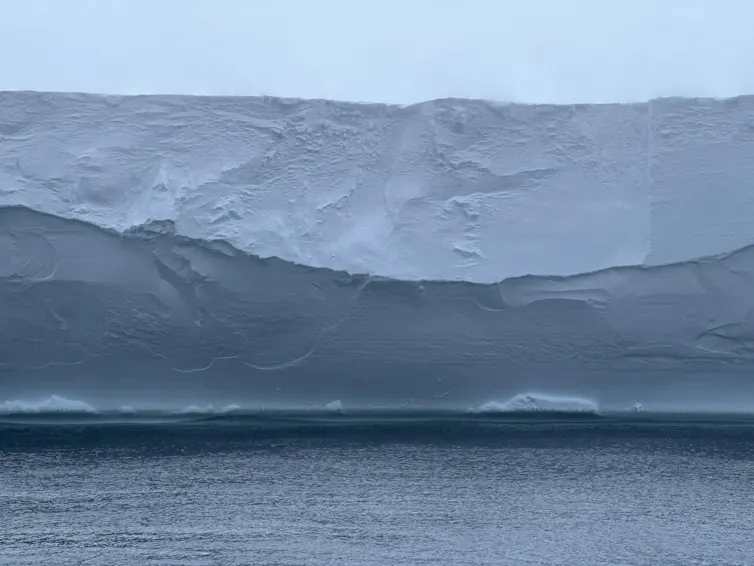
We think the water closer to the seabed is coming directly from the open ocean. Despite this, it showed relatively fast changes in temperature and salinity over a week or so.
Why this should be the case, when the water has been on a journey of somewhere between 500 and 1000 kilometres from the open ocean, remains an open question.
If the warming ocean acts to pump more thermal energy into the cavity, understanding the pathway this heat takes will have big ramifications for how melting of the ice underside will evolve.
Climate and Antarctica’s ocean cavities
There has been a view that these far-south giant and cold ocean cavities are immune to warming further north. A consequence has been a focus on warmer, faster changing ice shelves and glaciers.
However, as we learn more about these hidden oceans from a combination of on-ice expeditions, ocean voyages, robots, satellite and model results, we are discovering that small changes to large systems can have far-reaching effects.
A side view of circulation patterns for a “cold cavity” with the grounding line far to the left. If some of the “red” warmer water enters the cavity, the system will change.Changes to the ocean north of the ice shelf, around the edge on the continental shelf, might see more warm water arriving at the grounding zone, heating up the ice shelf’s vulnerable underbelly.
The climate emergency is amplifying the need for greater understanding of Earth systems. Our glimpse into the southernmost part of the ocean shows how heat could rapidly find its way under the ice.
Authors: Craig Stevens, Professor in Ocean Physics, University of Auckland, Waipapa Taumata Rau; Earth Sciences New Zealand


















