

Honeybees may be helping spread tree-killing myrtle rust – new research
- Written by: Sacchi Shin-Clayton, PhD Candidate, Department of Zoology, University of Cambridge
We know introduced honeybees as the ever-busy helpers of our gardens, farms and orchards.
In pollinating crops and fertilising fruit, they support more than a third of the food we eat and are worth billions of dollars to New Zealand’s economy.
But they could also be unwittingly helping one of the worst natural threats facing Aotearoa’s native forests: myrtle rust.
By collecting spores as food, then carrying them from plant to plant, honeybees may be under-appreciated vectors of this recently-arrived fungal disease.
Our recently published research adds further weight to this idea, challenging the assumption that myrtle rust spreads mainly by wind alone.
How myrtle rust hitches a ride
Indigenous to Central and South America, myrtle rust was first detected in New Zealand in 2017. Since then, it has spread across much of the North Island and into parts of the South Island and the Chatham Islands.
It attacks plants in the myrtle family, including treasured native species such as pōhutukawa, rātā and mānuka, as well as exotic species such as guava, feijoa, bottlebrush, lilly pilly and eucalyptus. It poses a particularly serious threat to vulnerable native plants such as ramarama and swamp maire.
As the disease has emerged in more places, researchers have been paying closer attention to the possible role of honeybees in helping move it between plants and across landscapes.
These famously efficient foragers constantly buzz between flowers, collecting nectar and pollen before returning to the hive with their furry bodies coated in yellow dust.
Myrtle rust spores closely resemble pollen grains: they are yellow, spherical and often found on flowers and infected leaves. That makes them easy for honeybees to take for a traditional food source.
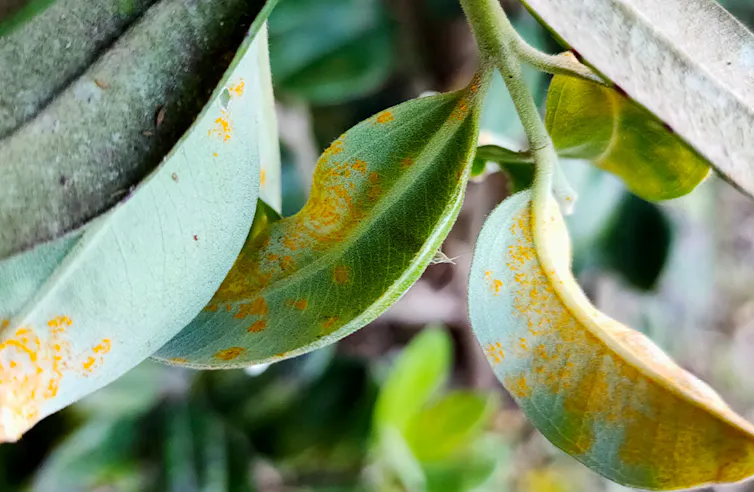
To test whether this has been happening, we compared myrtle rust spores with familiar pollen sources such as kiwifruit and willow.
We found the spores themselves contained all the essential amino acids young bees need to grow, along with enough protein to support healthy colony development.
We also fed bee larvae royal jelly – a honey bee secretion used in the nutrition of larvae and adult queens – mixed with myrtle rust spores. The larvae developed just as well as those fed high-quality pollen from familiar sources such as kiwifruit and willow.
This suggests bees may not be collecting the spores by accident, but deliberately using them as a nutritious food source, which could increase the likelihood of repeated transport of spores.
We also tested whether the spores stayed alive after entering the hive. Honeybee colonies were placed near active myrtle rust outbreaks, and we sampled both returning bees and pollen stored inside the hive.
Spores were found on nearly half of returning bees and in almost half of the pollen cells. Further experiments showed those spores could remain viable inside colonies for at least nine days.
That means hives themselves may act as reservoirs for the disease, with managed hives potentially carrying infectious spores long distances when they are moved between sites.
Rethinking the risk
Our analysis suggests the very same behaviour that makes honeybees such invaluable pollinators may also make them highly effective carriers of myrtle rust.
The relationship may also represent what scientists call “invasional mutualism” – where two introduced species help each other succeed. In this case, the honeybee gains a new food source, while the fungus gains a powerful long-distance transport system.
That raises important biosecurity questions, not only for beekeepers but for the wider protection of native ecosystems.
Honeybees live in highly organised colonies and communicate with each other about good food sources. Once they find one, they recruit other workers and return to it repeatedly.
If myrtle rust spores are being treated like pollen, that means infected plants could become repeated targets, increasing the chances of spores being picked up and spread to new host plants.
There is also the issue of hive movement. Beekeepers often shift hives long distances to follow flowering crops and mānuka blooms, creating the possibility that spores could be transported far beyond the original outbreak.
If hives are moved from heavily infected areas into native forest or conservation land, they may unintentionally help trigger new outbreaks.
A stand-down period could potentially help reduce that risk, giving any spores carried back to the hive time to die off before bees are introduced near vulnerable native forest. Otherwise, infected hives could help drive more serious outbreaks in those ecosystems.
In Australia, myrtle rust has become a biological disaster, threatening at least 15 native species with extinction, while costing the nursery and lemon myrtle industries millions of dollars in annual management and lost production.
In Aotearoa, where taonga species are also under threat, the stakes are just as high.
Understanding how the disease moves – not just by wind, but potentially by bees as well – is essential if we want to slow its spread before irreversible damage is done to our native forests.
The authors acknowledge the contribution of Dr David Pattemore.
Authors: Sacchi Shin-Clayton, PhD Candidate, Department of Zoology, University of Cambridge

















