

Why has this autumn been so hot and dry?
- Written by: Kimberley Reid, Postdoctoral Research Fellow in Atmospheric Sciences, The University of Melbourne
We’re less than a month away from the southern hemisphere winter. But you’d be forgiven for thinking summer was only last week.
April was unseasonably warm and dry across Australia. Temperatures were above average or very much above average for most of the country.
New South Wales had its second-driest April on record, while Bairnsdale in Victoria’s typically wet Gippsland region only recorded 5.4mm in rainfall in April, the lowest since since 1943.
So why has the weather been so unseasonally warm? And what will winter look like?

Under pressure
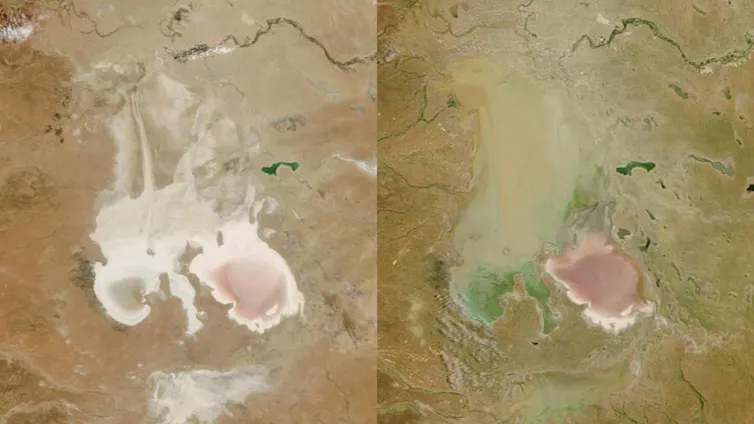
The dry April came as a stark contrast to a very wet February and March. In late February, a low pressure system from the tropics stalled over central Australia, causing widespread heavy rainfall. Kati Thanda-Lake Eyre began to fill for the second time in two years and the desert turned green.
But during April, persistent high pressure systems sat over large areas of eastern Australia. Air descends within high pressure systems, stopping clouds forming. When high pressure systems are above us, we tend to experience warm sunny days and no rain.
At night, the lack of clouds means more of the day’s heat absorbed by land and water radiates back out to space. This leads to colder mornings, which is why we saw lower minimum temperatures over eastern Australia in April and a few foggy mornings.
These persistent high pressure systems over eastern Australia acted like boulders in a stream, diverting the flowing atmosphere around them.
When cold fronts came across from the west, they hit the “boulder” and veered south near the Great Australian Bight, missing the eastern states.
Climate heating
Of course, high pressure systems aren’t the only reason autumn has been so warm.
Every one of the past 13 autumns in Australia have had hotter daily maximum temperatures than the 1961–90 baseline average.

Climate change has already made air temperatures in Australia 1.51°C hotter than in 1910, when records began. The extra heat is inextricably linked with increased emissions of greenhouse gases caused by the burning of oil, gas and coal.
As global warming intensifies, it’s expected to strengthen the subtropical ridge – a semi-permanent band of high pressure that circles the planet, deflecting cold fronts away from Australia in summer and autumn. The ridge runs across Australia at about 30°S latitude, above Perth and Sydney. Scientists believe a stronger ridge will lead to reduced autumn and winter rainfall over southern Australia, though the exact impact is still being investigated.
What about El Niño?
Many media reports have suggested a giant El Niño climate event is likely this year. But these reports are premature. We aren’t actually in an El Niño yet, so we can’t say the autumn heat is linked.
During an El Niño, sea surface temperatures in the central Pacific are warmer than usual, while the east-to-west Pacific trade winds weaken or even reverse.
On average, El Niño conditions make eastern Australia hotter and drier during winter and spring, as fewer rain-bearing weather systems arrive. Some of Australia’s biggest droughts have hit during El Niño years.
Officially, the Pacific is in a neutral condition (neither El Niño nor the opposite, La Niña). But warmer ocean water is brewing beneath the surface and forecasts suggest an El Niño is likely to develop by late winter. The strength and duration of the likely El Niño are still uncertain.
What should we expect for winter?
During winter, the subtropical ridge migrates north, triggering the dry season in the tropics. With the ridge absent, more cold fronts can reach southern Australia, which is why most rain tends to fall during these months in the southern half of the continent. But if an El Niño forms, there may not be as much of the anticipated rain. So what type of winter will Australians have in the south?
The Bureau of Meteorology’s long-range forecast accounts for all major drivers of Australia’s weather, from the winds pushing cold fronts to southern regions, to El Niño, to the Indian Ocean Dipole, El Niño’s cousin over west.
What this shows is that Australia is likely to be warmer than average this winter. May rainfall is tipped to be below average almost everywhere in Australia, other than normal rainfall in southern Victoria, southwest Tasmania and central Western Australia. Queensland’s northern tip may see above-normal rainfall.
Between June and August, the bureau predicts drier than normal weather in the southwest and southeast. There’s a higher chance of wetter than normal conditions in northern Queensland, the Northern Territory’s northeast and central WA.
Long-term rainfall forecasts become less reliable once we look further than a month ahead. For farmers, fire managers and anyone else dependent on rain, it’s worth checking for rainfall forecast updates more regularly.
Authors: Kimberley Reid, Postdoctoral Research Fellow in Atmospheric Sciences, The University of Melbourne
Read more https://theconversation.com/why-has-this-autumn-been-so-hot-and-dry-282049


















