

Modern Australian
The Times

How looking through static can help people with a common degenerative disease see better

  • Written by Pratik Raul, Postdoctoral Research Fellow, Psychology and Cognitive Neuroscience, University of Canberra

Age-related macular degeneration (AMD) is the leading cause of irreversible blindness among ageing people globally. Around one in seven Australians over the age of 50 have some signs of AMD.

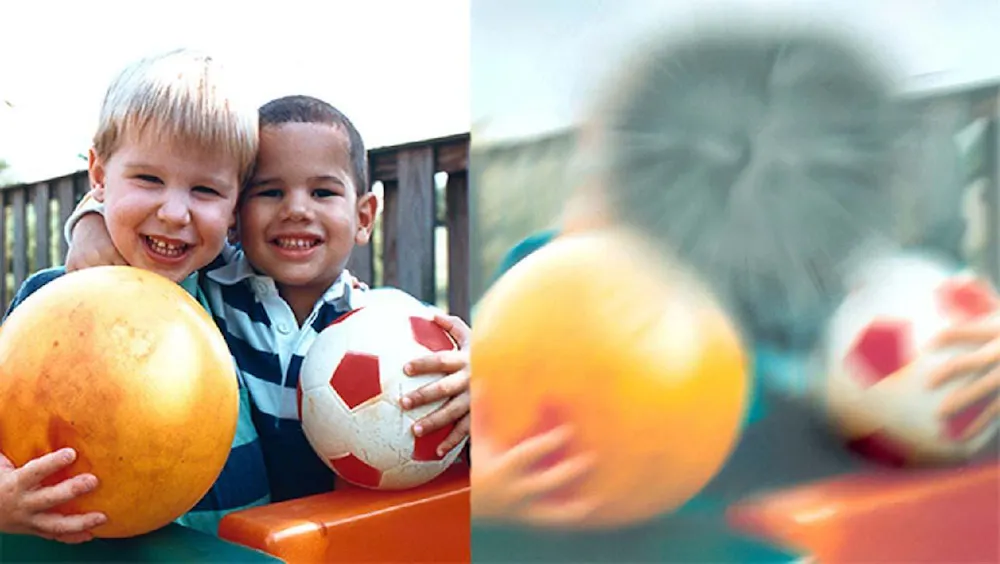
The disease results in blurred and distorted vision, and often loss of function at the centre of the eye’s visual field.
How looking through static can help people with a common degenerative disease see better
This image is often used to educate about AMD. The left panel is normal vision, and the right panel is AMD vision. National Eye Institute / Wikimedia, CC BY

The best current treatment involves a series of injections to slow the progression of the disease, but this process can be expensive and difficult with potentially negative long-term effects.

In our latest research, we trialled a surprisingly effective non-invasive way to improve the vision of people with AMD: augmented reality headsets that add “visual noise” to what they see.

Noise – and how it can help

We usually think of noise as an annoyance. If you are listening to the radio, auditory noise makes it hard to hear the music.

However, it turns out that the right amount of controlled noise can actually be beneficial. This is due to an interesting phenomenon called stochastic resonance.

In the right circumstances, a little bit of noise can make a faint signal “loud enough” for us to detect.

An image of moving static.
An example of visual noise. The Conversation

Different forms of noise, such as tactile noise (vibrations) or auditory noise, have been used previously to improve balance, gait and hearing in patients.

Visual noise (essentially static, like on a detuned TV) has also been shown to improve performance on computer-based letter identification tasks.

However, it had not yet been tested in a device that could actually serve as a visual aid for people with AMD.

Augmenting reality with a little bit of noise

In our new study, we used the Microsoft HoloLens 2 augmented reality headset to introduce visual noise to what people with AMD saw.

Twelve patients with a particular kind of AMD (called the exudative variant) wore the headset and completed a standard letter chart vision test (this type of letter chart is often used for measuring visual driving ability). We assessed their performance with no added visual noise against several different amounts of added noise.

A photo of a room with a square in the middle covered with translucent static.
Image illustrating the patient’s view of the letter chart under high levels of visual noise. Raul et al. / npj Aging

The patients’ vision improved with medium levels of visual noise, as predicted by stochastic resonance.

On average, there was a small improvement, showing people could read about half a line lower on a letter chart. This moved the average from 6/13.5 to 6/12 vision in our study, which is the minimum standard for driving a private car or motorcycle. If this were to occur for an individual, that could mean the difference between being allowed to drive or not being allowed to drive.

Additionally, we also saw the effect in a control group of healthy individuals, although the amount of vision gain was smaller. This suggests that people with healthy vision can also benefit from this setup.

What does the future look like?

Our study showed that noise-adding augmented reality devices may be a promising avenue for non-invasive visual aids for AMD patients. An approach like ours could help improve the quality of life in AMD patients while supporting greater independence.

Our work is only a proof of concept at this stage. Further research is required in various contexts (such as reading and driving tasks), with more patients, before we know how it might work in practice.

Authors: Pratik Raul, Postdoctoral Research Fellow, Psychology and Cognitive Neuroscience, University of Canberra


Read more https://theconversation.com/how-looking-through-static-can-help-people-with-a-common-degenerative-disease-see-better-282998

Your Baby's First Year: A Local Guide to Feeding, Sleep, and When to Get Extra Support

Ask ten parents in a Brisbane mothers' group how their baby is feeding or sleeping, and expect ten different answers.  Someone's baby sleeps throu...

Kitchen and Laundry Makeover Ideas That Don't Require a Full Renovation

Full kitchen renos are expensive — and most people don't actually need one.  They need the kitchen to stop looking like it's stuck in 2009, or t...

How Technology Is Reshaping the Modern Australian Commercial Kitchen

The commercial kitchen has always been shaped by technology. Refrigeration changed how ingredients could be stored, modern ventilation transformed k...

The Number on a Roller Blind Fabric That Nobody Explains

Somewhere in the fabric book, next to the colour name, there is a percentage. Three per cent. Five per cent. Ten per cent. Nobody explains it, most c...

What’s Trending in Men’s Jewellery This Father’s Day!

Finding a Father’s Day gift that feels personal, stylish and genuinely wearable is not always easy. While socks and novelty mugs have traditionall...

Road Signs: Understanding Their Role in Clear and Effective Signage

Effective signage and display hardware can help businesses communicate information, promote products and organise customer or visitor movement. Road...

Bottle Label Printing: Key Factors to Consider Before Your Next Packaging Run

Effective packaging begins with understanding the product, bottle material, artwork and production requirements when planning bottle label printing. H...

Planning a Long-Distance Move With Interstate Movers Melbourne

Moving between states involves more planning than a typical local relocation. Along with packing and transporting household belongings, you need to...

Understanding the Role of an I/O Controller in Industrial Automation

Modern industrial systems depend on accurate communication between sensors, machines and control systems. An I/O controller can help manage this commu...

How the Right Mining Hose Supports Demanding Operations

Mining environments place considerable demands on equipment used for material transfer, water management and processing. Hoses operating in these co...

Simple Ideas for Making Social Gatherings More Memorable

We have all been to those parties where everyone just stands around the kitchen island, staring at their phones, waiting for someone else to make a mo...

Outdoor Wall Lights: Improving Exterior Lighting Around Your Home

Lighting can influence how a room looks, feels and functions, so the right fitting should be selected according to both appearance and practical req...

Commercial Office Cleaning: Combining Routine Office Cleaning With Melbourne Service

Keeping a workplace clean requires a service that can accommodate everyday tasks as well as the particular needs of the business. Professional comme...

Caravan Sales in Queensland: How to Find the Right Caravan for Sale QLD

Caravan ownership is about more than having somewhere to sleep while travelling. For many Queenslanders, it is one of the best ways to explore regio...

What Sir Walter Buffalo Turf Actually Costs in 2026 (And Why Quotes Vary So Much)

Two quotes landed on a Hills District homeowner's kitchen table last spring for the exact same 80-square-metre backyard. One said $12 a metre. The o...

Nearly 1,300 NSW Hospital Beds Are Occupied By People Who Are Ready To Go Home

1,276 people in NSW hospitals have been medically cleared for discharge but remain in hospital because they're still waiting for NDIS or aged care sup...

National Survey Launched to Measure Operational Impacts of Federal NDIS Policy Reforms

The effects of recent NDIS reforms are beginning to move beyond policy papers and into day to day service delivery. A new national survey is asking ...

Beyond the Nappy Cake: Baby Shower Gifts That Get Used

What new Australian parents unwrap, keep, and quietly thank you for months later. Six weeks after my daughter was born, I did an audit of the baby sh...














