

NATO would survive a US withdrawal. But what kind of alliance would it become?
- Written by Gorana Grgić, Head of Global Security, Center for Security Studies, Swiss Federal Institute of Technology Zurich; University of Sydney
As NATO counts down to its annual summit in Turkey in July, the alliance is facing perhaps the biggest challenge in its history – what a potential future without the United States, or US security guarantees, would look like.
In recent weeks, the Trump administration has taken a series of steps widely interpreted in European capitals as retaliation for allies’ reluctance to more strongly support the US position in the Iran war. It has announced the withdrawal of 5,000 troops out of Germany, halted the deployment of 4,000 troops to Poland and even reportedly considered moves to suspend Spain from the alliance.
Europe was already uneasy about Washington’s broader strategic intentions. Increasingly, NATO allies are realising they can no longer depend on the United States for their security and will have to shoulder far greater responsibility themselves.
NATO 3.0
US President Donald Trump’s narrow understanding of the value of alliances has long been known. Now, his vision for a new NATO is coming into view.
At a NATO defence minister meeting in February, the US under secretary of defence for policy, Elbridge Colby, introduced the idea of “NATO 3.0”. This would entail Europeans assuming a much larger role in conventional deterrence. The US, meanwhile, would prioritise strategic competition with China and supporting European security more selectively and from greater distance.
NATO Secretary General Mark Rutte and Elbridge Colby speaking at NATO in February.At the same time, the White House has reportedly been pushing to roll back decades of NATO’s mission expansion and keep Ukraine and NATO’s four Indo-Pacific partners (Japan, South Korea, Australia and New Zealand) out of the annual summit in July.
This reflects a broader transformation in US strategic thinking. NATO is no longer viewed as a political community and a pillar of the liberal international order. Increasingly, it is seen as a narrower military arrangement whose value depends on whether Europeans can shoulder more of the burden themselves and remain compliant with Trump’s agenda.
In this new paradigm, the United States is not simply asking European allies to spend more. It is telling Europe to do more with less American hardware, a looser political alignment, and fewer guarantees.
Plus, there’s a deeper problem: the erosion of trust within the alliance and the assumptions that have underpinned NATO’s deterrence posture for decades.
The result is a “Europeanised NATO” emerging by necessity rather than design. What such an alliance would actually look like remains unclear.
A focus on collective defence
One thing is certain: one single country won’t simply replace the United States as alliance leader. No European power possesses the capabilities, resources or political legitimacy to fill that role alone. Instead, leadership will likely come from the most capable states acting together.
That trend is already visible in “Europe’s minilateral moment”. The E3 group (Britain, France and Germany) and newer E5 coalition (with Italy and Poland), for example, have begun accelerating coordination among Europe’s leading military powers.
These arrangements are not alternatives to NATO. Rather, they may become the mechanisms through which a stronger European focus inside NATO is organised.
But this is where the uncertainties begin. A more Europeanised NATO is far from guaranteed to become a more cohesive NATO. The alliance has long struggled with the strategic cacophony of its 32 members, driven by divergent threat perceptions, regional priorities and strategic cultures. As American leadership recedes, those differences may become even sharper and harder to manage.
A more Europeanised alliance is, at least initially, likely to narrow its focus on collective defence and deterrence to counter Russia’s militarism and its ongoing war against Ukraine.
The broader agenda that expanded after the Cold War to include crisis management and cooperative security may increasingly become secondary. This included efforts to address global security challenges (such as supporting capacity building in countries affected by violent conflict), counter-terrorism operations, and enhancing energy and maritime security.
Yet, many NATO allies, particularly those on NATO’s southern flank, continue to argue that crisis management and cooperative security must remain core alliance functions. For countries facing instability across North Africa and the Middle East, migration pressures, terrorism and maritime insecurity, NATO cannot be concerned only with Russia.
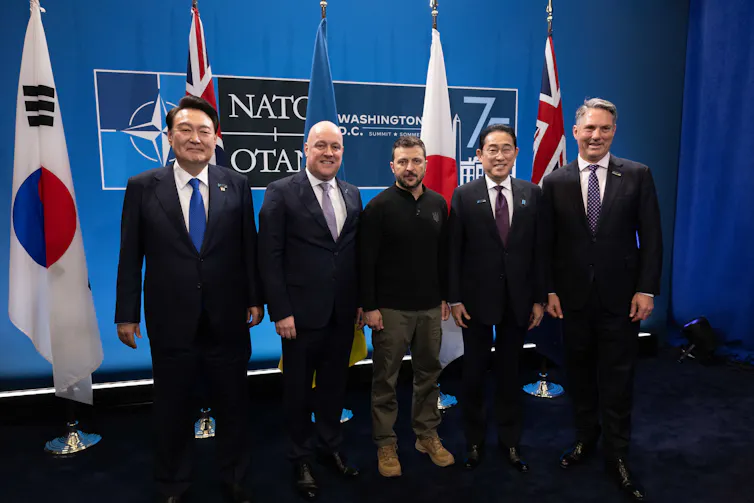
NATO’s cooperative security partnerships in the Indo-Pacific are also increasingly important, even though they are no longer openly supported by the US administration.
Cooperation with Japan, South Korea, Australia and New Zealand (known as the IP4) has emerged as perhaps NATO’s most promising cooperative-security framework, precisely because it strengthens the alliance’s core deterrence mission.
Unlike many earlier partnership initiatives, this is tied directly to defence-industrial cooperation, technological resilience, security of supply chains for defence-critical materials, and strategic signalling.
The new reality
The “new NATO” is by no means a settled compact. It is an alliance caught between competing visions, profoundly uncertain political commitments from erstwhile supporters, and unresolved strategic questions.
Europe is moving towards greater responsibility for its security, but without a clear consensus on what greater strategic autonomy ultimately means.
The central question facing NATO today is not whether the alliance survives. It almost certainly will in some form, as one should never underestimate the binding power of bureaucracies.
The real question is what kind of alliance emerges and how credible it remains. Will it be a narrower military pact laser-focused on continental defence? Or a broader political-security community capable of managing the full spectrum of crises affecting Europe?
Authors: Gorana Grgić, Head of Global Security, Center for Security Studies, Swiss Federal Institute of Technology Zurich; University of Sydney

















