

Beyond travel, a trans-Tasman bubble is an opportunity for Australia and NZ to reduce dependence on China
- Written by Hongzhi Gao, Associate professor, Te Herenga Waka — Victoria University of Wellington
When it comes to our economic over-reliance on China, New Zealand consumers need look no further than their most popular big box chain, The Warehouse. The familiar “big red shed” sourced about 60% of its home brand stock from China in 2017 – and a further NZ$62 million in products directly through offices in China, India and Bangladesh in 2019.
In Australia, many major chain stores as well as online retail giant kogan.com are in a similar position. Reliant on China for much of what they sell, including exclusive home-brand items, they are part of what has been described as the world’s most China-reliant economy.
The COVID-19 crisis has thrown Australian and New Zealand businesses’ dependence on China into stark relief. With countries reportedly competing with and undercutting each other to secure desperately needed medical supplies from China, many are now waking up to their economic exposure to a single manufacturing giant.
Understandably, discussions about creating a “trans-Tasman bubble” between Australia and New Zealand have focused on kick-starting economic activity in the short term, particularly through tourism. But both countries also need to take a longer-term view of boosting economic activity – including through increased manufacturing and trade integration.
Read more: High-tech shortages loom as coronavirus shutdowns hit manufacturers
The statistics support this. In 2018, 20% of global trade in the manufacturing of “intermediate” products (which need further processing before sale) came from China. Chinese manufacturing (including goods made from components made in China) also accounted for:
- 35% of household goods
- 46% of hi-tech goods
- 54% of textiles and apparel
- 38% of machinery, rubber and plastic
- 20% of pharmaceuticals and medical goods
- 42% of chemical products.
Australia and New Zealand are no exception, with China the number one trading partner of both. Australia earned 32.6% of its export income from China in 2019, mostly from natural resource products such as iron ores, coal and natural gas, as well as education and tourism.
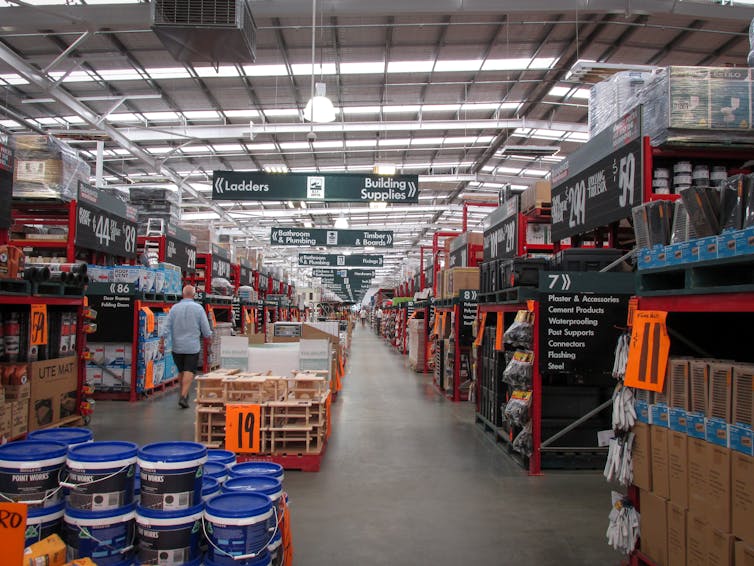 Inside a Bunnings store in Australia: many of the shelves would be empty without goods sourced from China.
www.shutterstock.com
Inside a Bunnings store in Australia: many of the shelves would be empty without goods sourced from China.
www.shutterstock.com
From New Zealand, 23% of exports (worth NZ$20 billion) went to China in 2019, and much of the country’s manufacturing has moved to China over the past 20 years. The China factor in New Zealand supply chains is also crucial, with a fifth of exports containing Chinese components.
Supply shortages from China
The world is now paying a price for this dependence on China. Since the COVID-19 outbreak in early 2020 there has been volatility in the supply of products ranging from cars and Apple phones to food ingredients and hand sanitiser packaging.
More worryingly, availability of popular over-the-counter painkiller paracetamol was restricted due to Chinese factory closures. This is part of a bigger picture that shows Australia now importing over 90% of medicines and New Zealand importing close to NZ$1.59 billion in pharmaceutical products in 2019. Overall, both countries are extremely vulnerable to major supply chain disruptions of medical products.
For all these reasons, a cooperative trans-Tasman manufacturing strategy should be on the table right now and in any future bilateral trade policy conversations.
 The big red shed: New Zealand’s Warehouse chain sources 60% of its products from China.
www.shutterstock.com
The big red shed: New Zealand’s Warehouse chain sources 60% of its products from China.
www.shutterstock.com
Read more: Australia depends less on Chinese trade than some might think
Opportunities for Australia and NZ
Rather than each country focusing on product specialisation or setting industrial priorities in isolation, the two economies need to discuss how best to pool resources, add value and enhance the competitive advantage of strategic industries in the region as a whole.
Currently, trans-Tasman trade primarily involves natural resources and foodstuffs flowing from New Zealand to Australia, with motor vehicles, machinery and mechanical equipment flowing the other way. Manufacturing is skewed towards Australia, but closer regional integration would mean increased flows of capital, components and finished products between the countries. We have seen this already in the primary and service sectors but not much in the manufacturing sector, especially from New Zealand to Australia.
Medical technologies and telecommunications equipment manufacturing (both critical during the pandemic) stand out as potential new areas of economic integration. In that sense, it was heartening to see major medical tech companies such as Res-Med Australia and Fisher & Paykel Healthcare in New Zealand rapidly scale up their production capacities to build respiratory devices, ventilators, and other personal protective equipment products.
Read more: China turns on the charm and angers Trump as it eyes a global opportunity in coronavirus crisis
These brands enjoy a global technology edge, smart niche positioning and reputations for innovation. We need more of these inside a trans-Tasman trade and manufacturing bubble.
China still vital but balance is crucial
Key to successful regional integration will be the pooling of research and development (R&D) resources, mutual direct investment, subsidising R&D and manufacturing in emerging markets with profits from another (such as China), and value-adding specialisation in the supply chain. For example, Tait Communication in New Zealand recently invested in a new facility based in one of Australia’s largest science, technology and research centres.
Together, we can make a bigger pie.
None of this means cutting ties with China, which will remain the main importer of primary produce and food products from Australasia for the foreseeable future. And Chinese exports will still be vital. Fisher & Paykel Healthcare sells its products in about 120 countries, for example, but some of its key raw materials suppliers are Chinese.
Getting this dynamic balancing right will be key to Australia and New Zealand prospering in the inevitably uncertain – even divided – post-pandemic global business environment. And you never know, maybe one day we’ll see a “made in Australia and New Zealand” label in the aisles of The Warehouse and Bunnings.
Authors: Hongzhi Gao, Associate professor, Te Herenga Waka — Victoria University of Wellington

















