

We need to plan for life after JobKeeper now. We need to make it portable
- Written by: John Quiggin, Professor, School of Economics, The University of Queensland
As an emergency response to the potential mass unemployment created by the sudden lockdown, the Morrison government’s JobKeeper program has been reasonably successful.
An estimated 700 000 employers, accounting for 4.7 million workers have signed up.
On the other hand, the sign up of workers has been been about one million less than expected.
Plenty of problems have emerged with limits on coverage.
Some reflect the difficulty of defining a “job” in an environment in which permanent employment has been eroded in favour of casual employment and contracting and the gig economy.
Read more: How to tweak JobKeeper, if we must
Others seem arbitrary, such as the effective exclusion of local government and university employees, and workers whose employers are companies owned by foreign governments.
There will be bigger problems as time goes on.
Working life will change
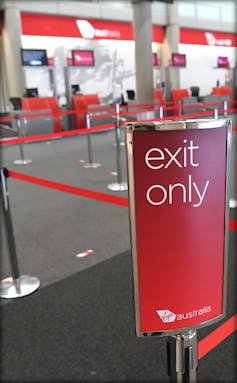 Many workers will need to move.
Dan Peed/AAP
Many workers will need to move.
Dan Peed/AAP
JobKeeper helps workers keep their existing jobs, but it can’t do anything for those who are already unemployed, who leave their jobs, or who need to switch employers.
As the crisis continues, the number in these categories is going to grow, while the number of workers protected by the scheme will shrink.
In six months time, when JobKeeper is due to end, it seems reasonable to assume that most of the restrictions requiring businesses to close their doors will have been lifted.
Shops, cafes, gyms and bars will be open, with adaptations for social distancing.
But other parts of the economy won’t be anything like the “normal” that existed before the crisis.
Even after the domestic restrictions end, large-scale international travel won’t resume until an effective vaccine is found and distributed widely enough so that (at a minimum) all intending travellers can be vaccinated.
Tourism will be very different, as will work and commerce, with the shift to online working, shopping and medicine only partly reversed.
Read more: This time is different: Australia's tourist numbers may take years to recover
A much smaller number of people coming into the country (even if long-term arrivals are be allowed in subject to quarantine) means weaker construction and education industries.
And even if we recover fully, our customers in the rest of the world will not. Europe is already in a deep recession. The pandemic was slow to reach the United States, but the likely impacts on both health and the economy look to be even worse.
These shocks would be a challenge even to a strong economy. But Australia’s performance before the crisis was sluggish at best.
Read more: The jobs market is nowhere near as good as you've heard, and it's changing us
Unemployment had barely come down from the levels reached during the global financial crisis and under-employment had reached all time highs. Inflation was persistently below the Reserve Bank’s target range, reflecting the overall weakness of the economy.
In these circumstances, the idea that the economy will magically “snap back” to normal once restrictions are lifted is a dangerous fantasy.
If we are to avoid an era of sustained high unemployment similar to the one we had in the early 1990s, the government must act to stop it happening.
JobKeeper should be made portable
The first step should be to convert JobKeeper into a wage-subsidy program, in the hands of workers, not tied to previous employment. Unemployed workers could assign the subsidy to whichever employer willing to hire them under standard wages and conditions.
There are plenty of difficulties with such a program. The most immediate is the need to ensure that it creates additional jobs, rather than allowing employers to sack existing workers and replace them with subsidised new hires.
A second lot of problems arises, as with JobKeeper, because of the increasing prevalence of non-standard forms of employment.
Read more: Despite huge coronavirus stimulus package, the government might still need to pay more
These problems are not reasons to abandon the idea of wage subsidies. Rather, they imply that the government should be thinking about these problems now, rather than deferring the problem with the assertion that everything will return to normal in six months.
Much more will be needed to avoid mass unemployment.
Public services such as health and education will need to employ more people to deal with the extra requirements of social distancing, and the need for training and retraining.
Read more: Our ailing aged care system shows you can't skimp on nursing care
Restructuring the economy will require the abandonment of free-market doctrine in favour of direct government involvement, including public ownership where necessary, at least for a while.
And while it is appropriate to meet the immediate needs of the economy through increased borrowing, we will ultimately need increased revenue, and we will probably need to forgo the lavish legislated tax cuts that were due to kick in from the mid-2020s.
Authors: John Quiggin, Professor, School of Economics, The University of Queensland


















