

The positives and negatives of mass testing for coronavirus
- Written by: Jennifer MacLachlan, Epidemiologist, WHO Collaborating Centre for Viral Hepatitis, The Peter Doherty Institute for Infection and Immunity
Many jurisdictions around the world are now testing people without symptoms as part of efforts to manage COVID-19. In Victoria, asymptomatic health-care workers have been part of the recent “testing blitz”.
We tend to take for granted that the results of medical tests are accurate – but no test is perfect and all carry a risk of harm of some kind. Although there has been a drive to increase testing, we must recognise this is also true for coronavirus.
Read more: What is sentinel surveillance and how might it help in the fight against coronavirus?
All tests have limitations
Among the shortfalls of diagnostic testing is the possibility of false negatives (failing to detect a condition when it’s present) and false positives (detecting a condition when it’s absent).
It’s easy to see why false negatives can be a problem – we lose the benefits of early intervention.
But false positives can also cause harm, including unnecessary treatment. This is why positive screening tests are often followed up with a second, different test to confirm a diagnosis.
Examples include further imaging and possibly biopsy following a positive mammogram for breast cancer, or colonoscopy following positive screening for colon cancer.
Read more: As restrictions ease, here are 5 crucial ways for Australia to stay safely on top of COVID-19
Why do we get false positives?
False positives can occur for many reasons, including normal human and system errors (for example mislabelling, data entry errors or sample mishandling).
Sometimes false positive test results could be due to a cross-reaction with something else in the sample, such as a different virus.
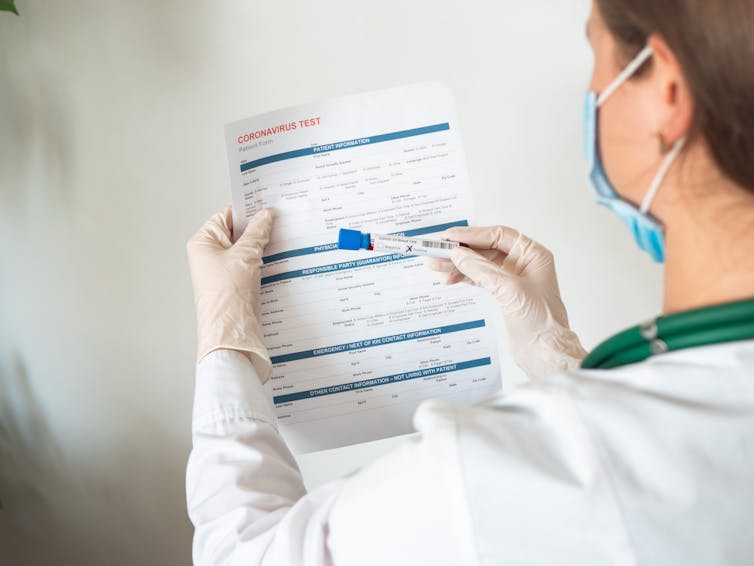 Data entry errors can lead to false positives or false negatives.
Shutterstock
Data entry errors can lead to false positives or false negatives.
Shutterstock
For COVID-19, the only routinely available option to confirm a positive result is to retest using the same method. This can address the false positives generated through sample contamination or human error.
Even so, some authorities recommend isolation for any person who returns a positive test, regardless of subsequent results.
Testing more widely could mean more false positives
The proportion of false positives among all positive results depends not just on the characteristics of the test, but on how common the condition being tested for is among those being tested.
This is because even a highly specific test – one that generates hardly any false positives – may still generate more false positive results than there are actual cases of the condition in those being tested (true positives).
Let’s work through an example.
Say we have a very good test which is 99.9% specific – that is, only one in 1,000 tests give a false positive. And imagine we’re testing 20,000 people for condition X. Condition X has a very low prevalence – we estimate it affects 0.01%, or one in 10,000 people in the population.
At this level we could expect two people in our sample to have condition X, so we might get two true positive results. But we would also expect around 20 false positive results, given the error rate of our test.
So the proportion of people testing positive who actually have condition X would be only two out of 22, or 9.1%.
This is called the positive predictive value of a test. The lower the prevalence of a condition in the population, the lower the positive predictive value.
What about COVID-19?
In Australia, control measures have been very successful in reducing the number of people currently infected with COVID-19. We estimate the likelihood of a positive test to be very low right now (although of course this may change as restrictions ease).
The current reported number of active COVID-19 cases in Australia is about 600. And even if we’ve only diagnosed one in every ten people currently infected, this still represents less than 0.03% of the population.
Read more: Can you get the COVID-19 coronavirus twice?
While we’re still establishing the specificity of tests for SARS-CoV-2 (the coronavirus that causes COVID-19), early evidence suggests an estimate of 99% or greater is reasonable.
However, following the same calculations as in the example above, at a prevalence of 0.03%, even a test with 99.9% specificity would mean only 30% of people who test positive actually have the condition. This means more than two-thirds of positive results would actually be false positives if we were testing asymptomatic people with no increased risk.
This is why testing criteria are often applied. If testing is offered only to those with symptoms consistent with COVID-19, the condition is almost certainly more common in those being tested than in the general (asymptomatic) population, and therefore the rate of true positives is going to be higher.
But if we start testing more broadly, the likelihood of false positives becomes a greater concern.
 Few new COVID-19 cases recorded from widespread testing is seeing restrictions beginning to ease in Australia.
Michael Dodge/AAP
Few new COVID-19 cases recorded from widespread testing is seeing restrictions beginning to ease in Australia.
Michael Dodge/AAP
Why are false positives a problem?
Clearly we need tests to be as sensitive as possible – it’s easy to see why a false negative COVID-19 result could be a serious issue. But it’s important to recognise a false positive result can also cause significant problems for an individual and the community.
Consider, for example, the impact of asymptomatic health worker screening if a false positive test result leads to isolation of the person falsely diagnosed, and quarantining of their clinical co-workers identified (incorrectly) as close contacts of a case of COVID-19.
Further, a person who has had a false positive result may feel they are not at risk of future infection as they believe they are immune, leading to potential consequences for the individual and their contacts.
Even from an epidemiologicial perspective, a high proportion of false positives could distort our understanding of the spread of COVID-19 in the community.
Read more: More testing will give us a better picture of the coronavirus spread and its slowdown
Testing for COVID-19 in Australia is highly regulated and uses the best possible tests and highly qualified staff.
But asymptomatic screening when the prevalence of a condition is as low as that of COVID-19 in Australia currently must carefully weigh the benefits of such testing against the potential harms.
Authors: Jennifer MacLachlan, Epidemiologist, WHO Collaborating Centre for Viral Hepatitis, The Peter Doherty Institute for Infection and Immunity
Read more https://theconversation.com/the-positives-and-negatives-of-mass-testing-for-coronavirus-137792


















