

2024 Triggers First-Ever Insurance Payout for Disaster Fund
NEW YORK, US/GENEVA, SWITZERLAND - Media OutReach Newswire - 21 November 2024 - For the first time, an insurance payout has been triggered by the International Federation of Red Cross and Red Crescent Societies' Disaster Response Emergency Fund ('IFRC-DREF'), as demands for disaster relief surpassed its 'deductible' threshold.
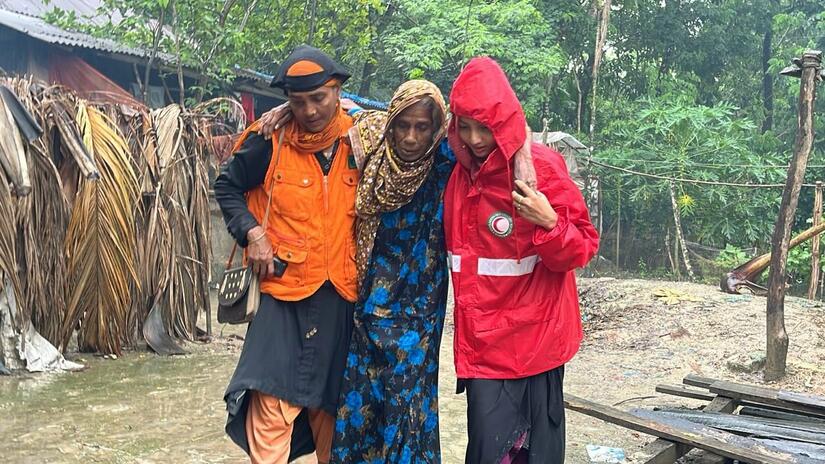
A Bangladesh Red Crescent volunteer helps a lady away from her flooded home following Cyclone Remal. The response was part funded through an IFRC-DREF allocation
Photo: BRCS
Photo: BRCS
The IFRC-DREF is a vital fund that provides immediate funding for National Red Cross and Red Crescent Societies when disasters strike, especially for smaller-scale emergencies that may not attract global attention. Previously, the fund could run dry before year-end, prompting the IFRC to secure a groundbreaking — and humanitarian-sector first — indemnity insurance policy with Aon and reinsurers.
Since the start of 2023, and for an annual premium of CHF3m, the IFRC-DREF 'pot' has been insured on an indemnity basis. A potential payout of up to CHF15m is available if, or when, demands on the IFRC-DREF fund because of natural hazard-associated disasters hit a certain threshold — a 'deductible' set at CHF33m in one calendar year. For the rest of the calendar year, further demands on the IFRC-DREF for natural hazard disasters are covered by the insurance payout, up to that total maximum of CHF15m.
In 2023, the threshold was not reached so the policy did not pay out. But in 2024 it has been, with allocations to respond to Super Typhoon Yagi in Asia last week tipping IFRC-DREF spend over the insurance trigger threshold. Overall, there have been almost 100 separate IFRC-DREF allocations in 2024; combined those to respond to the impacts of eligible natural hazards have exceeded CHF 33m. When National Red Cross and Red Crescent Societies make further requests of the fund in September, October, November or December, allocations to respond to natural hazard disasters will be paid for by the commercial insurers, up to that CHF15m cap.
The IFRC's Under Secretary General for Global Relations and Humanitarian Diplomacy, Nena Stoiljkovic, announced the insurance payout at an event at the United Nations General Assembly in New York on Wednesday.
Ahead of it, Ms Stoiljkovic said:
"The triggering of the IFRC-DREF insurance policy is a significant moment. For the first time ever a single, worldwide, commercial indemnity insurance policy will pay the emergency humanitarian costs of disasters. The scale of the needs caused by 2024's disasters is sobering. But the fact the insurance is helping with the burden is good news and proof that there are innovative finance solutions that we hope to grow in coming years."
The IFRC has plans to grow its IFRC-DREF insurance, to widen coverage beyond disasters caused by natural hazards — to epidemics and anticipatory action, for example. It hopes grant donors will see the added value of contributing to the IFRC-DREF fund if their humanitarian contributions could potentially be multiplied in particularly calamitous years.
Notes to journalists
In 2024, IFRC-DREF allocations so far have been paid, among others to:
- Maldives Red Crescent to help deal with a Filariasis outbreak in January (CHF 299,986)
- Chile Red Cross to help deal with wildfires in February (CHF 496,982)
- Eswatini Red Cross to help with its drought response in March (CHF 546,683)
- Iraqi Red Crescent to help with it deal with Flash Floods in April (CHF 499,900)
- Honduran Red Cross to help it deal with a hospital fire in May (CHF 336,394)
- Armenia Red Cross to help its response to floods in June (CHF 499,759)
- Venezuelan Red Cross in the aftermath of Hurricane Beryl in July (CHF 270,049)
- Philippines Red Cross after floods in August (CHF 738,170)
- Cameroon Red Cross after floods in September (CHF 421,471)
The single largest allocation so far in 2024 was to the Sudanese Red Crescent after floods in September (CHF 943,271); the single 'smallest' allocation was the Red Cross of Equatorial Guinea after a shipwreck in July (CHF 24,962).
- More data is available by searching 'DREF' under 'Appeal Type' at the 'IFRC's Go Platform'
- 1 CHF = 1.19 USD
- IFRC-DREF insurance is co-funded by InsuResilience Solutions Fund (ISF) to support project preparatory work, development and refinement of the insurance product as well as premium funding.
- IFRC-DREF insurance is also made possible by generous support in paying the premium, particularly from the British Red Cross, the Danish Red Cross and the British government (FCDO).
- IFRC-DREF has provided rapid and efficient funding to local Red Cross and Red Crescent Societies before and after disasters strike since 1979. However, with the increasing frequency and intensity of disasters, particularly due to climate change, the demand for humanitarian assistance continues to grow.
- More information on IFRC-DREF insurance can be found here: IFRC-DREF Insurance
For more information, for interviews, for quotes from IFRC-DREF partners or for video of IFRC and Red Cross Red Crescent responses to disasters contact media@ifrc.org
Hashtag: #Aon #IFRC
The issuer is solely responsible for the content of this announcement.


















