

Stainless Steel Tube: A Complete Specification Guide for Engineers, Project Managers, and Industrial Buyers
- Written by Modern Australian
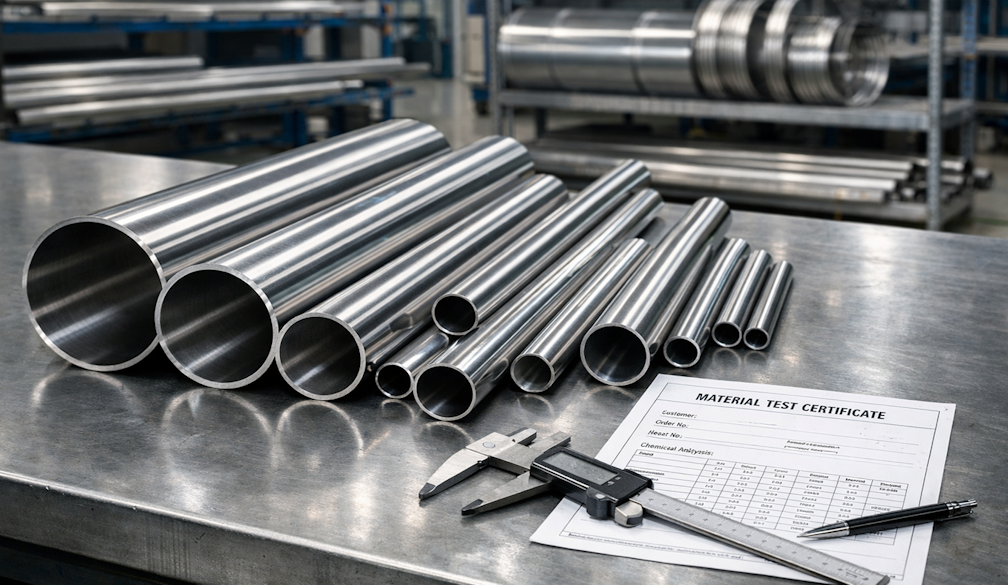
Few materials in the industrial and manufacturing world are as universally relied upon — or as frequently misspecified — as stainless steel tube. Walk through any processing plant, pharmaceutical facility, food production site, or mining operation in Australia, and you'll find stainless steel tubes doing everything from conveying high-purity fluids to bearing structural loads, from managing high-pressure hydraulic circuits to carrying corrosive chemicals that would destroy virtually any alternative material within months.
The appeal is understandable. Stainless steel tube combines mechanical strength, corrosion resistance, temperature tolerance, and hygienic surface characteristics in a way that few materials can match across such a broad range of applications. But that versatility comes with a specification challenge: the term "stainless steel" encompasses dozens of alloy grades, multiple manufacturing processes, a wide range of dimensional standards, and significant variation in surface finish and heat treatment — all of which affect performance in service.
Choosing the right stainless steel tube for an application is not simply a matter of picking a size and placing an order. Done well, it's an engineering decision that accounts for the operating environment, the mechanical and dimensional requirements of the application, the relevant Australian and international standards, and the total cost implications of the specification over the life of the installation. This guide is designed to give engineers, project managers, and industrial buyers the framework they need to make that decision well.
Understanding Stainless Steel Grades: Which Alloy for Which Application?
The starting point for any stainless steel tube specification is grade selection. The grade determines the alloy composition — and therefore the corrosion resistance, mechanical properties, and fabricability of the material. Getting this wrong can result in premature corrosion failure, insufficient strength, or fabrication difficulties that add cost and delay to a project.
Grade 304 — The Workhorse
Grade 304 (also designated 1.4301 under European standards) is the most widely used stainless steel alloy in the world, and with good reason. It contains approximately 18 per cent chromium and 8 per cent nickel, which gives it excellent general corrosion resistance in a wide range of environments, good formability, and reliable weldability.
Grade 304 stainless steel tube is well-suited to applications involving water, mild chemicals, food and beverage processing, pharmaceutical manufacturing, architectural applications, and general industrial service where chloride exposure is not a primary concern. It is cost-effective relative to higher-alloy grades and is available in the broadest range of dimensions and forms.
The key limitation of Grade 304 is its susceptibility to chloride-induced pitting and crevice corrosion. In environments with elevated chloride concentrations — coastal installations, applications involving seawater or salt solutions, or processes using chlorinated cleaning agents at high concentrations — Grade 304 can fail prematurely through localised corrosion.
Grade 316 — Enhanced Corrosion Resistance
Grade 316 (1.4401) adds molybdenum to the 304 alloy composition — typically 2 to 3 per cent — which significantly improves resistance to pitting and crevice corrosion in chloride-containing environments. This makes Grade 316 the preferred choice for marine and coastal applications, chemical processing, pharmaceutical manufacturing where aggressive cleaning regimes are used, and any application involving elevated chloride exposure.
Grade 316L — the low-carbon variant — is widely specified for welded applications because the reduced carbon content minimises the risk of sensitisation (the precipitation of chromium carbides at grain boundaries during welding, which can compromise corrosion resistance in the heat-affected zone). For most welded stainless steel tube applications involving corrosive service, 316L is the appropriate specification.
The step up in material cost from 304 to 316 is meaningful, so specifying 316 where 304 would perform adequately is an unnecessary expense. Conversely, using 304 in an environment that warrants 316 is a false economy that typically results in early failure and expensive replacement. The operating environment analysis is the essential first step.
Duplex and Super Duplex Grades
For applications involving highly corrosive environments, elevated temperatures, and high mechanical loads — such as those found in offshore oil and gas, desalination, and aggressive chemical processing — duplex and super duplex stainless steel grades offer performance that austenitic grades like 304 and 316 cannot match.
Duplex grades (such as 2205 / 1.4462) have a mixed austenitic-ferritic microstructure that gives them approximately twice the yield strength of 304 or 316 at equivalent corrosion resistance, and superior resistance to stress corrosion cracking — a failure mode that can affect austenitic grades in certain high-stress, chloride-rich environments. Super duplex grades (such as 2507) extend these properties further for the most demanding applications.
The higher cost and more demanding fabrication requirements of duplex and super duplex grades mean they are typically reserved for applications where the operating conditions genuinely warrant the upgrade. Engineering assessment of the specific application conditions is essential before specifying these grades.
Tube vs. Pipe: Understanding the Distinction
One of the most common sources of confusion in stainless steel specification is the distinction between tube and pipe — terms that are often used interchangeably in conversation but have specific and different technical meanings in engineering and procurement.
Pipe is specified by nominal pipe size (NPS) and schedule, where the nominal size is an approximate designation that doesn't directly correspond to the actual outside diameter, and the schedule determines the wall thickness and therefore the internal diameter. Pipe specifications are primarily driven by flow capacity requirements.
Tube, by contrast, is specified by its actual outside diameter (OD) and wall thickness — both of which are precise dimensions rather than nominal approximations. Stainless steel tubing is used where dimensional accuracy matters — in instrumentation, hydraulic systems, heat exchangers, precision fluid handling, and structural applications where specific OD and wall thickness values are required by the design.
Confusing tube and pipe specifications can result in ordering material that doesn't fit the fittings, flanges, or supports designed for the application. When specifying stainless steel tube, always specify actual OD, wall thickness, and length — not nominal pipe size or schedule.
Manufacturing Processes: Seamless vs. Welded Tube
Stainless steel tubing is manufactured by two primary processes — seamless and welded — and the choice between them has implications for pressure rating, surface quality, dimensional consistency, and cost.
Seamless Stainless Steel Tube
Seamless tube is produced by hot or cold working a solid billet of stainless steel into a tubular form without any longitudinal weld seam. The result is a tube with uniform material properties throughout its cross-section, no weld-related microstructural variation, and typically tighter dimensional tolerances than welded alternatives.
Seamless stainless steel tubing is the preferred specification for high-pressure hydraulic and instrumentation applications, applications involving cyclic or dynamic loading where a weld seam could act as a stress concentration, and any service where the integrity of the tube wall must be absolutely assured. It is also commonly specified in pharmaceutical and high-purity applications where the absence of a weld seam simplifies cleaning and validation.
The trade-off is cost — seamless tube is more expensive than welded tube of equivalent grade and dimensions, and may have longer lead times in some sizes.
Welded Stainless Steel Tube
Welded tube is produced by forming flat strip into a tubular shape and welding the longitudinal seam — typically by TIG (GTAW) or plasma welding. Modern welded tube manufacturing produces high-quality product with consistent weld seam integrity, and for the majority of industrial applications — fluid transfer at moderate pressures, structural use, heat exchanger tubing, general process piping — welded tube performs reliably and cost-effectively.
Welded and drawn (W&D) tube, where the welded tube is subsequently cold-drawn through a die, offers improved dimensional accuracy, better surface finish, and enhanced mechanical properties compared to as-welded tube — bringing it closer to seamless quality at a cost point between standard welded and full seamless.
For most general industrial applications, welded or welded-and-drawn stainless steel tubing is the appropriate and cost-effective specification. Seamless should be reserved for applications where its specific properties are genuinely required.
Surface Finish: Why It Matters More Than You Might Think
The surface finish of stainless steel tube affects far more than appearance. In hygienic and high-purity applications, surface finish directly influences cleanability, bacterial retention risk, and compliance with industry standards. In corrosive environments, surface finish affects the performance of the passive oxide layer that gives stainless steel its corrosion resistance. And in visible architectural applications, finish determines aesthetic outcome.
Common surface finish designations for stainless steel tube include:
- 2B finish — the standard mill finish for cold-rolled stainless steel, smooth and slightly reflective, suitable for most general industrial applications
- BA (Bright Annealed) finish — produced by annealing in a controlled atmosphere, giving a bright, reflective surface with excellent corrosion resistance
- Electropolished finish — an electrochemical process that removes surface material to produce an ultra-smooth, highly reflective finish with enhanced corrosion resistance; the standard for pharmaceutical, food, and high-purity applications
- Mechanical polished finishes (e.g., 180 grit, 240 grit, mirror polish) — produced by abrasive polishing to specified Ra (surface roughness) values
For food, beverage, and pharmaceutical applications, the relevant industry standards — including those of the 3-A Sanitary Standards organisation and the European Hygienic Engineering and Design Group (EHEDG) — specify maximum surface roughness values (typically Ra ≤ 0.8 μm for product-contact surfaces) that drive finish specification.
Key Application Areas for Stainless Steel Tubing in Australian Industry
Understanding where stainless steel tubing is most commonly and most effectively applied helps engineers and project managers identify the right specification for their specific context.
Food and Beverage Processing
The food and beverage industry is one of the largest consumers of stainless steel tube in Australia. From dairy processing and brewing to beverage filling lines and meat processing, stainless steel tube provides the corrosion resistance, hygienic surface characteristics, and compatibility with CIP (Clean-in-Place) and SIP (Steam-in-Place) cleaning processes that food-grade applications demand. Grade 316L with electropolished or fine-ground finish to Ra ≤ 0.8 μm is the standard specification for product-contact tubing in most food applications.
Pharmaceutical and Bioprocessing
Pharmaceutical manufacturing and bioprocessing represent the most demanding end of the stainless steel tube specification spectrum. Pure water, water for injection (WFI), and process fluid systems in pharmaceutical facilities require ultra-high purity tubing with electropolished internal surfaces, full traceability documentation, and compliance with relevant standards including ASME BPE (Bioprocessing Equipment). Grade 316L seamless electropolished tube is the near-universal specification in this sector.
Oil, Gas, and Mining
The oil, gas, and mining sectors deploy stainless steel tube across a wide range of applications — from instrumentation tubing in control systems to process piping in corrosive service, heat exchanger tubing, and hydraulic systems on mobile equipment. The specific grade and specification vary considerably depending on the operating environment, with duplex and super duplex grades commonly used in the most demanding offshore and sour service applications.
Instrumentation and Control Systems
Instrumentation tubing — small-diameter, high-precision stainless steel tube used in process control, pneumatic signal lines, hydraulic control circuits, and analytical sampling systems — is one of the most technically demanding stainless steel tube applications. Dimensional accuracy, consistent wall thickness, and reliable pressure ratings are critical. Grade 316 seamless tube to ASTM A269 or equivalent is the typical specification for instrumentation service.
Procurement Considerations: What to Specify and What to Verify
For procurement managers and project engineers sourcing stainless steel tubing, a complete specification includes more than just grade and dimensions. The following parameters should be defined and verified for any significant purchase:
- Material grade and applicable standard (e.g., Grade 316L to ASTM A269 or AS 1528)
- Outside diameter and wall thickness — specified as actual dimensions, not nominal
- Manufacturing process — seamless, welded, or welded-and-drawn
- Surface finish — internal and external, with Ra values where relevant
- Heat treatment condition — annealed and pickled is standard for most austenitic stainless tube
- Test and inspection requirements — hydrostatic test, eddy current test, dimensional inspection, chemical analysis, mechanical testing
- Certification and traceability — material test certificates (MTCs) to EN 10204 3.1 or 3.2 as required by the application
- Length — random mill lengths, fixed cut lengths, or specific tolerances
For critical applications — pressure systems, pharmaceutical, food-grade — material traceability from mill to installation is an essential quality assurance requirement. MTCs should be reviewed against the purchase specification before material is accepted, and any discrepancies resolved before the material enters the supply chain.
Working with a Quality Stainless Steel Tube Supplier
The supplier relationship matters considerably in stainless steel tube procurement. A supplier with deep product knowledge, reliable stock of common grades and dimensions, strong quality assurance processes, and the capability to source non-standard specifications when required is a genuine asset to any engineering or procurement team.
Look for suppliers who can provide full material traceability and MTCs as standard practice, who understand the technical requirements of your industry and application, and who can provide technical input on grade selection and specification — not just process orders. The difference between a transactional supplier and a technically capable partner is most evident when a project throws up a specification challenge or a non-standard requirement.
For businesses sourcing quality stainless steel tubing for industrial, food-grade, or precision applications, working with a supplier who stocks a comprehensive range of grades, dimensions, and finishes — and who can provide the documentation and traceability that demanding applications require — simplifies procurement and reduces the risk of specification errors making it through to installation.
Final Thoughts: Specify Right, Specify Once
Stainless steel tube is a high-performance material that rewards careful specification. The combination of grade, manufacturing process, dimensions, surface finish, and quality documentation requirements all interact to determine whether a tube specification delivers the intended performance in service — for years, in some cases decades, without issue.
For engineers and project managers, the investment of time in getting the specification right at the outset is always worthwhile. The cost of an incorrectly specified installation — in early failure, replacement, production downtime, and in some industries, regulatory consequences — invariably exceeds the cost of getting the engineering right in the first place.
Use this guide as a starting framework, engage with technically capable suppliers who can provide application-specific input, and don't accept generic substitutions without verifying that the substitute material genuinely meets your application requirements. In stainless steel tube specification, the details matter — and so does the quality of the people you rely on to get them right.


















