Another savage blow to regional media spells disaster for the communities they serve
- Written by: Kristy Hess, Associate Professor (Communication), Deakin University
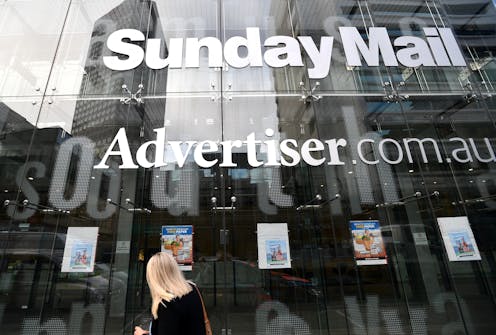
With swift and savage force, the COVID-19 pandemic has inadvertently attacked Australia’s local news media ecology, which was already battling a weakened immune system.
As a researcher working on Australia’s largest academic study into the future of local newspapers, the phones have been running hot in recent weeks. We’ve had calls from everyday people, journalists made redundant, cadets surviving on JobKeeper, and independent news proprietors, all navigating their way through the crisis.
Read more: Local newspapers are an 'essential service'. They deserve a government rescue package, too
News Corp has announced plans to close or suspend printing operations of more than 100 suburban and small community titles. Its more successful publications, such as the Geelong Advertiser, Gold Coast Bulletin, Hobart Mercury and the iconic Northern Territory News, will remain with print and digital editions.
Other independently-owned newspapers across rural and regional Australia are still breathing: they are gasping for air, but they are breathing. They’ve either temporarily suspended operations, cut back the number of print editions or shifted to a digital-only model to “see how it goes”.
Since the COVID-19 crisis emerged, there have been two key funding schemes introduced (or re-introduced) to support news providers - the government’s $50 million Public Interest News Gathering Program and a $5 million Regional and Small Publishers Innovation Fund.
The federal government has also announced plans to force Google and Facebook to share advertising revenue with producers of quality journalism in Australia. The Australian Competition and Consumer Commission is now seeking views on its new draft mandatory code that will address bargaining power imbalances between Australia’s news media businesses, and Google and Facebook.
Read more: Trust in quality news outlets strong during coronavirus pandemic
This has been met with some initial concern from the Country Press Association of Australia amid fears the modelling may only benefit big companies and not the little players that serve small towns and cities.
The Victorian government has waded in to provide more than $4 million in additional advertising support for local and regional print publications. Our preliminary research indicates Victoria leads the way with this type of support for local news. Other states, such as South Australia and New South Wales, lag behind or have announced changes to legislation that provides government authorities freedom to advertise on their own sites or via social media.
The problem is, social media sites like Facebook don’t put the interests of local communities first, whereas local news outlets do (or at least they should). Facebook has gone to great lengths to distance itself from the types of local content posted on its platform. In the local news ecology, it tends to feed from traditional local news providers or the goodwill of citizens who moderate and upload content of local importance and reap the advertising rewards. One off, $10,000 grants from social media juggernauts to local news entrepreneurs won’t fix this systemic problem.
In some local areas, business owners are offering donations or advertising support to preserve the journal of record during COVID-19. JobKeeper is keeping many cadet journalists on the payroll, and there are some keen reporters doing their bit to report on the news, even if they are not getting paid.
There’s also stories of new start-ups emerging – like Matt Dunn in Victoria’s South Gippsland region. He was made redundant by the local newspaper, which is planning to close its doors permanently. He immediately set to work developing his own digital news platform, “The Paper”.
Dunn is confident elderly residents who have little experience with technology will come on board because they will be hungry for good quality local meaningful news. It’s about the content, not the platform.
However, digital-only publications are problematic in areas of rural and regional Australia that struggle with broadband connectivity. It’s even more worrisome for those areas with ageing populations, where reading the local paper is a daily or weekly ritual to maintain a sense of connection to their community.
I’ve spoken with several elderly residents in recent weeks who are distressed about the decline of Australian Community Media’s local content and the reduction of the print edition. Without the newspaper and technological capabilities, they feel “lost”. And importantly, they can’t read the death notices, so have no idea who has died.
Read more: Without local papers, regional voices would struggle to be heard
Perhaps that is the key for policymakers, researchers and industry in a post COVID-19 world. Big news conglomerates around the world have been accused of building a plethora of zombie newspapers that are local in name only – full of syndicated content, without really being attuned to the needs and wants of a community or helping people to develop shared social connection and purpose to place.
My hunch is zombie papers will be the first to fall.
Audiences aren’t stupid. It’s the newspapers and community individuals determined to provide news that are the heart of their communities and should survive into the future. Policymakers, researchers and industry need to be acutely aware of the types of news outlets and individuals that best provide – or are willing to provide – real, credible and meaningful local news and information for their communities in areas of Australia big and small.
They are the ones that should be at the front of the queue for any type of media vaccine.
Authors: Kristy Hess, Associate Professor (Communication), Deakin University