

Why is there so much furore over China's Belt and Road Initiative?
- Written by Michael Clarke, Associate Professor, National Security College, Australian National University
There were certainly questions asked when Victoria first signed a memorandum of understanding to join China’s Belt and Road Initiative (BRI) in 2018, but it wasn’t until the past week that the criticism reached a fever pitch.
The depth of the animosity over the deal shows the extent to which the BRI has become a faultline in the China-US competition.
And Australia, economically interdependent with China but a committed ally of the US, finds itself caught in the middle.
What is the BRI and what does China want?
There is a diverse array of projects encompassed under the BRI umbrella, focused on six main “economic corridors”.
These corridors link China to Central Asia, the Middle East and Europe by land (the “Silk Road Economic Belt”), and to Southeast Asia, the Indian subcontinent, the Pacific and east Africa by sea (the “Maritime Silk Road”).
To date, China has pledged an estimated US$1 trillion in investments in “hard” and “soft” infrastructure (from ports and high-speed rail to telecommunications and cyberspace) and signed memorandums of understanding with 138 countries.
Read more: China's worldwide investment project is a push for more economic and political power
However, there is much debate about what is actually driving the project.
Some see it as a purely geopolitical gambit to break what Beijing perceives as American “encirclement” after the Obama administration’s “pivot to Asia”.
Others see it as President Xi Jinping and the Chinese Communist Party’s desire to shake the Chinese economy out of its recent slowdown and resolve some of its structural maladies.
From an economic standpoint, the initiative serves multiple purposes. It allows China to redress economic imbalances between its coastal and interior provinces, find outlets for excess production capacity and internationalise the Chinese currency.
Finally, some have dismissed the Belt and Road Initiative as a “soft power” vanity project to burnish China’s international image.
Indeed, the Chinese leadership views BRI as a way of both legitimising China’s model of government and economic development to the rest of the world, and positioning China as the leader of an alternative new world order from the one authored by the US after 1945.
In reality, BRI is about all of these things.
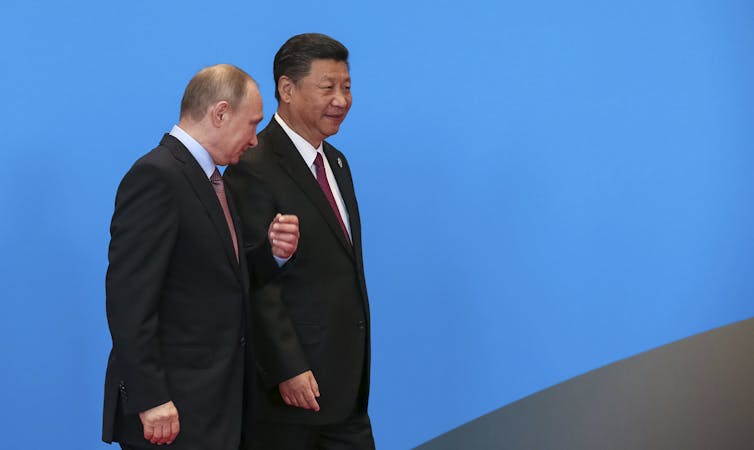 Xi Jinping and Vladimir Putin at the Belt and Road Forum in Beijing in 2017.
ROMAN PILIPEY / POOL
Xi Jinping and Vladimir Putin at the Belt and Road Forum in Beijing in 2017.
ROMAN PILIPEY / POOL
What are the benefits and pitfalls of BRI?
In thinking about BRI’s global and regional reception, we need to recognise there is demand for what Beijing is offering.
Its commitment of US$1 trillion is a drop in the bucket of the estimated US$26 trillion needed by Asia’s economies for infrastructure investment, but it still surpasses anything put up by other major regional players.
The “blue-dot network” announced by the US, Australia and Japan in November as a response to the BRI, for instance, was trumpeted as promoting infrastructure investment that is “open and inclusive, transparent, economically viable”.
But the initiative is not an infrastructure funding mechanism itself. Rather, it merely certifies projects that “demonstrate and uphold global infrastructure principles”.
While this might be an admirable goal, there is a problem, as former Asian Development Bank executive director Peter McCawley points out:
A road is a road, whether it is built with US or Chinese money. At present, it seems that the Chinese are prepared to fund the construction of infrastructure in Asia, while the US is not.
Concerns about the nature of Chinese investments under BRI are valid. Many BRI projects are financed through Chinese public financial institutions such as the Export-Import Bank of China that enjoy low borrowing costs and interest rates.
This enables them to lend on favourable terms to Chinese companies, who can then significantly undercut foreign companies for infrastructure bids.
Another concern is that Beijing is engaging in “debt trap diplomacy” by extending excessive credit to countries that will struggle to pay it back.
Read more: Will an ambitious Chinese-built rail line through the Himalayas lead to a debt trap for Nepal?
The aim is then to extract political and economic concessions or physical assets, such as ports or land deals, from those countries.
Several studies have suggested the “debt trap” narrative has been exaggerated. But while a Lowy Institute report last year noted that China has not “deliberately” engaged in debt-trap diplomacy, it added
the sheer scale of China’s lending and its lack of strong institutional mechanisms to protect the debt sustainability of borrowing countries poses clear risks.
Victoria’s BRI agreement: storm in a teacup?
Beyond the economics, the Belt and Road Initiative carries clear political risks for Australia.
Australia’s attempt to balance its alliance with the US and economic interdependence with China has become even more difficult, as both have become “rude and nasty” in pursuit of their interests under Donald Trump and Xi Jinping.
Some analysts claim Victoria’s BRI agreement means Chinese firms will be
building chunks of national infrastructure, perhaps with tie-ups to Chinese state banks and other entities.
But the reality may be more prosaic. The memorandum of understanding and subsequent “framework agreement” speak of mutual commitments to “promote practical cooperation” of Chinese firms in Victorian infrastructure and Victorian firms in “China and third-party markets”.
They are also not legally binding and may be terminated by mutual agreement.
Meanwhile, Premier Daniel Andrews said this week Victoria would not agree to telecommunications projects under the BRI, a key security concern.
Read more: Why we should worry about Victoria's China memorandum of understanding
BRI and the great power competition
The furore over Victoria’s agreement is due to the fact there is no Australian consensus on BRI or the broader issue of our relationship with Beijing. Debate on these issues is necessary if Australia is to chart a course between two great powers gearing up for confrontation.
Unfortunately, the debate on China has become toxic.
Those who recognise the risks of engaging with China, but still advocate for closer relations, are often lambasted as “craven” or worse. Those sounding the alarm bells about Beijing’s malign intentions are accused of sowing a “China panic”.
To say this is unhelpful is an understatement.
Some talk of a new Cold War between the US and China.
Yet, as the Cold War historian Odd Arne Westad, has noted, today’s China-US competition is not a replay of the past. The conflict between the two biggest powers will not lead to bipolarity, but rather
will make it easier for others to catch up, since there are no ideological compulsions, and economic advantage counts for so much more.
Tying ourselves ever more tightly to either protagonist is imprudent, as Westad says,
The more the US and China beat each other up, the more room for manoeuvre other powers will have.
Authors: Michael Clarke, Associate Professor, National Security College, Australian National University
Read more https://theconversation.com/why-is-there-so-much-furore-over-chinas-belt-and-road-initiative-139461

















