

why suicide modelling is so difficult
- Written by Jayashri Kulkarni, Professor of Psychiatry, Monash University
We’ve recently heard experts raise concerns about a looming mental health crisis, warning COVID-19’s psychological toll on Australians could be like a second wave of the pandemic.
Suicide modelling from the University of Sydney’s Brain and Mind Centre has predicted a potential 25-50% increase in the number of people taking their lives in Australia over the next five years. The researchers expect this projected increase to disproportionately affect younger people.
Any suicide is a tragedy and prevention must be a priority.
But the grim predictions from suicide modelling warrant analysis and exploration. They have significant implications for public health policy and funding decisions, as well as community concern.
The challenges of modelling in health
Models in health have to begin with questions about the basic assumptions underpinning them. They need to be built on reliable data, be clear on how they’ve dealt with uncertainty, and describe whether they are generalisable or not.
The best models for diseases are mechanistic models, not purely statistical ones. Mechanistic models are based on understanding how a system’s components interact with each other.
For example, the preferred mechanistic model for COVID-19 includes measures of actual viral infections and underlying transmission processes, plus testing how the pandemic may change under various conditions.
 The complexities of mental illness mean suicide doesn’t fit neatly into a mathematical model.
Shutterstock
The complexities of mental illness mean suicide doesn’t fit neatly into a mathematical model.
Shutterstock
Trying to emulate this in suicide modelling has many problems, starting with the basic assumptions. Mental illness and suicide are multifaceted, complex and fluctuating entities.
There is a spectrum from fleeting thoughts of suicide, through to planning or attempting suicide, to the final tragedy of completing suicide. These subtle but important phases are crucial to identify, intervene in and factor into a model.
But to date, existing suicide prediction tools have not been able to account for these factors, and have largely failed to generate accurate predictions.
Read more: We need to flatten the 'other' coronavirus curve, our looming mental health crisis
The recent modelling takes into account social factors such as homelessness, unemployment, domestic violence and substance use as causal factors for suicide. Importantly, psychological distress, a critical causal factor, can change rapidly and is very difficult to measure.
The lack of clear, objective tests for mental illness together with the many rapidly changing social and personal factors makes it very difficult to develop a reliable mechanistic model for suicide.
Add COVID-19, and it becomes even harder
Mental health during the coronavirus pandemic is impacted by many unique and variable factors which are difficult to model with reliability.
Suddenly Australians have had to be isolated from extended family and friends, contend with disrupted work and home routines, and manage the fear of becoming ill with a virus that has claimed more than 350,000 lives around the world to date.
These factors can create temporary psychological distress of varying severity, which changes with time and is difficult to measure.
All of this is quite different to mechanistic viral disease models, which include actual, stable measures of infection with nonlinear spread. This means one infected person can spread the virus to others who subsequently spread it – an exponential rise.
While viral disease models are not perfect either, we can’t track suicide in the same way.
Some people are at higher risk
International surveys show women of all ages are experiencing significantly higher rates of anxiety and depression than men during the pandemic.
Older citizens, (with a female majority due to their greater longevity), understandably have increased fears about their health and safety if infected, as well as their financial security. So they’re at greater risk of mental ill health too.
Read more: Is isolation a feeling?
People with pre-existing mental health conditions or physical illness are also likely to be struggling more with COVID-19-related mental health problems.
These disparities create further complexities that are difficult to model.
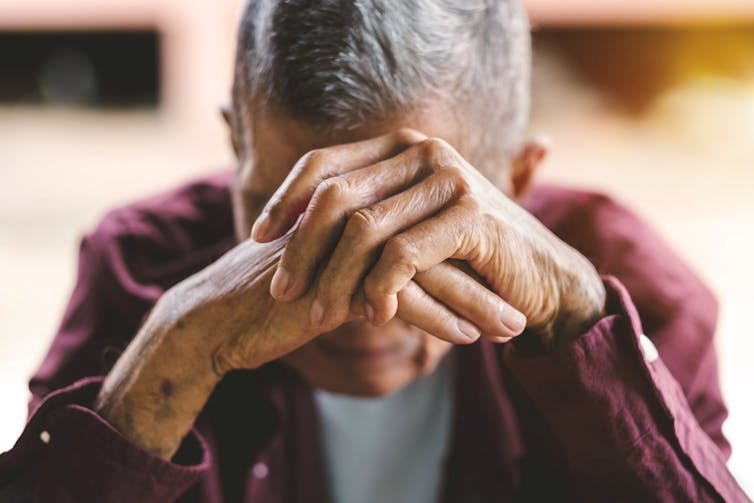 Some people will be at higher risk of mental ill health during COVID-19.
Shutterstock
Some people will be at higher risk of mental ill health during COVID-19.
Shutterstock
We need to act
For many of us, the fear and anxiety we felt during the early stages of COVID-19 will have improved as it’s become apparent Australia has been able to avoid the enormous toll seen elsewhere.
Nonetheless, past experience of financial crises and increased unemployment, such as during the great depression, show us the suicide rate does increase at such times.
Stressors such as rising household debt, increased social isolation and loneliness are key risk factors for suicide.
Read more: COVID lockdowns have human costs as well as benefits. It's time to consider both
While we may not be able to predict accurately how significantly deaths from suicide will rise, we do need to take action to prevent or minimise any increase in suicides in the months and years following the pandemic.
Close monitoring of the nation’s mental health through repeated targeted and well-constructed surveys will be vital to inform how we go about this.
We need all sectors of our nation to unite to face this challenge. Governments must invest wisely and in a timely manner to enhance mental health care for the whole community, paying particular attention to groups at higher risk.
Tackling this while avoiding a national panic about suicide is imperative. Raising well-meaning concerns is of course important, but placing the country on “suicide watch” is alarmist and could potentially cause more anxiety.
Authors: Jayashri Kulkarni, Professor of Psychiatry, Monash University

















