Yes, street art is on public display — but that doesn't mean we should share it without credit
- Written by Mike Dickison, Research Information Advisor, Massey University
When Wellington mural artist Xoë Hall discovered her work on a calendar, she hadn’t been contacted by anybody, let alone credited or paid for it.
This wasn’t the first time. Her art often appears on T-shirts and postcards without permission. This is because Hall is a street artist — and most people think street art is in the public domain, to be freely photographed, shared and republished. They’re wrong.
Street artists make a difference to the character of our cities and often use their art to raise social issues. But with a few high-profile exceptions, most don’t make much money.
Seeing street artists’ work ripped off, particularly by agencies with big photography budgets, is common. But there are things artists can do to protect their work from unauthorised use.
Read more: Street art: Personal creations get political with public messaging
Street art and copyright
Under New Zealand law, all original artworks are copyrighted automatically from the moment they’re created. Artists don’t need to register them or put a copyright symbol on them.
This gives two sorts of legal protection: legal rights and moral rights.
Moral rights mean the artist is identified as the author, and the work cannot be used in a derogatory way which could harm their reputation. Legal rights describe the exclusive right to make a copy of, communicate, or adapt the artwork.
To photograph and share an original artwork legally, you need to get the permission of the copyright owner and credit the artist. A common misconception is that copyright law only kicks in if you’re making money from using an artwork – but copying is copying.
Read more: Melbourne's love-hate relationship with being Australia's 'street art capital'
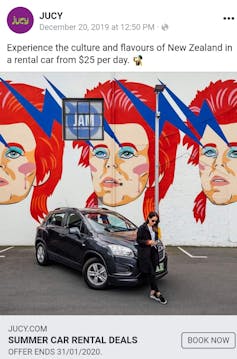 Xoë Hall, Author provided
Another misconception is that work in a public space isn’t copyrighted. New Zealand’s Copyright Act (1994) exempts some works like sculptures permanently installed in a public space, but protects “graphic works”, which include murals and other street art. Copies (photos) of those works need the permission of the copyright owner.
But many people aren’t aware of this. This includes tourists sharing holiday snaps on social media; marketing firms using street murals as a backdrop to advertising campaigns; building owners letting artists use their walls; city councils commissioning the art; and often even the artists themselves.
A test: would you carry a camera and tripod into an art gallery and photograph paintings to make a set of postcards? If this scenario gives you an ethical twinge, you should feel the same when photographing street art.
In most cases, casual photography is not a problem. Street artists usually don’t mind people celebrating their work by sharing photographs of it, especially if they’re credited. But when street art is used to sell a product or push a message, that’s a different story.
Xoë Hall, Author provided
Another misconception is that work in a public space isn’t copyrighted. New Zealand’s Copyright Act (1994) exempts some works like sculptures permanently installed in a public space, but protects “graphic works”, which include murals and other street art. Copies (photos) of those works need the permission of the copyright owner.
But many people aren’t aware of this. This includes tourists sharing holiday snaps on social media; marketing firms using street murals as a backdrop to advertising campaigns; building owners letting artists use their walls; city councils commissioning the art; and often even the artists themselves.
A test: would you carry a camera and tripod into an art gallery and photograph paintings to make a set of postcards? If this scenario gives you an ethical twinge, you should feel the same when photographing street art.
In most cases, casual photography is not a problem. Street artists usually don’t mind people celebrating their work by sharing photographs of it, especially if they’re credited. But when street art is used to sell a product or push a message, that’s a different story.
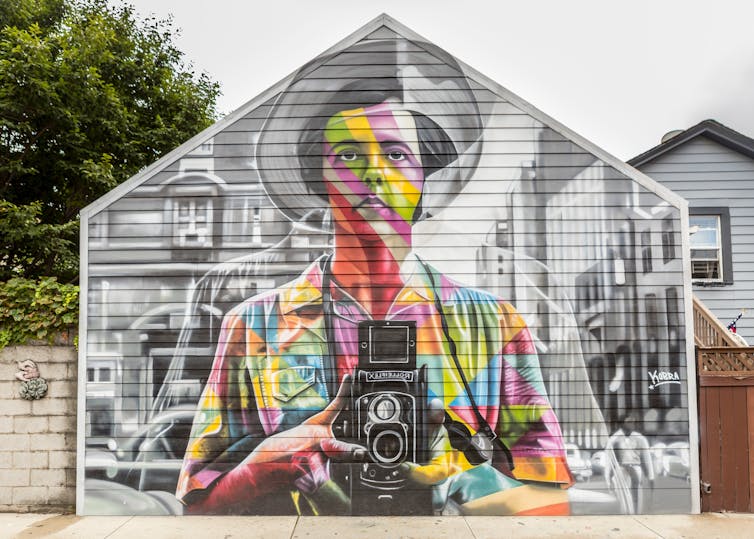 Brazilian street artist Eduardo Kobra’s mural in a Chicago park features the late photographer Vivian Maier. But since Kobra probably owns the copyright, the photo was almost certainly taken and shared without permission.
Matthew T Rader/Unsplash
How artists can protect themselves
One complication is figuring out who owns the copyright in an artwork, even one that has been signed. A lot of street art is commissioned, and under New Zealand law, copyright rests in the person who commissioned the work. Either party can put a clause in the contract assigning copyright back to the artist. The only problem: most street art is arranged with a handshake, not a contract.
And what exactly “commissioning” means can be murky. If the artist was paid, it’s obviously a commission, but what if they were paid in materials, or had their airfare or accommodation reimbursed, or were shouted a meal or beers?
Some street art festivals don’t pay the artists but cover their expenses. Do the artist know that by accepting they may be handing over their copyright to the organisers?
For their own protection, we think street artists shouldn’t do any work, paid or unpaid, without a contract. Ideally they should retain both their legal and moral rights to the work and get it in writing.
We also strongly recommend artists paint a copyright symbol and a date on the artwork along with their name. This makes it clear to photographers whom they need to credit and ask permission to reuse. If there’s a copyright owner who’s not the artist, add their name too.
The copyright owner might want to specify that taking photos for noncommercial use is permitted. The easiest way to do this is with a Creative Commons licence. The appropriate licence is Creative Commons Attribution Non-Commercial, which just involves painting “CC BY-NC” somewhere on the work, near the copyright symbol. This is an extra reminder to advertisers and marketers that they need to ask permission, and gives the copyright owner some comeback in cases of a flagrant breach.
We hope artists will feel motivated to organise and demand legal protection in their contracts, stop companies from selling unauthorised copies of their work, and even send an invoice to the worst offenders. And we should all credit them for what they do and respect their copyrights.
Many thanks to Tom Huthwaite for legal advice, which this article is not. Xoë and Tom have set up a website, Bad Exposure, to educate street artists about copyright.
Brazilian street artist Eduardo Kobra’s mural in a Chicago park features the late photographer Vivian Maier. But since Kobra probably owns the copyright, the photo was almost certainly taken and shared without permission.
Matthew T Rader/Unsplash
How artists can protect themselves
One complication is figuring out who owns the copyright in an artwork, even one that has been signed. A lot of street art is commissioned, and under New Zealand law, copyright rests in the person who commissioned the work. Either party can put a clause in the contract assigning copyright back to the artist. The only problem: most street art is arranged with a handshake, not a contract.
And what exactly “commissioning” means can be murky. If the artist was paid, it’s obviously a commission, but what if they were paid in materials, or had their airfare or accommodation reimbursed, or were shouted a meal or beers?
Some street art festivals don’t pay the artists but cover their expenses. Do the artist know that by accepting they may be handing over their copyright to the organisers?
For their own protection, we think street artists shouldn’t do any work, paid or unpaid, without a contract. Ideally they should retain both their legal and moral rights to the work and get it in writing.
We also strongly recommend artists paint a copyright symbol and a date on the artwork along with their name. This makes it clear to photographers whom they need to credit and ask permission to reuse. If there’s a copyright owner who’s not the artist, add their name too.
The copyright owner might want to specify that taking photos for noncommercial use is permitted. The easiest way to do this is with a Creative Commons licence. The appropriate licence is Creative Commons Attribution Non-Commercial, which just involves painting “CC BY-NC” somewhere on the work, near the copyright symbol. This is an extra reminder to advertisers and marketers that they need to ask permission, and gives the copyright owner some comeback in cases of a flagrant breach.
We hope artists will feel motivated to organise and demand legal protection in their contracts, stop companies from selling unauthorised copies of their work, and even send an invoice to the worst offenders. And we should all credit them for what they do and respect their copyrights.
Many thanks to Tom Huthwaite for legal advice, which this article is not. Xoë and Tom have set up a website, Bad Exposure, to educate street artists about copyright.
Authors: Mike Dickison, Research Information Advisor, Massey University