

how a faster WHO response could have slowed COVID-19's spread
- Written by Michael Toole, Professor of International Health, Burnet Institute
Urgent global action is needed to end the COVID-19 pandemic and prepare for future threats, according to a new report by the Independent Panel for Pandemic Preparedness and Response.
The panel, co-chaired by former New Zealand prime minister Helen Clark and former Liberian president Ellen Johnson Sirleaf, criticises the World Health Organization (WHO) for its tardy actions during the first months of 2020.
The WHO was slow to warn of person-to-person transmission after it first received this information in Wuhan, China, in early January.
And it was slow to declare a public health emergency of international concern (PHEIC), which it did on January 30.
The WHO also opposed international travel restrictions that, if implemented earlier, might have slowed the international spread of the virus. By the time the PHEIC was declared, COVID-19 had spread to 18 countries outside China.
But WHO’s hands were tied
While this may appear just a scathing criticism of the world’s peak health body, the WHO had its hands tied by the international framework that governs the response to emerging infectious diseases and pandemics, the International Health Regulations (IHR).
These regulations were drafted in 2005 in response to the SARS (severe acute respiratory syndrome) and H5N1 (avian flu) pandemics and endorsed by member nations in 2007.
The regulations imposed new requirements that must be met before the WHO director general could act on emergencies, rather than enabling the WHO to act immediately and independently.
The regulations also prohibit international travel restrictions in public health emergencies.
Read more: 'Fortress Australia': what are the costs of closing ourselves off to the world?
Many member nations failed to act
The report describes February 2020 as a “lost month”, referring to the time between the declaration of a PHEIC and the WHO statement on March 11 that characterised COVID-19 as a pandemic.
The panel found this was due to a lack of understanding that the PHEIC declaration was the loudest possible alarm open to the director general. The pandemic declaration was not based on International Health Regulation guidelines.
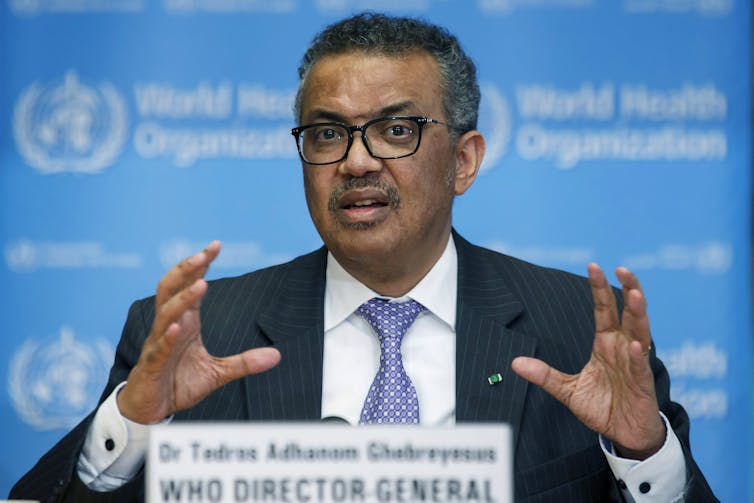 A public health emergency of international concern was the loudest alarm available to WHO director general Tedros Adhanom Ghebreyesus.
AP/Salvatore Di Nolfi
A public health emergency of international concern was the loudest alarm available to WHO director general Tedros Adhanom Ghebreyesus.
AP/Salvatore Di Nolfi
The panel found a number of countries took a wait-and-see attitude during February 2020, allowing the virus to spread uncontrollably.
Effective and high-level coordinating bodies were critical to a country’s ability to adapt to changing information. Yet only a few countries set in motion comprehensive and coordinated COVID-19 protection and response measures.
Of the 28 country responses the panel analysed in depth, only a handful adopted aggressive containment strategies, including China, New Zealand, South Korea, Singapore, Thailand and Vietnam.
Some others had uncoordinated approaches that devalued science, denied the potential impact of the pandemic, delayed comprehensive action and allowed distrust to undermine efforts. While not named, the United States and Brazil were probably among them.
The report praises the role of the African Union and the Africa CDC in leading a continent-wide coordinated response.
It also singles out research and development as a major achievement, especially in vaccine development.
Read more: Over 700 health experts are calling for urgent action to expand global production of COVID vaccines
Preparation was inadequate
Despite the lessons learned from previous outbreaks of SARS, H1N1 (avian flu), Zika, MERS (Middle East respiratory syndrome) and Ebola, preparedness was vastly underfunded.
The US government, led by the Centres for Disease Control, established the Global Health Security Agenda, a group of 70 countries — including Australia – committed to building global capabilities to implement the International Health Regulations. But the Trump administration defunded most of the US CDC’s activities under the agenda.
Read more: Defunding the WHO was a calculated decision, not an impromptu tweet
After the H1N1 pandemic, Australia reviewed its health sector response and made many recommendations for future preparedness. However, inaction followed. Australia has not run a large-scale pandemic simulation exercise since 2008.
Australia also dropped the ball on regional pandemic preparedness. After the SARS outbreak in 2003, the government developed a five-year regional emerging diseases and pandemics strategy, which received A$100 million from the Howard government. Yet the second five-year strategy attracted very little funding.
Fixing the global system
The panel urges immediate action to end the pandemic through:
- accelerated vaccination
- proven measures such as masks and social distancing
- testing and contact tracing.
However, the focus of its recommendations is on future preparedness.
The panel is convinced a Global Health Threats Council at the most senior level is vital to future success. It would help secure high-level political leadership and ensure attention to pandemic prevention, preparedness and response is sustained over time. Such a body is long overdue.
To ensure the WHO is more agile, the panel recommends an increase in the proportion of funding that is unearmarked for specific programs and countries. This would allow for financial reserves to respond to sudden, unexpected events. It also needs an improved surveillance system, quicker alerts for emerging virus threats, and authority to publish information and dispatch expert missions immediately.
Transparency, speed, flexibility to act more independently and better resourcing are critical to the reforms proposed. Efforts to do this will need unqualified support from its member nations, starting at this month’s World Health Assembly.
After the disruptive years of the Trump presidency, the WHO needs restoration. Australia is influential and should be at the forefront of ensuring this happens.
Authors: Michael Toole, Professor of International Health, Burnet Institute

















