

Zero-COVID is no longer an effective strategy. We need to learn from other countries how to adapt
- Written by: Tim Soutphommasane, Professor of Practice (Sociology and Political Theory) Director, Culture Strategy, University of Sydney
It’s four more weeks of lockdown for Sydneysiders, with no end yet in sight. NSW Premier Gladys Berejiklian is still to outline a roadmap out.
Sydney feels like it is going through COVID Groundhog Day right now. And not just because many are having to cope with being confined to home or struggling to stay on top of homeschooling.
Australia’s public policy approach to COVID also hasn’t significantly shifted from the settings of 2020. Despite the advent of astonishingly powerful vaccines and lessons from across the world, we still seem fixated on getting cases down to zero. We are also reliant on lockdowns.
Even Berejiklian, once so resistant to lockdowns, has now fallen into line.
It is vital, of course, that we vigorously control the current outbreak. We can’t afford to let the virus run rampant. Too many remain vulnerable as most Australians have not yet been offered the opportunity to be fully vaccinated.
But we have to prepare for a new future. Despite frequent promises, we have no focus on the more fundamental question about how we transition to reopening and rebuilding.
How can we learn from the examples of other countries that have adapted their public policies in the face of the Delta variant? What plans can we start putting in place now to safely reopen to the rest of the world when our vaccination rates eventually catch up?
The lessons learned in other countries
COVID-19 will be with the world for at least the foreseeable future. Experts tell us it will become endemic. The challenge then is to learn to live with the virus effectively, protecting public health while restoring freedoms and reconnecting with each other.
Countries around the world have taken different approaches to this challenge.
The UK has placed most of its confidence in vaccinations, with almost all pandemic restrictions now lifted and a plan to allow people who were fully vaccinated in the US and the European Union, and arriving from safer countries, to begin travelling to the UK without quarantining.
While there are many critics of the UK’s overall strategy, the country is also widely deploying rapid antigen home testing, which enables people to ascertain their own risk to others before they step out into crowded streets. Infection numbers have fallen in recent weeks, with some suggesting the country is perhaps reaching endemic equilibrium.
Read more: Why COVID cases are now falling in the UK – and what could happen next
France is taking another route, with a firmer focus on mandating vaccinations. Parliament this week approved a bill that will require a health pass (proof they are fully vaccinated, recently tested negative or recently recovered from the virus) to enter restaurants, bars, trains and planes.
In the wake of President Emmanuel Macron’s announcement of the new policies, more than 2.2 million vaccination appointments were made in under 48 hours.
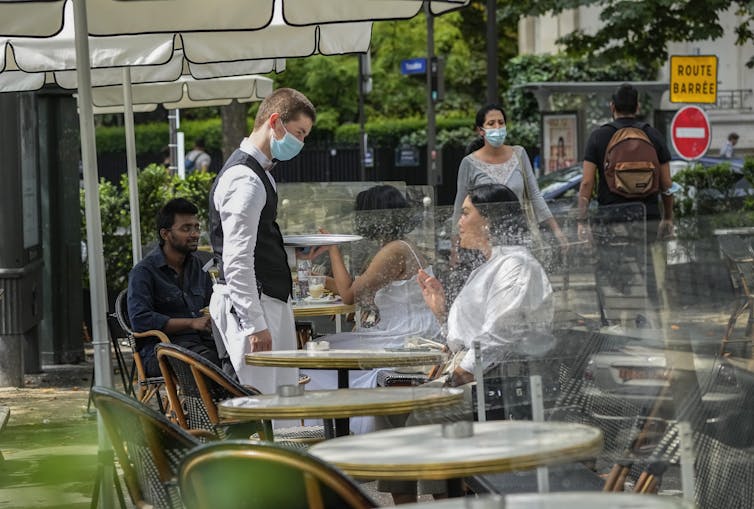 France’s health pass for restaurants and travel will come into force in August.
Michel Euler/AP
France’s health pass for restaurants and travel will come into force in August.
Michel Euler/AP
And in the US, President Joe Biden has unveiled a new door-to-door campaign in which health workers are literally knocking on doors to counter misinformation about vaccines and convince people to get the jabs.
Meanwhile, many countries that have pursued a zero-COVID path have struggled. Taiwan, once a success story in countering the virus, has only just emerged from more than two months of partial lockdown.
Like Australia, it has failed to vaccinate its population quickly enough – just 28% of Taiwanese people have had a single dose and only 1% are fully vaccinated.
Plans we could put in place now
For Australia to plan its next steps, we need to break the psychological hold that “zero Covid” has had on us for many months. We need to shift our attention to a long-term strategy for minimising hospitalisations and death.
Two months ago, a taskforce we convened published a “roadmap to reopening” that called for a staged, controlled and safe re-engagement with the world.
Read more: Australia risks becoming a hermit nation. Here's a five-step road-map to reopen our borders safely
We recommended the creation of travel bubbles prior to the conclusion of the nationwide vaccination program — namely, piloting programs for fully vaccinated foreign nationals with negative COVID tests to enter Australia for education or to work in specific industries, such as horticultural agriculture.
We also called for improving government messaging on vaccinations to challenge the terrible misinformation that has been spread, particularly about the AstraZeneca vaccine. And we argued that fully vaccinated people within Australia should be granted specific exemptions from some of the more onerous restrictions as a way of incentivising vaccinations further.
In addition, Australian states should be working to keep our schools open — even during outbreaks – by vaccinating our teachers, improving ventilation, mandating masks where required and deploying rapid testing. The NSW government’s plan to introduce rapid antigen testing at schools for Year 12 students is a welcome announcement, but more needs to be done.
Lastly, we urge the prime minister to make a more concrete plan to reopen the country. There should be a clear target date set for easing our domestic border restrictions and reopening our international borders. We should also move to home quarantine restrictions for fully vaccinated travellers and those travelling with negative tests from safer countries.
All of these measures should be in our grasp. If we look beyond ourselves, we see other forward-looking, democratic countries have chosen to work towards a staged, controlled and safe reopening with the rest of the world. Once the immediate crisis has passed, it’s time that became our choice, too.
Authors: Tim Soutphommasane, Professor of Practice (Sociology and Political Theory) Director, Culture Strategy, University of Sydney


















