

Increased incarceration of First Nations women is interwoven with the experience of violence and trauma
- Written by Deirdre Howard-Wagner, Senior Fellow, College of Arts and Social Sciences, Australian National University
There is a national incarceration crisis impacting First Nations women in Australia.
First Nations women are the fastest-growing prison population, constituting 37% of the female prison population, despite making up only 2% of Australia’s total population. The daily average number of women in full-time custody in the 2021 March quarter was 3,302, of whom 1,247 were First Nations women.
First Nations women in Australia are also imprisoned at more than 20 times the rate of non-Indigenous women.
The incarceration of First Nations women is interwoven with the experience of domestic, family, sexual and other forms of violence against women. A high number of First Nations women spend time in custody unsentenced for domestic violence incidents that would never result in a custodial sentence.
Thirty years on from the Royal Commission into Aboriginal Deaths in Custody Report, prominent cases continue to draw attention to the wrongful imprisonment of First Nations women:
the case of Jody Gore, who after experiencing decades of abuse, killed her former partner and was found guilty in 2016 and sentenced to life behind bars.
Ms Dhu, who was detained after calling for help during a domestic violence incident in 2014, only to be detained for unpaid fines. She subsequently died in police custody from septicaemia caused by a previous domestic violence injury.
Ava, who called police because she feared for her safety after a fight with her son in 2020. She was misidentified by police as the primary aggressor and spent five weeks in custody.
These cases draw attention to the connection between the multiple forms of violence First Nations women experience, and incarceration.
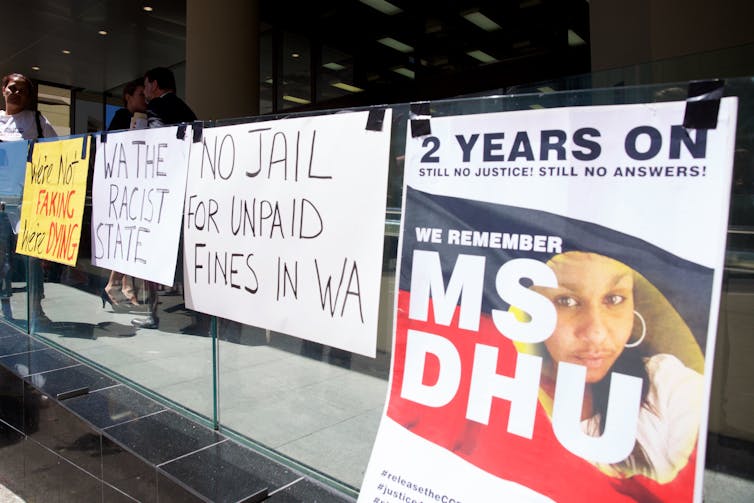 Signs put up by supporter of Ms Dhu outside the coroner’s court in Perth.
Richard Wainwright/AAP
Signs put up by supporter of Ms Dhu outside the coroner’s court in Perth.
Richard Wainwright/AAP
Links with domestic violence
Up to 90% of women in prison have experienced domestic and family violence. Most First Nations women in prison report experiencing multiple forms of violence at different times in their life.
Some had witnessed and experienced family violence as children and gone on to experience sexual assault, social isolation and physical intimate partner violence as young people and adults.
Trauma from these experiences contributes to other risk factors for incarceration, such as poor mental health, substance misuse, unemployment and low education. These factors disproportionately affect First Nations women and are linked to their own offending.
Twenty years ago, a report by the NSW Aboriginal Justice Council found that at least 80% of First Nations women linked previous abuse to their offending. This report revealed sexual abuse was “a central feature of pathways into offending”.
Domestic and family violence is also driving the incarceration of First Nations women through misidentification by police and other authorities.
Often, women who have experienced long-term abuse from an intimate partner are misidentified as the primary abuser and/or are named as the respondent in domestic violence orders. A domestic violence order sets out rules that must be obeyed by the respondent — the person who committed domestic violence — to protect the person listed as the aggrieved.
Women who have used retaliatory or pre-emptive violence in response to abuse or to protect themselves also come into contact with the criminal legal system. First Nations women are also more likely to encounter structural racism in their interactions with the criminal legal system.
Read more: Another stolen generation looms unless Indigenous women fleeing violence can find safe housing
First Nations women misidentified as perpetrators of violence
Misidentification can have disastrous and devastating consequences for women. Research has found that almost half of the women murdered by an intimate partner in Queensland had formerly been misidentified by police as a domestic violence perpetrator.
Alarmingly, in nearly all of the domestic and family violence-related deaths of Aboriginal people, the deceased person had been recorded as both a respondent and an aggrieved party in domestic violence orders.
Not only is the misidentification of First Nations women as the primary domestic violence abuser driving incarceration rates, it is costing women their lives. Not only are they not protected, they are being killed, and when they try to protect themselves, they are jailed.
Behind the increasing incarceration rates lies a serious crisis with many Indigenous policy considerations, such as the experiences of trauma, sexual and emotional abuse, and family and intimate partner violence.
We haven’t even addressed mental health issues, homelessness and entrenched social and economic disadvantage among incarcerated First Nations women. Or how, ten years ago, Australian Bureau of Statistics data revealed 67% of all First Nations women in prison had been incarcerated before, compared with fewer than half of non-Indigenous women.
The data also showed more than 80% of First Nations women in prison were mothers.
 First Nations women make up 37% of the female prison population in Australia.
Damian Pankowiec/ shutterstock
First Nations women make up 37% of the female prison population in Australia.
Damian Pankowiec/ shutterstock
What needs to happen
Community-led, trauma-informed preventative support programs for First Nations women are desperately needed. This would include significant investment in community-based services and housing for vulnerable First Nations women at risk of becoming involved in the criminal legal system.
Systemic change is needed to divert women from entering prison by addressing the way the police and criminal legal system identify primary domestic violence abusers and respond to domestic, family, and sexual violence.
Ultimately, addressing violence against women requires long-term commitment to create social and cultural change through the promotion of gender and racial equality.
Authors: Deirdre Howard-Wagner, Senior Fellow, College of Arts and Social Sciences, Australian National University

















