

We can't rely solely on arbitrary vaccination levels to end lockdowns. Here are 7 ways to fix Sydney's outbreak
- Written by Quentin Grafton, Australian Laureate Professor, Crawford School of Public Policy, Australian National University
On July 15, New South Wales Premier Gladys Berejiklian said Sydney’s COVID lockdown wouldn’t end until the number of new cases not in full isolation was zero or as close to zero as possible.
But by August 1 the premier’s message had shifted:
Once you get to 50% vaccination, 60%, 70% it obviously triggers more freedoms […] The challenge for us is to get as many people vaccinated in August as possible so that by the time August 28 comes around, we have a number of options before us as to how we can ease restrictions.
There are around five million Australians under 16 who aren’t eligible to be vaccinated (bar a few groups of 12-15-year-olds whom the Australian Technical Advisory Group on Immunisation (ATAGI) said this week should be prioritised for vaccination, including Aboriginal and Torres Strait Islanders and those with certain underlying health conditions).
So, vaccinating 50% of the eligible population represents only about 40% of the whole population. Vaccinating 70% of the eligible population means only 56% of the whole population are vaccinated.
There can be no relaxation options determined solely by vaccination rates of 50% or even 70% of the eligible population. We cannot give up on our safety by pretending these vaccination rates in over-16s during an insufficiently controlled COVID outbreak would be like “living with the flu”. It won’t be.
Relaxing lockdown prematurely based solely on an arbitrary (and much too low) vaccination rate will likely lead to escalating cases and impose huge costs on Sydney and the rest of Australia.
Having not gone early, hard and fast, we propose seven key actions to save Sydney.
Crucially, Sydney’s lockdown needs to continue until the number of new daily cases who weren’t in full isolation reaches zero.
What does 70% of the eligible population vaccinated mean for Australia?
The premier’s August 1 announcement was similar to the federal government’s National Transition Plan released on July 30. The plan states that when 70% of Australians over 16 are vaccinated, governments should “ease restrictions on vaccinated residents”, and that lockdowns will be “less likely but possible”.
Read more: Vaccination rate needs to hit 70% to trigger easing of restrictions
As we’re seeing in Southeast Queensland now, Delta is acquired and transmitted by children. This means only vaccinating 70% of over-16s will leave our kids vulnerable to COVID outbreaks. In the absence of public health measures, these children will pass it on to their friends and families.
While the risk of death from COVID, even with Delta, is lower among children than adults, there’s still a risk of long-term health consequences called “long COVID” among the young (and old).
Researchers dispute how common long COVID is in kids. But a study of children in Italy who have had COVID reported more than half had at least one symptom lasting more than four months, and more than 40% had a health problem due to long COVID that impaired their daily activities.
A UK survey of 23,000 households, published online as a preprint in June, found 5% of children infected with COVID had suffered persistent post-COVID symptoms for longer than four weeks.
What could happen if Sydney’s lockdown is relaxed too soon?
As of August 6, and since the Delta outbreak began in Sydney on June 16, there have been 4,610 locally acquired cases and 22 deaths. On August 6 there were 304 people hospitalised, 50 in intensive care with 22 requiring ventilation.
Using these stats, we can estimate what might happen should there be a partial relaxation of the current Sydney lockdown after 70% of over-16s in Greater Sydney are fully vaccinated and the outbreak is still ongoing.
First, if the vast majority of new daily cases aren’t in full isolation while infectious when lockdown restrictions are relaxed, this could easily result in a rapid growth in infections. This is because Delta is highly transmissible — infected people develop a viral load on average 1,000 times higher than the original strain. Even with new daily case numbers much lower than the numbers in early August, contact tracing wouldn’t be an effective secondary prevention strategy.
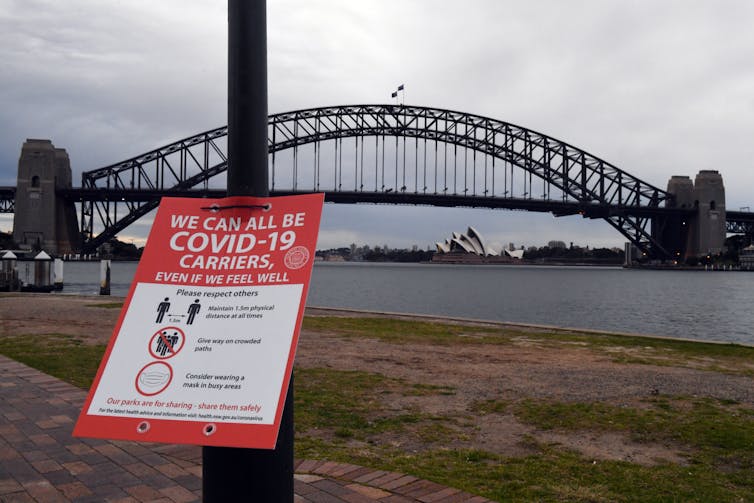 Relaxing restrictions with infectious cases still out there will likely lead to escalating cases again.
Mick Tsikas/AAP
Relaxing restrictions with infectious cases still out there will likely lead to escalating cases again.
Mick Tsikas/AAP
Let’s say partial relaxation after August 28 resulted in rapid and uncontrolled growth of new cases. We estimate that over a few months, and in the absence of subsequent lockdowns, this could result in as many as 100,000 cumulative hospitalisations, a total of more than 10,000 COVID patients in intensive care and, tragically, thousands of deaths in Greater Sydney alone.
This assumes that in an uncontrolled spread, eventually all unvaccinated people become exposed to COVID. We based these figures on the current ratios of how many people in Sydney have been hospitalised and died from COVID from the total number of cases, multiplied these numbers by the unvaccinated population, and extrapolated these numbers forward in the scenario of an uncontrolled outbreak.
Based on our previous research, the minimum economic cost of those hospitalisations (ignoring lost wages and the costs of “long COVID” and ongoing care generally) in Greater Sydney could easily exceed half a billion dollars. The economic costs from the expected loss of life would be in the tens of billions.
Read more: No, we can’t treat COVID-19 like the flu. We have to consider the lasting health problems it causes
7 ways to fix Sydney’s outbreak
Experience from Australia and around the world tells us what needs to be done to protect public health and the economy.
NSW must:
ensure Sydney’s lockdown continues beyond August 28 until the number of new daily cases who aren’t in full isolation reaches zero
focus on daily testing of essential and front-line workers so pre-symptomatic and asymptomatic workers are identified before they enter the workplace. NSW should use the very best rapid test technology. Essential workers can be quickly and easily screened at a fraction of the cost and time of the standard PCR test
ensure everyone in lockdown gets adequate financial support to stay home, including those on visas. This is much more cost-effective than having those struggling financially not get tested and go to work, get infected and possibly spread COVID
actively minimise leakage to rural NSW, including setting up a “ring of steel” around Greater Sydney. This should include checking essential services drivers are up to date with daily rapid testing and measures to prevent other travellers from leaving
make masks mandatory outdoors as well as indoors (outside the home) throughout Greater Sydney
maintain the focus on increasing the vaccination rate among Sydneysiders by taking vaccinations to essential workplaces
recognise that until Sydneysiders, including children, have had the opportunity to be fully vaccinated then stringent lockdowns will need to be implemented rapidly whenever there are uncontrolled outbreaks of COVID.
Authors: Quentin Grafton, Australian Laureate Professor, Crawford School of Public Policy, Australian National University

















