

Australia's stumbling, last-minute dash for climate respectability doesn't negate a decade of abject failure
- Written by Lesley Hughes, Professor, Department of Biological Sciences, Macquarie University
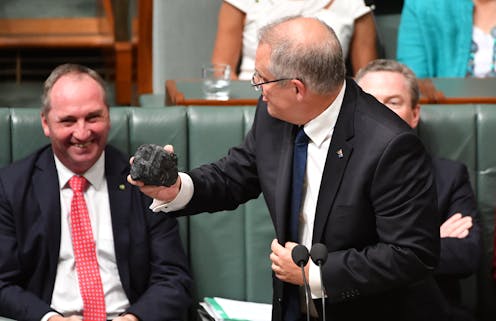
Prime Minister Scott Morrison is poised to announce Australia will adopt a target of net-zero greenhouse gas emissions by 2050. The pledge is long overdue – but the science tells us 2050 is about a decade too late to reach net-zero.
If we want to meet the goals of Paris climate agreement and limit global warming to 1.5℃ this century, what actually matters is the action we take this decade.
No doubt the federal government will expect to be congratulated for finally succumbing to the extraordinary international and community pressure brought in the lead up to the COP26 meeting in Glasgow.
But after eight years without an effective policy to reduce emissions, it’s sadly too little, too late.
Balancing the carbon budget
The carbon budget approach is a useful way to assess whether climate targets are adequate.
Carbon budgets show the amount of carbon dioxide (CO₂) that can be emitted for a given level of global warming. It’s based on the (approximately linear) relationship between the amount of CO₂ emitted from all human sources since the beginning of industrialisation and the increase in global average surface temperature.
Once the carbon budget has been “spent”, or emitted, emissions must be at net-zero to avoid exceeding the corresponding temperature target. In a report released in April, the Climate Council used this approach to estimate Australia’s fair share of the global effort to meet the Paris targets.
To keep global temperatures below 1.5℃, and assuming humans emit CO₂ at the current rate of 43 billion tonnes a year, we have about 2.5 years of emissions still to spend. This pushes out to 5 years at a linear rate of emission reduction, achieving net-zero emissions by 2026.
Using the same logic, we also calculated when the world would exceed the Paris ambition of staying “well below 2℃” of warming, which we assume to be 1.8℃. Our remaining global carbon budget would be spent in about 9.5 years – so by about 2030. This pushes out to 19 years at a linear rate of emission reduction, so net-zero emissions would need to be achieved by about 2040.
Read more: Who's who in Glasgow: 5 countries that could make or break the planet's future under climate change
Australia’s fair share
These calculations relate to the global effort. So what is Australia’s fair contribution? In 2014 the Climate Change Authority, a panel of government-appointed experts, addressed this question.
The Climate Change Authority recommended Australia’s emissions be reduced by between 45% and 65% on 2005 levels by 2030. This approach generously allocated 0.97% of the remaining global carbon budget to Australia even though our population is about 0.33% of the global total.
Applying the same method today to estimate Australia’s share of the remaining carbon budget, we calculate Australia needs to achieve net-zero emissions within 16 years – around 2038 – and reduce emissions by 50% to 75% by 2030.
So any way you cut it, net-zero emissions by 2050 is too late.
And we must not forget, Australia is a wealthy country, with one of the highest per capita emission rates. That means doing our “fair share” should entail emissions reductions greater than the global average.
An emissions target for Australia of 75% below 2005 levels by 2030, and reaching net-zero emissions by 2035, is consistent with global efforts to limit warming to 1.8℃. There’s no doubt achieving a 75% reduction in Australia’s emissions by 2030 would be challenging, but this target is both scientifically robust and ethically responsible.
The world is watching
COP26 in Glasgow will be a defining moment in the global response to climate change. In the words of COP President-Designate Alok Sharma:
The choices we make in the year ahead will determine whether we unleash a tidal wave of climate catastrophe on generations to come. But the power to hold back that wave rests entirely with us.
More than 100 countries have pledged to achieve net-zero emissions by 2050, and the G7, consisting of the world’s largest developed economies, has committed to at least halving its emissions this decade. That’s the good news.
The bad news is that for all the ambition, a United Nations report released last month points to a 16% increase in emissions by 2030 compared to 2010. This would lead to about 2.7℃ warming by 2100.
Adding to the bad news, Australia is the worst-performing of all developed countries when it comes to meaningful climate action.
We ranked dead last in 2021 for action taken to reduce global greenhouse gas emissions in the UN Sustainable Development Report. The latest report from the Climate Council also ranks Australia last, compared to 30 other wealthy developed countries, for both climate policy/action, and fossil fuel dependence.
The list of poor rankings could go on, but there’s no doubt Australia is viewed as a global climate pariah.
Repairing the damage
To turn this miserable position around, Australia should be going to Glasgow with a far stronger emissions-reduction target for 2030. This should be backed by a national plan to rapidly decarbonise our electricity and transport sectors, absorb more carbon in the landscape and support the transition of communities to new clean industries.
It goes without saying Australia must commit to ending public funding for coal, oil and gas – both their use and extraction. And we must say no to any new fossil fuel developments.
Australia must also make a new commitment to support climate action in developing countries because if poorer nations don’t also make the low-carbon transition, the whole world suffers. As a first step, Australia should follow the United States in doubling its current climate finance contribution, which would bring AUstralia’s contribution to least A$3 billion over 2021-2025.
A week before a major international meeting aimed at saving life on Earth, the Morrison government has apparently seen the light.
Granted, it’s a start. But the new targets are less than the bare minimum required. The government’s last-minute jump on the bandwagon is not quite the Damascene conversion it would have the public believe.
Will Australia’s stumbling, last-minute dash towards climate respectability be well-received in Glasgow? Don’t hold your breath.
Authors: Lesley Hughes, Professor, Department of Biological Sciences, Macquarie University

















