

New bird brain study shows evolving a big brain depends on having 'good' parents
- Written by Szymek Drobniak, DECRA Fellow, UNSW Sydney
As owners of some of the biggest brains in the animal kingdom, we humans often assume cognitive performance, task solving and social interactions were the basic ingredients that promoted the evolution of our complex brains.
Our new study, recently published in the Proceedings of the National Academy of Sciences, challenges this intuitive assumption.
Taken together with other biological and ecological factors, cognitive and social factors lose their leading role in driving increased brain sizes. Instead, it is the amount of parental care the offspring receives that supports a larger brain.
Brains are expensive
The brain is one of the most costly organs in an animal’s body – neural activity requires large amounts of energy. The bigger the brain is, the more energy it needs to sustain itself.
Biologists have long assumed this large cost has to come with some solid benefits provided by being large-brained. Some of the proposed advantages were cognitive skills, the ability to solve difficult problems and engage in complex social interactions.
Looking at humans, great apes and other primates seemed to confirm this assumption: our large brains are routinely used in situations requiring creative solutions, and to maintain social integrity in large groups.
There is one problem with this reasoning. Large brains take a long time to grow and while they do so, they still need substantial amounts of fuel (even more than in adulthood). They are also significantly less powerful before they reach their final size and complexity. Growing animals would therefore have to “pay” for growing brains, but would not be able to use the brains’ power for a considerable time.
Bird brain investigations
To solve this apparent paradox, we decided to look away from mammals, which are traditionally used in brain research – but also have almost exclusively been studied in the context of cognition. Instead, we dived into the bird world. Birds are amazing models in many evolutionary studies: they are extremely diverse, have a wide range of lifestyles, and live in nearly all wild habitats on Earth.
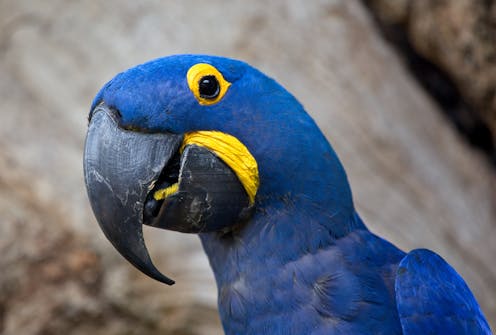
Bird brain sizes are also hugely variable, ranging from relatively small-brained chickens and ostriches to some of the smartest large-brained species such as parrots and corvids.
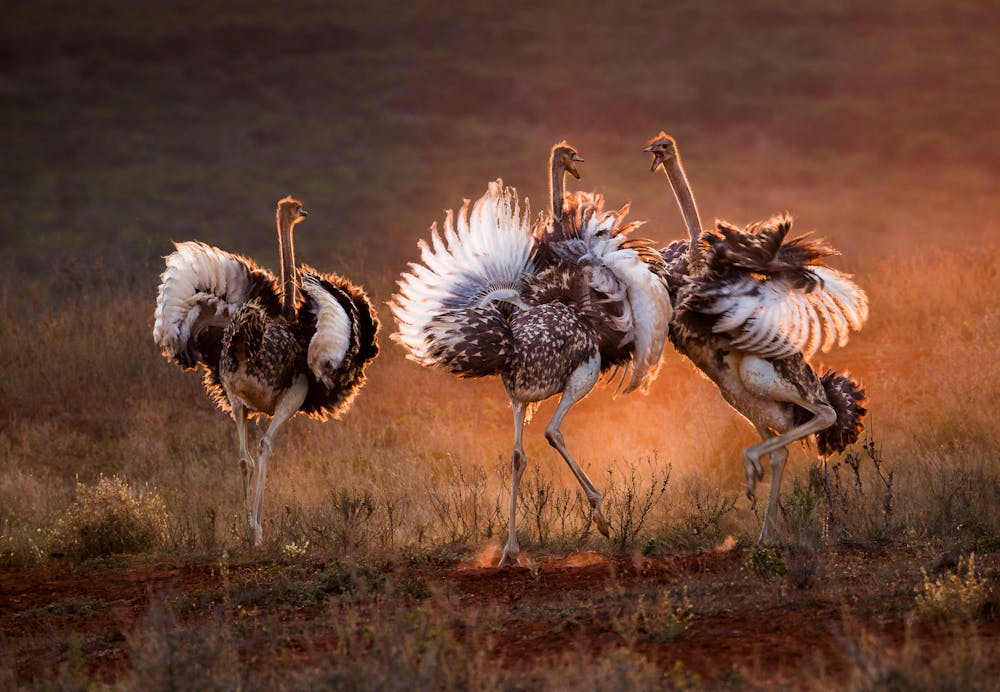
Note that we are referring here to relative brain size. In other words, we are interested in the size of the brain in relation to the animal’s whole body. After all, it is easy to have a large brain (in absolute terms) if you are a large animal in general. Such body-size-related increases in brain size also would not necessarily lead to improved cognition.
Our analysis included more than 1,000 bird species for which we had data on brain size. We also collected many other variables that might be relevant as potential drivers of brain size: the climate each species lives in; whether it is migratory or not; how it feeds and what its main food source is.
Most importantly, for all included species, we were able to find records on how social and co-operative they were, and how much parental care they provided to their offspring.
It starts in the nest
Our analysis revealed that, in combination with all included variables, social factors were only weakly related to brain size variation in birds.
It turned out that co-operation and living in larger groups – circumstances commonly assumed to be strongly linked to large and complex brains – almost did not matter as causes of exceptional braininess.
Of all analysed species traits, only those directly linked to parental care and offspring provisioning showed strong relationships with brain size. Our data showed species that fed their young for a longer time were species with some of the biggest brains (again, relative to body size).
The development style mattered a lot, too. Birds can be easily divided into two large groups. Precocial species are those where juveniles hatch from eggs already relatively well developed (such as chickens, ducks, geese), requiring little to no feeding.
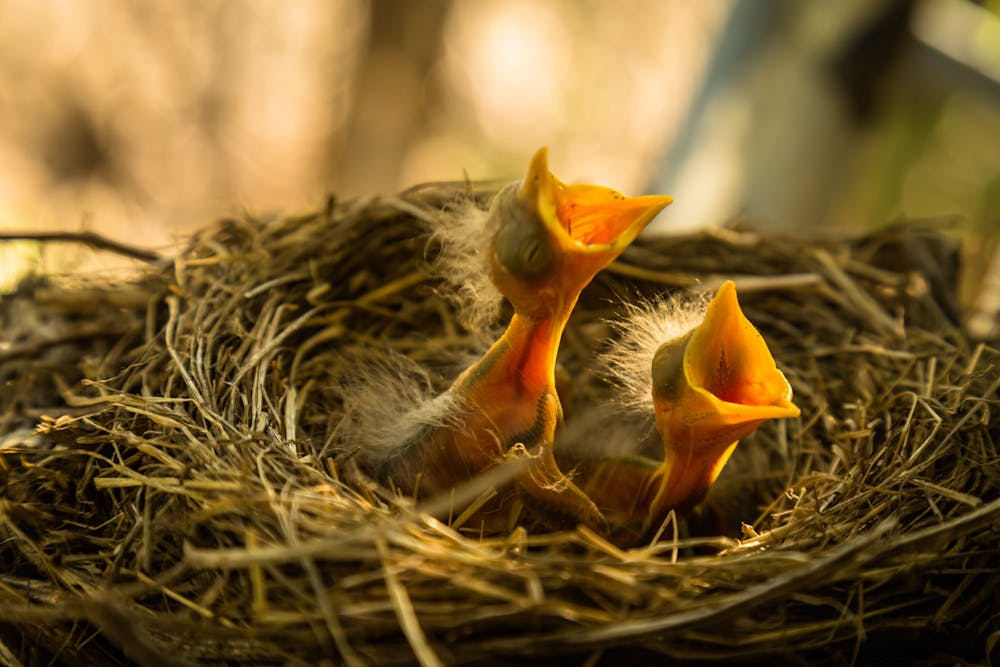 Altricial birds are born helpless, but being fed for long periods by their parents lets them grow bigger brains.
Shutterstock
Altricial birds are born helpless, but being fed for long periods by their parents lets them grow bigger brains.
Shutterstock
Altricial birds, in contrast, hatch severely underdeveloped. Usually their hatchlings are blind, naked and fully dependent on their parents’ care. This group includes some of the best-known bird groups we encounter every day, such as sparrows, tits, robins and finches.
Because altricial birds receive relatively more care from their parents, we predicted that they should also be able to evolve bigger brains – a pattern that we see clearly in our data.
Even if challenging from the point of view of other existing hypotheses (such as the “social brain hypothesis” mentioned earlier), our results make a lot of sense.
As said earlier, brains are huge consumers of energy. If this energy cannot be provided in the usual way (because a juvenile has an underdeveloped brain and cannot feed itself independently), it must be supplied by parental feeding.
Did human brain evolution follow the bird path?
Our results raise an interesting question – did the evolutionary history of mammalian and human brains follow the same logic? Did it depend more on parental care than on the expansion of social behaviours and co-operative interactions?
Probably yes. Evidence exists that large acceleration of human brain-size evolution was associated with increased number of caregivers and prolonged provisioning of juveniles well into their adolescence.
It also seems mammalian brain size is indeed constrained by the amount of energy mothers can transfer to their offspring until weaning. When it comes to having a large brain, it appears parental love and care come before any subsequent learning.
Read more: Mammals' brains: new research shows bigger doesn't always mean smarter
Authors: Szymek Drobniak, DECRA Fellow, UNSW Sydney

















