Batteries are the environmental Achilles heel of electric vehicles – unless we repair, reuse and recycle them
- Written by Mehdi Seyedmahmoudian, Associate Professor of Electrical Engineering, Swinburne University of Technology
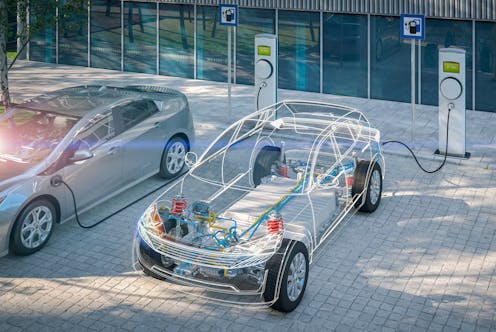
Electric vehicle advocates say the cars ultimately have a smaller carbon footprint than their fossil-fuelled counterparts and could resolve our energy concerns for good. Well, fair enough, but questions arise when we dig into the inner layers of electrical vehicles and see how sustainable their components are. In fact, the batteries that power electric vehicles may also be their Achilles heel.
Batteries are the most expensive component of an electric vehicle. If the battery pack is damaged, defective or simply old, this can lead to the vehicle being written off prematurely. Tesla is even producing “structural” battery packs described as having “zero repairability”.
Increasingly scarce and valuable resources, such as lithium and water, are needed to make these batteries. Despite this, they are often not designed for ease of repair, reuse or recycling. This has significant environmental impacts, ranging from the mining for materials and the water and energy used in making new batteries and vehicles, through to the hazardous waste from discarded batteries.
In other words, the answer to the question of “Are electric vehicles really eco-friendly?” largely depends on how we manage the downsides associated with their batteries. Changes in how we design, produce, use and recycle electric car batteries are urgently needed. These changes can ensure that, in solving the problem of fossil fuel emissions, we also minimise other environmental harms.
Read more: Electric cars can clean up the mining industry – here's how
Tackle the problems before they get too big
It’s important to resolve these issues now, while electric vehicles make up a small fraction of the global vehicle fleet. Even in world-leading Norway, only 20% of cars on the road are electric. In Australia, fewer than 100,000 out of 20 million registered vehicles are battery-powered.
Yet already we are wrestling with the emerging concerns about their batteries. The performance of lithium batteries in an electric vehicle can degrade to 70-80% of its full capacity within six to ten years, depending on the owner’s driving routine. At that point, the battery is barely reliable as the main energy source of the vehicle. Repeated fast charging can degrade a battery sooner.
Globally, about 525,000 batteries will reach the end of their useful life for powering a vehicle by 2025. That number soars to over 1 million by 2030.
Read more: Can electric vehicle batteries be recycled?
There’s life after EVs for batteries
However, the total lifetime of lithium batteries is 20 years. This means the end of a battery’s usefulness in a vehicle doesn’t necessarily mean it has to be discarded. These retired batteries can have plenty of other uses.
So how much capacity does a retired battery still have? As an example, an energy storage made of five repurposed Chevrolet Volt batteries can meet two hours of peak-use energy demand for five houses. The numbers become even more appealing for Tesla Model 3 batteries, which have three times the energy capacity of the Chevrolet Volt’s.
That is a tremendous capacity still available in a retired battery. So why not use that?
And once the battery has reached the end of its useful life, most of the raw materials used to make it can be recovered. It is possible to extract over 95% of the valuable metals like lithium, nickel, cobalt and copper. The European Union already requires electric vehicle batteries to be at least 50% recyclable by weight, increasing to 65% by 2025.
However, the current lack of standardisation of battery packs presents a challenge for battery recycling. There are many different physical configurations, cell types and cell chemistries.
Read more: Designing batteries for easier recycling could avert a looming e-waste crisis
Reuse has a long value chain
The good news is that battery reuse is not a fictional utopia. Carmaker Nissan is already doing it on Koshikishima, an island in south-western Japan. Batteries are recovered from electric vehicles, have their health assessed and then allocated to suitable second-life applications.
These batteries can be reused in a solar farm, as an emergency household power supply, or for an electric forklift in a warehouse. Research shows this repurposing of batteries can get another 10-15 years’ use out of them. That’s a huge leap towards reducing their environmental impact.
So, who benefits from this scheme? Well, there’s a long list.
In the first row, electric vehicles owners benefit immediately if their used batteries can be sold for a good price.
In the longer run, the list of beneficiaries expands massively. Households can enjoy more reliable and cheaper energy simply by charging up their battery storage during off-peak hours for use at peak times when electricity costs are higher. As an initiative in Portugal showed, using repurposed electric vehicle batteries in this way could cut energy bills by 40%.
Reusing batteries is good news for the environment. Research suggests reducing the demand for new batteries in this way could cut greenhouse gas emissions from making batteries by as much as 56%.
Read more: Cooperation with the US could drive Australia’s clean energy shift – but we must act fast
The long list of benefits of giving electric vehicle batteries a second life, then recycling their materials, is enticing. Given the scale of the potential economic and environmental gains, along with the countless jobs such work can create, batteries could be more generous in their afterlife than in their first incarnation in electric vehicles.
Authors: Mehdi Seyedmahmoudian, Associate Professor of Electrical Engineering, Swinburne University of Technology