carers talk about the lonely, stressful work of looking after loved ones
- Written by Fleur Sharafizad, Lecturer in Management, Edith Cowan University
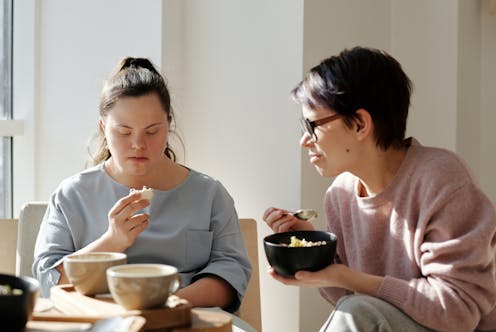
An informal personal carer is someone who looks after a family member, neighbour or friend in need of care due to disability, illness or age.
In Australia, there are approximately 2.8 million informal personal carers, including 906,000 who are primary carers. Projections suggest the national demand for carers will rise 23% by 2030.
Around one in ten Australians are informal carers: most of these unpaid. This group of people support one of society’s most foundational needs and our economy would struggle without them.
Yet, little is understood about their experiences. Our recent research reveals how this group of carers lack necessary support for their own wellbeing.
Our research
We interviewed 36 informal personal primary carers living across Western Australia and Queensland. Respondents were aged between 34 and 69 years, and had all been the primary carer for a child, parent, partner, or in-law, for between two and 21 years. Data was collected in two waves: one in 2020 and the other in 2021. Respondents were recruited with the help of an Australian carers’ organisation.
‘I’d rather it be someone else’s problem’
Many of the carers we spoke to said they were not caring by choice, but by necessity. They said they feel both unseen and undervalued. A husband who had been caring for his wife who suffers from Alzheimer’s said:
I would rather work. I really don’t like being a carer. I’d rather it be someone else’s problem. Being a carer, you just get forgotten.
Carers generally provide care around-the-clock, yet their compensations (such as carer payments) are far from equivalent to full-time pay. The carer payment, for example, equates to only 28% of weekly ordinary time earnings in Australia, and carers can expect to lose approximately $17,700 in superannuation every year they provide care.
Few of Carers Australia’s pre-budget submission items to benefit carers were adopted in the most recent federal budget. Instead, the budget contained items which may indirectly benefit carers through increased support for the cared-for. But these measures do not explicitly recognise and support carers’ wellbeing.
Similarly, the recent draft of the National Strategy for the Care and Support Economy recognises the contribution informal carers make to Australia’s economy but focuses on paid care and support.
Our interviewees spoke about the personal costs of their work, and the stress and loneliness they experience. They shared feelings of being taken for granted as if their role was not work, let alone difficult work. One mum caring for her disabled son shared:
I just want people to see that, [a] carer doesn’t have any leave, paid leave, or recognition. People just think that’s your loved one, that’s your job. But I do want people to understand that I did not choose to be a carer as my career, but I will do it because it is important.
This played into a feeling of people losing their sense of self, because caring work was so demanding and time consuming. A mother who had been caring for her daughter for 17 years after she had been involved in an accident said:
People don’t realise how much we put our life on hold to support the people that need that emotional and mental and physical and spiritual support. We put ourselves in the back shed while we’re supporting them, so we lose ourselves.
Read more: 'Respite care' can give carers a much-needed break, but many find accessing it difficult
A mental toll
Many spoke of how they once had individual goals and ambitions, which they now considered unachievable. All of our interviewees had quit jobs and halted careers to take on personal care full-time. One mother caring for her ill child said:
I think if I had a crystal ball, I don’t know that I would perhaps have become a parent, I think I would have just stuck to my corporate life and had a cat and be done with it.
The mental health toll experienced by carers in our study was clear throughout all interviews. A mother looking after her child with mental health challenges expressed:
Every carer has mental health impacts from being a carer. They won’t say it’s depression or anxiety, but it’s mental health because when the hierarchy of needs is not being met for you, you can’t provide them for somebody else.
As one interviewee explained, the demanding nature of the work had left them exhausted and as though they “can’t do it”. Our interviewees spoke of “falling apart” under the strain of constantly caring for high-needs people in their households. One mother who cared for her children who were both on the autism spectrum recalled:
How many times, if I don’t go to the bathroom and have a shower to cool down myself, I could kill the kids and myself easily. That’s how bad. We are not ever in the category to get help.
Feeling abandoned
Because so much of their work happens in pre-existing relationships and behind closed doors, carers talked about not just feeling unseen but abandoned. A common theme across all interviews was how carers felt abandoned by institutions, health professionals and, in many cases, friends and family members. One husband who had cared for his wife for close to 20 years said:
The government doesn’t even care about the carers […] we’re not really getting anything and then they’re trying to take the crumbs off us.
Carers do not have psychological, institutional or social support for themselves as individuals, separate from their role. But these support pillars are necessary so the entire responsibility of care does not fall solely on informal carers.
Carer-inclusive activities could be a good start. But policy should also be responsive to the unique and unmet needs of carers. These relate to the lack of personal and professional development, feelings of abandonment and social isolation.
With an ageing population, a pandemic, and an emerging crisis over the quality of care for older Australians and people with disabilities, the role of informal carers has become increasingly important.
The truth is that most of us will likely, at some point, undertake care work or be the person being cared for. Better formalised support for carers will ultimately improve the care for the most vulnerable among us and society as a whole.
If this article has raised issues for you, or if you’re concerned about someone you know, call Lifeline on 13 11 14. Carers Australia also offers advice and support.
Authors: Fleur Sharafizad, Lecturer in Management, Edith Cowan University