

Modern Australian
Times Advertising

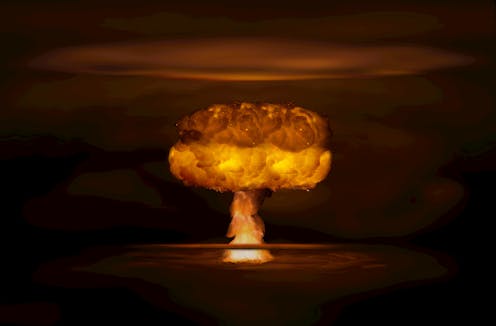
what does a nuclear bomb actually do?

  • Written by Kaitlin Cook, DECRA Fellow, Department of Nuclear Physics and Accelerator Applications, Australian National University
what does a nuclear bomb actually do?

I would like to know what a nuclear bomb actually does – Rafael, age 11, Melbourne

Hi Rafael!

A nuclear bomb, like any bomb, makes an explosion by releasing an enormous amount of energy at once. Nuclear bombs just use a different process from other bombs.

You may have heard of atoms. These are the super-tiny particles that make up matter – which in turn makes everything around us (and us).

Nuclear bombs work by changing the cores of atoms to turn them into other types of atoms. This process releases a lot of heat energy, which quickly gets converted into a big wave of pressure: an explosion!

What are nuclei?

Nuclear bombs release much more energy than normal bombs that use chemicals such as TNT. This is because the cores of atoms are held together very strongly. But before I get into that, let me explain some of the basics.

Atoms themselves are made up of even smaller particles called protons, neutrons and electrons. A cloud of electrons surrounds a tiny inner core made of protons and neutrons. This core is called the nucleus, and more than one nucleus are called nuclei.

Diagram of an atom, showing electrons surrounding a core of protons and neutrons.
An atom is made up of electrons surrounding a central core of protons and neutrons. The core is about one-hundred thousand times smaller than the atom. AG Caesar/Wikimedia Commons

Chemical reactions happen when electrons are rearranged, whereas nuclear reactions happen when protons and neutrons inside the nucleus are rearranged.

There are two types of nuclear bombs. In the case of “fission” bombs, nuclei that have a lot of protons and neutrons – such as those in a very dense metal called uranium – are split apart.

Uranium is a chemical element with the atomic number 92. It has 92 protons and electrons. Shutterstock

In another type of nuclear bomb called a “fusion” bomb, two very small nuclei – such as the cores of two hydrogen atoms – are stuck together.

But fission bombs are simpler and more common, so let’s talk about those.

Chain reactions

Some nuclei don’t take very much energy at all to split apart, such as those in some types of uranium or plutonium atoms (plutonium is another dense metal which has 94 protons in its nuclei).

These nuclei will sometimes fission even when they’re just sitting around. When a nucleus fissions, it turns into two smaller nuclei and spits out a few neutrons.

However, one nucleus doing this isn’t a big deal. To make an explosion, you need to have a certain amount of uranium together in one spot.

For instance, a fission bomb would usually use a very purified sphere of uranium weighing about 52kg. Even this would have to use certain types of uranium in which the atoms have a specific number of neutrons.

If you have enough of these atoms together in one spot, the neutrons that are spit out during fission will hit other nuclei, which then also fission and spit out more neutrons – and so it continues in a chain reaction that sets off a massive explosion.

Diagram of one atom fissioning, showing two smaller nuclei and three neutrons, which cause two more nuclei to fission producing neutrons in a chain reaction
A nuclear chain reaction happens when one nucleus fissions, releasing neutrons which cause another nucleus to fission, and so on. Adapted from MikeRun/Wikimedia Commons

An unexploded fission bomb will usually be holding separate pieces of uranium (or plutonium) that are too small to start the chain reaction on their own. A chemical explosive is used to smash the pieces together – triggering the chain reaction that sets the bomb off.

Two different types of fission bombs -- one where two small pieces of uranium are pushed together by a chemical explosive, and another where plutonium is compressed by a chemical explosive.
Fission bombs work by taking pieces of uranium or plutonium that are too small to make a chain reaction on their own, and using a chemical explosive to push them together until a chain reaction starts. Adapted from Fastfission/Wikimedia Commons

Fallout

After fission happens, the two smaller nuclei that are left over are radioactive. Having enough of them in one spot can be very harmful to human health.

These leftovers after a nuclear explosion are called “fallout”. Besides the huge size of the explosion itself, the fallout in particular is what makes nuclear bombs more dangerous than other bombs. The technology used to make nuclear weapons is some of the most secret information in the world.

Nuclear bombs have only ever been used twice. Both of these bombs were detonated during World War II, by the United States against Japan. People around the world are working hard to make sure they are never used again.

Authors: Kaitlin Cook, DECRA Fellow, Department of Nuclear Physics and Accelerator Applications, Australian National University

Read more https://theconversation.com/curious-kids-what-does-a-nuclear-bomb-actually-do-208475

3PL Logistics Australia Driving Smarter Supply Chains And Faster Deliveries

In a world where customers expect speed almost as much as quality, logistics has become the silent heartbeat of every successful business. Behind th...

Why Professional Electrical Services Are Essential For Modern Properties

Electricity powers almost every aspect of daily life, from lighting and appliances to complex systems in homes and businesses. This makes choosing a...

What Not to Pack When Moving: The Essential Guide to Smart Packing

Moving house is one of those all-encompassing events in life and most people focus their energy on deciding what to pack. But knowing what not to pa...

From Assistance to Independence: Progression in Daily Living Skills

The ultimate goal of many support systems is to empower individuals to lead lives defined by autonomy and self-reliance. While some support requiremen...

The Cost Difference Between Early Repairs and Delayed Replacement

Automotive maintenance often involves a choice between addressing a small issue immediately or waiting until a component fails completely. When it c...

What Is a Stainless Steel Bar? Applications, Benefits, and Buying Tips

Stainless steel is one of the most widely used materials across industrial and commercial sectors, known for its strength, corrosion resistance, and...

Scholars in Developing Nations Depending on Z library

Access to books often shapes the course of study for scholars who live in regions with thin library shelves and slow supply chains. Many students wo...

6 Cheapest POS Systems in Australia (2026)

The cheapest POS systems in Australia for 2026 are POSApt, Square, Zeller, Loyverse, Epos Now, and Shopify POS (Lite). However, “cheap” does no...

The Ultimate Guide to Automating Your Weekend Yard Chores

We all look forward to the weekend as a chance to unwind after a long week of work. You probably picture yourself relaxing on the patio with a cold ...

How Ignoring Regular Car Servicing Can Lead to Costly Repairs

Owning a car gives you a sweet sense of freedom and comfort. You can go wherever you want, whenever you want. But with that freedom comes responsibili...

Someone Trips at Your Fundraiser. Now What? Understanding Public Liability for NFPs

Three months of planning. Volunteers giving up their weekends. Sponsorships chased, catering sorted, tables decorated. And then, about an hour into ...

Stainless Steel Tube: A Complete Specification Guide for Engineers, Project Managers, and Industrial Buyers

Few materials in the industrial and manufacturing world are as universally relied upon — or as frequently misspecified — as stainless steel tube...

How to Choose the Right Barber Shears Scissors for Professional Results

Since a barber is only as good as their tool, choosing the right barber shear scissor must not be taken lightly. Most barbers end up buying the first ...

Why Commercial Construction Companies Play A Critical Role In Modern Urban Development

Urban development requires highly organised planning, engineering expertise, and professional construction teams capable of delivering complex build...

Essential Features for Comfortable Family Caravan Trips

Choosing the right van for family travel requires careful consideration of how the space will be used on a daily basis. Families have specific needs...

Chatswood Tutor: Helping Students Achieve Academic Success With Personalised Learning

Education plays a crucial role in shaping a student’s future, and many students benefit from additional academic support outside the classroom. A pr...

How External Consulting Can Guide Enterprise IT Strategy and Procurement

Internal IT teams carry deep operational knowledge, but that familiarity can create blind spots in strategic decisions. An external IT consultant br...

Why Sports Nutrition Australia Is Important for Performance and Recovery

Athletes and fitness enthusiasts place significant demands on their bodies during training and competition. Maintaining energy levels, supporting mu...

















