High-speed rail plans may finally end Australia’s 40-year wait to get on board
- Written by Philip Laird, Honorary Principal Fellow, University of Wollongong
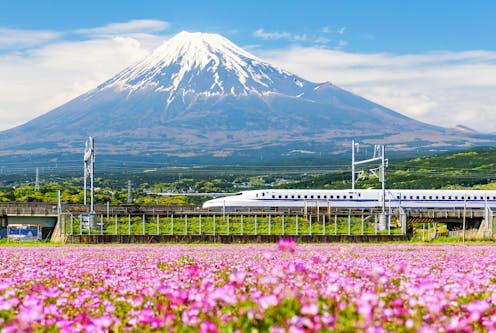
Australia has debated and studied high-speed rail for four decades. The High Speed Rail Authority has begun work on a project that could finally deliver some high-speed rail in the 2030s.
The Albanese government set up the authority in 2022. It also committed A$500 million to plan and protect a high-speed rail corridor between Sydney and Newcastle. This corridor was prioritised due to significant capacity constraints on the existing line, among other reasons.
The ultimate plan is for a high-speed rail network to connect Brisbane, Sydney, Canberra, Melbourne and regional communities across the east coast. The network would help Australia in its urgent task to reduce greenhouse gas emissions from transport. These continue to increase even as emissions from other sectors fall.
The authority has now publicly outlined plans for the first stage of this east coast network. After a history of failed proposals dating back to 1984, the new plans provide some cause for optimism that Australia could have some high-speed rail by 2037.
What is high-speed rail and why do we need it?
The International Rail Union of Railways defines high-speed rail as new lines designed for speeds of 250km/h or more and upgraded lines for speeds of at least 200km/h.
High-speed rail could greatly reduce transport emissions by replacing air travel in particular.
For example, the 7.92 million passengers flying between Melbourne and Sydney in 2023-24 produced about 1.5 million tonnes of emissions. Including travel to and from airports and other flight routes along the corridor (Sydney or Melbourne to Canberra, Albury etc), this adds up to about 2% of annual domestic transport emissions.
A Sydney–Melbourne high-speed rail link could cut emissions to a fraction of those from air and road transport. If Australia is to achieve net zero by 2050, a shift to rail will be essential.
High-speed city-to-city rail services will be needed to become an attractive alternative to air travel.
What is the authority working on?
Early this year the High Speed Rail Authority gained a new CEO, Tim Parker, with extensive experience in delivering mega-projects. In late August, the authority outlined its plans at an industry briefing in Newcastle.
The authority has commissioned eight studies, including a business case for a Sydney–Newcastle line. Significantly, it will include the cost of future highway upgrades if high-speed rail does not proceed. This study, along with a report on how high-speed rail will proceed along Australia’s east coast, is due by the end of this year.
Also under way is a geotechnical study that includes drilling 27 boreholes. It will help determine the proposed depths of two long rail tunnels and guide decisions on crossing the Hawkesbury River and the route to the Central Coast and on to Newcastle.
All going well, including land acquisition and agreements with the New South Wales government (which could include funding), work could start in 2027 and be completed by 2037.

Many questions remain
Given the time and money required to deliver a Sydney–Newcastle line, bipartisan support will be needed. However, the federal opposition is yet to make a clear commitment to high-speed rail.
There are other uncertainties too. Will the trains be operated by the public or private sector? The latter was the intention for projects that were scrapped decades ago, such as the CSIRO-proposed Very Fast Train (VFT) linking Sydney, Canberra and Melbourne, and the Sydney–Canberra Speedrail.
And how will the engineering projects be delivered? The new authority must learn from the project management problems in delivering the Inland Rail freight line. The project is running late and costs have blown out.
Some major federally funded government projects have worked well. These include upgrades of the national highway system (by state road authorities and contractors) and the new Western Sydney International Airport, which is nearing completion.
And what about a full Sydney–Melbourne line?
The big question is when work will start on a Sydney–Melbourne high-speed rail service. In 2019, International High-Speed Rail Association chairman Masafumi Shukuri estimated building this line could take 20 years.
The present line is 60km longer than it should be as the route dates back to the steam age. It also has far too many tight curves. This means train travel on this line is slower than cars and trucks.
As former NSW State Rail chief Len Harper said in 1995, this railway was already “inadequate for current and future needs” even back then.
When the VFT was proposed in 1984, questions were raised as to whether our population was big enough for such a project. Now, more than 15.5 million people live in NSW, Victoria and the Australian Capital Territory. Melbourne–Sydney is the world’s fifth-busiest flight route.
Advocacy group Fastrack Australia has called for a Sydney–Melbourne track built to high-speed standards and able to carry freight. The estimated travel time is four hours.
This group and the Rail Futures Institute propose the line be built in stages, with priority given to the section from near Macarthur to Mittagong in NSW. This would reduce the current line’s length by about 18km and allow for better Sydney–Canberra train services.
Urgent action is needed to protect the rail corridor from encroaching urban development.
Australia needs to catch up
In June 2023, when the new authority started work, I observed that Australia must surely hold the world record for studies into high-speed rail with no construction.
In stark contrast, this October marks the 60th anniversary of the world’s first dedicated high-speed rail line, the Tokaido Shinkansen in Japan linking Tokyo to Shin-Osaka. The network has since grown in stages to about 3,000km of lines.
Today, high-speed rail operates in 21 countries over about 60,000km of lines – China has about 40,000km. Indonesia’s high-speed rail service between Jakarta and Bandung started running last year. India and Thailand are in the advanced stages of delivering high-speed rail. It’s also under construction in another 11 countries.
Australia could finally join them in the next few years if it starts building the Sydney–Newcastle line.
Authors: Philip Laird, Honorary Principal Fellow, University of Wollongong