we traced how First Nations groups moved bunya pine and black bean trees
- Written by Monica Fahey, Adjunct Fellow in molecular ecology, Macquarie University
For millennia, Indigenous knowledge holders have passed down lore to the next generation. Much lore describes the relationships between people and Country, including custodial responsibilities to care for other species as kin.
Each species carries a history of movement and change in its DNA. By quantifying how related one individual of a species is to another, evolutionary ecologists can infer how a species migrated in the deep past.
When we combine both types of knowledge – lore and genetics – we can make new discoveries. Our recent body of research uses genomic techniques and interviews with First Nations knowledge holders to investigate whether First Nations Peoples moved two culturally important food sources, bunya pines and black bean trees.
Bunya pines
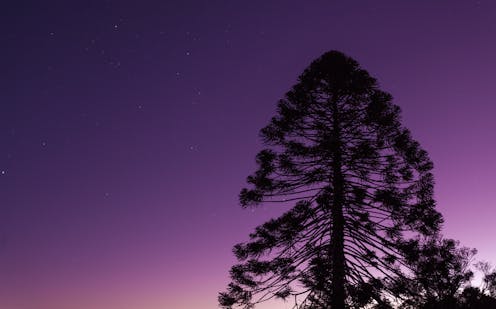
The bunya pine (Araucaria bidwillii) is an ancient native conifer of cultural and spiritual significance to several language groups in eastern Australia. It’s known as bonyi bonyi in Wakka Wakka and bunyi in Kabi Kabi.
For thousands of years, Indigenous groups gathered to share the edible nuts at bunya gatherings at locations such as Wakka Wakka Country in the Western Downs and Kabi Kabi Country in the Sunshine Coast hinterland. The last major known gathering took place in 1902, but they have restarted in recent years.

Bunya pines grow throughout Queensland’s southeast. They’re also found 1,400 km north, in the Wet Tropics near Cairns. In a recent study, co-author Patrick Cooke interviewed First Nations groups in both locations in southeast Queensland and the Wet Tropics to record Indigenous biocultural knowledge on the use of bunya.
In a companion study, Traditional Owners and this article’s lead author collected DNA samples from bunya pine leaves to retrace the conifer’s historical movement in its northern and southern locations. Genetic results were interpreted in the context of biocultural knowledge and archival evidence.
What did we find? In the Wet Tropics, we could not find traditional names or biocultural knowledge for bunya. DNA samples showed no evidence of its dispersal by people or animals. This suggests the species was not an important food source for First Nations groups in the region. In the absence of human-assisted dispersal, the remnant stands of bunya have become genetically isolated.
By contrast, groups in southeast Queensland had rich biocultural knowledge of bunya. DNA samples showed clear evidence of movement, consistent with people actively moving the species around. But when we analysed bunya patches pre-dating European colonisation, we found genetic patterns suggesting planting was sporadic and fairly localised.
Our Indigenous knowledge interviews and historical literature give crucial context. Knowledge holders told us only those with custodial rights to bunya were permitted to collect and share the edible cones, which likely restricted the movement of bunya out of existing Country.
This changed when First Nations people were displaced by European settlers. Wakka Wakka people planted bunya at Cherbourg mission in southeastern Queensland and Mulli Mulli mission on Githabul Country in northern New South Wales to maintain cultural connections.
Black bean trees
Like bunya pines, black bean trees (Castanospermum australe) have been an important food source for thousands of years. While the large seeds are toxic, they can be made edible.
Here, we have found evidence this rainforest species was spread on purpose – and rapidly.
The tree does not need to have its toxic seeds eaten. Instead, it relies on its seed pods floating down rivers to new locations. Curiously, the tree can be found far from any waterways. How did it get there?
 Black bean trees flower profusely.
Tatters/Flickr, CC BY-NC-ND
Black bean trees flower profusely.
Tatters/Flickr, CC BY-NC-ND
We found evidence Bundjalung groups spread black bean thousands of years ago, as they walked the ridgelines of the Nightcap, Border and McPherson ranges in northern New South Wales. This route follows the Nguthungulli Songline, a cultural pathway tracing the journeys of an ancestral spirit (likely to represent a real person) who left “bean tree” seeds as he journeyed inland from the east coast.
Samples taken adjacent to the Nguthungulli Songline showed higher levels of genetic diversity compared to other sample sites. This is what we would expect to see if seeds from different areas had been deliberately walked uphill along the songline and subsequently spread downstream through the waterways.
Ongoing genetic analyses suggest the black bean tree remained in small coastal pockets until Bundjalung groups walked its seeds northwards into southeast Queensland.
The Bundjalung story of Three Brothers tells of the arrival or return of key ancestors of Bundjalung peoples and related language groups Githabul and Yugambeh to coastal northern NSW. All three language groups use the name “bugam” for the black bean seed, which suggests a rapid transfer or shared ancestral connection to the species.
 The black bean tree produces large quantities of seeds – but they are poisonous without proper treatment.
Renae Grace 333/Shutterstock
The black bean tree produces large quantities of seeds – but they are poisonous without proper treatment.
Renae Grace 333/Shutterstock
Walking plants
These stories raise interesting questions about why Indigenous groups carried and nurtured plants in some cases and not others.
In the Wet Tropics, for instance, the lack of evidence for movement of black bean and bunya could be linked to different dietary preferences and alternative edible nuts.
In northern NSW and southeast Queensland, bunya gatherings brought far-flung groups and kin together. We speculate these social and cultural reasons may have been seen as more important than simply increasing food production by planting the tree in new locations.
But the deliberate movement of black bean along the Nguthungulli Songline shows some groups took the tree with them to ensure access to its nuts.
Read more: Iconic boab trees trace journeys of ancient Aboriginal people
Domestication over deeper time
For years, researchers thought domesticating a plant for human use was relatively straightforward. But newer research suggests it was a lengthier and more complex process than we thought.
Unpicking the deeper past using First Nations lore and genetic analysis is a promising combination to shed light on domestication. We hope it will become more widely used.
As we continue, we are likely to find examples of where Indigenous movement of plants worked to domesticate landscapes. That is, social and cultural preferences of ancestral groups drove ecological transformations which seem, at first glance, to be natural.
Read more: Farmers or foragers? Pre-colonial Aboriginal food production was hardly that simple
Authors: Monica Fahey, Adjunct Fellow in molecular ecology, Macquarie University