inside the supermarket giant’s controversial ‘Framework’
- Written by: Lauren Kate Kelly, PhD Candidate, ARC Centre of Excellence for Automated Decision-Making and Society, RMIT University
In early 2024, Woolworths introduced a new worker performance management program across warehouses run by the company’s distribution arm, Primary Connect.
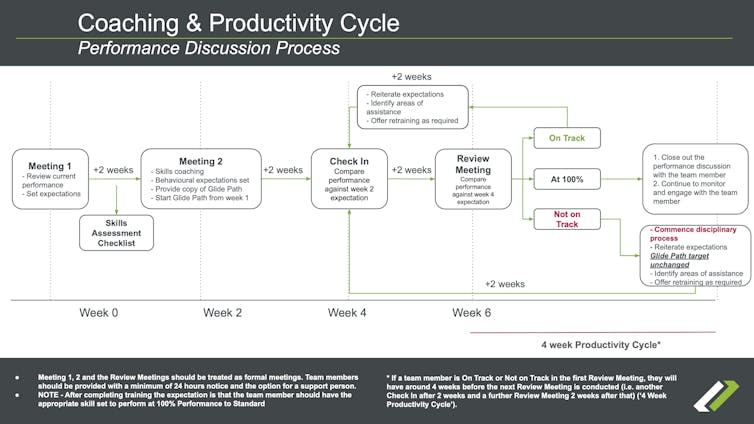
Under the program, known as the Coaching and Productivity Framework or simply “the Framework”, workers say they face potential disciplinary action if they fail to achieve 100% adherence to a speed-related metric known as pick rates. This represents a sharp break from previous approaches in which a pick rate of 100% was a non-enforceable goal, rather than a basic requirement.
A Primary Connect spokesperson told The Conversation the Framework is more flexible, ensuring “a fair approach to the standards is applied to any personal circumstances or abilities”, with exemptions “for when a team member is unable to perform to standards, including pregnancy, disability or injury”.
Workers say the new system creates huge stress and leads to unsafe work practices.

‘Scientific management’
Although pick rates are common across warehousing, enforcing 100% compliance is highly unusual. In a memo to warehouse staff, Woolworths justified the strict enforcement of pick rates by claiming they are based on “engineered standards”, which are “the times that a trained and competent person should take to complete a set task safely using the ‘agreed method’ for that task”.
Engineered standards (or engineered labour standards) are also widespread in the warehousing industry. Developed in the early 20th century by US management consultants, engineered standards follow the stopwatch studies and time-and-motion methodologies of Frederick Winslow Taylor, the pioneer of “scientific management”.
To this day, engineered standards may be developed by “putting the stopwatch” on workers to record and standardise the time taken to perform a particular task. These data sets may be used to develop and justify pick rates.
Turning workers into data points
The use of engineered standards integrates workers into Woolworths’ ongoing program of increased automation and surveillance across its business.
Much like inventory, workers’ bodies also become a data point to be monitored in terms of speed and movement. Engineered standards encode the assumption that human labour can be rationalised in the same way as the activity of a machine.
Engineered standards promise the ability to control the output of workers at every moment. In practice, the application of engineered standards is often flawed and inaccurate.
Regardless of accuracy, engineered standards and other algorithmic systems may have other benefits for management, providing a veneer of technological objectivity for decision-making.
Confusing and inconsistent
Through research for my PhD and my work with the United Workers Union, I have heard many concerns from workers subjected to the Framework.
One common concern is that, due to the algorithmic nature of the Framework, the pick rate is opaque. In practice, workers do not know what 100% compliance means, so they do not even know what is expected of them.
Workers report that rates seem to change and are applied inconsistently across different departments.
The psychological impact has been significant. Workers have reported lying awake at night and experiencing heightened anxiety of job loss following the introduction of the Framework.
One worker told me:
I can’t sleep thinking about what would happen if I lost my job because I didn’t meet the standards a few times and my average wasn’t high enough.
Another said:
I frequently go to sleep and dream of picking at work. I find myself thinking of work at home and dreaming of work when I’m sleeping. I’m constantly on edge whenever I see a team leader, thinking I’ve done something wrong.
And a third:
I have some personal issues at home with my marriage and I’m laying awake thinking about my pick rate and if I will have a job tomorrow.
Speed and safety
Workers have also reported they feel compelled to prioritise speed over safety to meet the pick rate, or risk losing their job. At the same time, failure to work safely can also result in disciplinary action, injury or worse.
Failure to meet the pick rate may result in a “tap on the shoulder” from management. This may be followed by notification that “coaching” will commence as part of a 12-week performance management program.
Coaching consists of working under the close supervision of a manager who is tasked with observing the worker’s movements and appraising their speed against a company checklist.
In the words of another worker:
They are watching you, following you around with a clipboard, piece of paper and a pen. Writing stuff down behind you. It feels degrading.
Monitoring ‘gap times’ such as toilet breaks
Distribution centres are complex and dynamic environments. Congestion builds in aisles, equipment glitches and breaks, pallets spill, and batteries go flat.
Woolworths claims the Framework takes into account “gap times”, which include reasonable periods of unavoidable delay, worker fatigue, rest breaks and so on.
Gap times refer to any time during a shift when a worker is not actively on task. Workers report that time pressures have resulted in breaks being skipped, and safety measures disregarded, to meet pick rate targets and avoid disciplinary action.
A question of control
Following widespread worker disputes, including one filed with the Fair Work Commission in April, the Framework has been temporarily placed on pause. If reinstated, it would take effect at 15 distribution centres across the country, impacting about 8,000 permanent workers and, indirectly or directly, several thousand casual labour-hire workers.
Woolworths team members represented by the United Workers Union are currently bargaining for a new enterprise agreement. Abolition of the Framework and related disciplinary action is a key demand of the union.
In a statement to The Conversation, a Primary Connect spokesperson said:
We have listened to the feedback from the union on the Framework, and will engage our teams in the distribution centres and the union in due course. As the country’s largest private sector employer, we are committed to ensuring that our workplaces are safe and productive for our teams and customers.
Beyond Woolworths, the contest over pick rates raises a broader question: to what extent should an employer be able to dictate the speed of work?
Clearly, an employer can assign the duration of a shift and ask workers to perform their role to the best of their abilities, but should workers retain the right to control the speed at which they move their own body?
The future of the Woolworths Framework may have widespread implications for working life in Australia.
Authors: Lauren Kate Kelly, PhD Candidate, ARC Centre of Excellence for Automated Decision-Making and Society, RMIT University