

The frozen carbon of the northern permafrost is on the move – we estimated by how much
- Written by: Pep Canadell, Chief Research Scientist, CSIRO Environment; Executive Director, Global Carbon Project, CSIRO
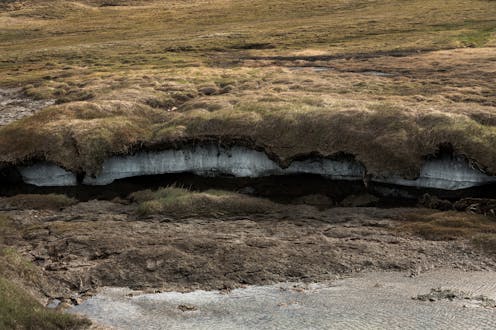
Among the most rapidly changing parts of our planet are the coldest landscapes near the top of the globe, just south of the Arctic. This region is warming two to four times faster than the global average.
The frozen ground beneath these “boreal” forests and treeless plains or “tundra” is thawing, fast. That’s a problem because the permafrost holds enormous amounts of vulnerable carbon, more than twice as much carbon as is already present in the atmosphere. Some of that carbon is now on the move.
We wanted to find out just how much carbon and nitrogen is being released from the northern permafrost region. The environment can be a source of greenhouse gases, or a “sink” – effectively soaking up carbon and removing it from the atmosphere. So we had to determine and balance the budget.
As part of the Global Carbon Project, we have now published the first full greenhouse gas budget tallying sources and sinks for the northern permafrost region. It contains a mixed bag of good and not-so-good news for the climate.
What is permafrost, and why should we be concerned?
Permafrost is ground that stays frozen. It may contain soil, peat, rocks and ice. Often, remnants of ancient plants and animals such as the now extinct woolly mamooth can also be seen.
In such cold conditions, plants mainly grow during summer. New leaf litter and dead plants are then quickly frozen and permanently stored for thousands of years. This has led to the buildup of a phenomenal store of carbon: more than a trillion tonnes. For comparison, all tropical forests and soils store less than half that amount.
While the top “active” layer of soil may thaw naturally in the warmer months, the lower layers typically stay frozen. But now that human-induced climate change is making soils warmer, the thawed season is growing longer and the permanently frozen carbon is thawing too.
In thawed soil, microbes get to work decomposing dead plants and other decaying organic matter. When this process happens in the presence of oxygen, carbon dioxide (CO₂) is released. In the absence of oxygen (such as in lakes and water-saturated soils), methane (CH₄) is released.

Methane is a more powerful greenhouse gas than CO₂ as it holds more heat in the atmosphere, so it is of particular concern. Unfortunately, the melting of ice in permafrost is making more of the land wet with low oxygen levels, so more methane is being released.
The soil organic matter being decomposed also contains nitrogen, causing emissions of nitrous oxide, another powerful greenhouse gas.
The process of warming leading to more greenhouse gas emissions, which in turn leads to more warming and again to more greenhouse gas emissions, is known as a “positive” carbon-climate feedback loop. It’s important to avoid these positive or self-reinforcing processes to limit global warming.
The other type of feedback loop is a “negative” carbon-climate feedback, even though it’s actually a good thing. It’s negative because it reduces the total amount of emissions remaining in the atmosphere.
In this study, we found evidence for a negative carbon-climate feedback, one that reduces the total emissions staying in the atmosphere. Longer growing seasons (due to global warming), the increase in available nitrogen in soils, and higher CO₂ concentrations in the atmosphere, all help plants to grow for longer and accumulate more carbon.
 Inland waters such as wetlands, lakes, ponds, water-saturated soils and peatlands, play an important role in the net greenhouse gas balance of the permafrost region.
Gustaf Hugelius
Inland waters such as wetlands, lakes, ponds, water-saturated soils and peatlands, play an important role in the net greenhouse gas balance of the permafrost region.
Gustaf Hugelius
What did we do?
A team of scientists from 35 research institutions compiled and assessed all available observations and modelling of greenhouse gas emissions on land, in freshwater, and in the atmosphere. With this information we developed a combined greenhouse gas budget for CO₂, methane, and nitrous oxide for the period 2000–20.
The effort was part of a global assessment of all regions and oceans.
Carbon on the move
We found permafrost was a small to medium CO₂ sink, storing between 29 million and 500 million tonnes of carbon a year.
The boreal forests of Canada and Russia, among other smaller regions, were largely responsible for soaking up the CO₂ during the study period from 2000–20, when there was increased plant growth and longer growing seasons. But at the same time, lakes, rivers and wildfires were a source of CO₂.
The region was also a source of methane and nitrous oxide – the second and third most important greenhouse gases globally after CO₂.
Although methane emissions were already occurring before human-induced warming, a number of sources have increased over time. We found wetlands were the largest source of methane and as the icy ground melts, more of the landscape is becoming saturated with water.
The largest sources of nitrous oxide emissions, though relatively small per unit area, came from the dry tundra and boreal forests.
Calculated over 100 years, the combined contribution to global warming of all three greenhouse gasses is close to neutral. That means the CO₂ sink leads to cooling that offsets the warming from methane and nitrous oxide emissions. The Intergovernmental Panel on Climate Change (IPCC) uses the 100 year-time frame to compare all greenhouse gases during the 21st century.
But over a 20-year time scale, current greenhouse gas emissions are a net source of warming. The strong warming potential of methane emissions is what influences temperatures in the short term.
 Permafrost collapse is opening up giant craters in Siberia.
Aleksandr Lutcenko, Shutterstock
Permafrost collapse is opening up giant craters in Siberia.
Aleksandr Lutcenko, Shutterstock
What does the future hold?
It’s not yet clear how greenhouse gas emissions of the permafrost region will change in the future. But we do know methane emissions are already growing in many regions and this trend is likely to continue.
Earth system models used by the IPCC suggest it could be possible to maintain the CO₂ sink through the 21st century under various emission scenarios. But these models are largely ignoring local permafrost collapse (as opposed to slow thawing) and extreme wildfires, which are both capable of rapidly increasing greenhouse gas emissions.
Wildfires in the permafrost regions are a growing concern. Our budget’s final year was 2020, so we missed the unprecedented wildfires of 2021 in Siberia and 2023 in Canada. Wildfire emissions from each of these two events amounted to about half a billion tonnes of carbon, enough to cancel out and even switch the CO₂ sink to a net source.
The only way to keep permafrost carbon in the ground is to quickly reduce and ultimately eliminate greenhouse gas emissions from human activities. Failing to do so is likely to give global warming a helping hand – as warming thaws permafrost and releases more carbon and nitrogen from ancient stores, creating a continuous feedback loop.
Authors: Pep Canadell, Chief Research Scientist, CSIRO Environment; Executive Director, Global Carbon Project, CSIRO


















